
Thank you to all the subscribers to our Early Access program…we thank you for your continued support.
We are excited to offer this new service to keep you informed and up-to-date on the latest Dinar and currency news.
Iraq Economic News And Points To Ponder Saturday Afternoon 5-16-26
Baghdad Targets 500k Bpd Export Goal Via Turkiye Amid Increased Hormuz Risks
2026-05-16 Shafaq News- Baghdad Iraq’s new Oil Minister Basim Khudhair al-Abadi warned on Saturday that escalating regional tensions threaten energy flows through the Strait of Hormuz, as Baghdad moves to ramp up crude exports via Turkiye and address long-standing production disputes with the Kurdistan Region.
Speaking during a press conference at the ministry on his first day in office, he pointed to a sharp decline in exports, stating that Iraq shipped an average of 93 million barrels per month before the latest US-Iran escalation, while volumes fell to around 10 million barrels in April.
Baghdad Targets 500k Bpd Export Goal Via Turkiye Amid Increased Hormuz Risks
2026-05-16 Shafaq News- Baghdad Iraq’s new Oil Minister Basim Khudhair al-Abadi warned on Saturday that escalating regional tensions threaten energy flows through the Strait of Hormuz, as Baghdad moves to ramp up crude exports via Turkiye and address long-standing production disputes with the Kurdistan Region.
Speaking during a press conference at the ministry on his first day in office, he pointed to a sharp decline in exports, stating that Iraq shipped an average of 93 million barrels per month before the latest US-Iran escalation, while volumes fell to around 10 million barrels in April.
Despite the slowdown, Iraq continues to export around 200,000 bpd from Kirkuk through Turkiye’s Ceyhan port, with plans to raise flows to as much as 500,000 bpd. Achieving that target, he remarked, depends on the return of international oil companies operating in the Kurdistan Region, several of which have recently suspended operations.
“The government is treating the energy file in the Kurdistan Region as a priority,” he added, referring to efforts aimed at narrowing gaps between Baghdad and Erbil and aligning production frameworks across the country.
Khudhair noted that crude production from Basra and Kirkuk currently stands at no more than 1.4 million barrels per day (bpd), reflecting continued uncertainty in one of the country’s key economic sectors.
He also urged the Organization of the Petroleum Exporting Countries (OPEC) and the international community to support an increase in Iraq’s production ceiling, arguing that higher output is needed to fund infrastructure, public services, and state operating costs.
Read more: Iraq's oil lifeline is blocked: Here is why the crisis runs deeper than Hormuz
Dollar Dips In Baghdad, Rises In Erbil
2026-05-16 Shafaq News- Baghdad/ Erbil The US dollar closed Saturday's trading lower in Baghdad and higher in Erbil, hovering around 154,000 dinars per 100 dollars.
According to Shafaq News market survey, the dollar traded in Baghdad's Al-Kifah and Al-Harithiya exchanges at 153,800 dinars per 100 dollars, down from the morning session’s 153,900 dinars.
In the Iraqi capital, exchange shops sold the dollar at 154,250 dinars and bought it at 153,250 dinars, while in Erbil, selling prices stood at 153,600 dinars and buying prices at 153,500 dinars.
Speaking to Shafaq News, Jabbar Goran, spokesperson for the currency market in al-Sulaymaniyah, Iraqi Kurdistan, expected the formation of Iraq’s new government to help lower the dollar exchange rate against the dinar in local markets, citing anticipated “US support” that could positively affect the financial market.
Goran predicted the exchange rate could fall below 150,000 dinars per 100 dollars in the coming period if regional conditions stabilize. He added that the gap between the official exchange rate of 132,000 dinars and the market rate should normally remain within 12,000 to 13,000 dinars. https://www.shafaq.com/en/Economy/Dollar-dips-in-Baghdad-rises-in-Erbil
Gold Prices Slip In Baghdad And Erbil
2026-05-16 Shafaq News- Baghdad/ Erbil Gold prices fell Saturday in Baghdad and Erbil markets, hovering below the million-dinar mark, according to Shafaq News market survey.
On Baghdad's Al-Nahr Street, wholesale markets recorded a selling price of 982,000 IQD per mithqal (equivalent to five grams) for 21-carat Gulf, Turkish, and European gold, with a buying price of 978,000 IQD, down from the previous session's 1.012 million IQD.
Iraqi 21-carat gold sold at 952,000 IQD per mithqal, with a buying price of 948,000 IQD.
In jewelry stores, 21-carat Gulf gold ranged between 985,000 and 995,000 IQD per mithqal, while Iraqi gold sold between 955,000 and 965,000 IQD.
In Erbil, prices also declined, with 22-carat gold selling at 1.021 million IQD per mithqal, 21-carat at 975,000 IQD, and 18-carat at 835,000 IQD.https://www.shafaq.com/en/Economy/Gold-prices-slip-in-Baghdad-and-Erbil-5
Iraq’s Gulf Power Project To Supply 500 Megawatts
2026-05-16 Shafaq News- Baghdad/ Basra The Gulf electricity interconnection project with Iraq has reached 94% completion, with the first phase expected to supply 500 megawatts of additional electricity to the national grid, Iraq’s Electricity Ministry announced on Saturday.
The Gulf Cooperation Council (GCC) states signed the implementation contract for the project in October 2024, aiming to supply Iraq with around 3.94 terawatt-hours of electricity annually at prices lower than domestic production costs. The project's original completion deadline of end-2025 was missed, with the launch subsequently pushed back without a revised date confirmed by officials.
Completed works include full construction of concrete tower foundations, installation of 112 out of 221 transmission towers within the Iraqi section, and the completion of 73 kilometers of power line wiring alongside 63 kilometers of Optical Ground Wire (OPGW) communications cable.
Technical teams from the South Electricity Transmission Company continue work on the 400-kilovolt interconnection line linking Kuwait’s Al-Wafra power station to the Al-Faw converter station in southern Iraq as part of what the ministry described as strategic projects aimed at supporting grid stability during the summer season. The project stretches approximately 285 kilometers, including 76.7 kilometers inside Iraqi territory from the Safwan border area to Al-Faw station.
Read more: Iraq power 2026: war collapses the grid's defenses ahead of peak summer
https://www.shafaq.com/en/Economy/Iraq-s-Gulf-power-project-to-supply-500-megawatts
PM Al-Zaidi Chairs First Financial Stability Council Meeting Hours After Launch
2026-05-16 Shafaq News- Baghdad Iraqi Prime Minister Ali al-Zaidi on Saturday chaired the first meeting of the newly established Financial Stability Council, only hours after ordering its creation during his cabinet’s inaugural session.
The council includes Finance Minister Falih al-Sari and the governor of the Central Bank of Iraq (CBI), Ali al-Alaq.
Al-Zaidi stressed the importance of financial stability and its impact on Iraq’s economic and development plans, calling for close coordination between the Finance Ministry and CBI. He also emphasized the need for financial decisions that support economic stability and strengthen the government’s service, development, and economic agenda.
What the Program Says?
Al-Zaidi's ministerial program commits to establishing a Supreme Council for Financial Stability to coordinate between fiscal and monetary policy, the body that held its first meeting on Saturday.
The program assigns the council a specific economic agenda: financial discipline, restructuring of public expenditure, enhancing non-oil revenues, and digitizing revenue collection in cooperation with relevant international institutions.
On banking, the program commits to reform aligned with international standards, anti-money laundering compliance, and structured coordination between the Central Bank and the fiscal authority.
The council is one of three new economic bodies mandated by the program. The other two are a Supreme Investment Council for foreign direct investment, and a Generations Fund to preserve Iraqi citizens' share of oil and natural resource revenues.
Read more: Ali Al-Zaidi sworn in with a program already failed
Who Stole Our Marble?
Mazhar Muhammad Salih Articles Economy News – Baghdad A heated intellectual debate raged in the corridors of research, where monetary policy was formulated in the heart of Baghdad. Marxists, graduates of British universities, argued with liberals, graduates of Iraqi universities, in a debate that spanned the 1950s and 1970s.
The central point of contention was the concept of the "public good"—that benefit created for all people, from which no one is excluded, and whose use by one individual does not diminish the rights of others, such as security, bridges, parks, and public lighting.
The name of Paul Samuelson was frequently invoked as one of the most prominent theorists of this concept in modern economics, as he argued that a state is not measured solely by its wealth, but also by its capacity to protect what belongs to everyone.
But the question that lingered above all that debate was even more brutal than the theories themselves:
Did people really need that extravagant display of civilization represented by the escalators in the Tahrir Square tunnel in the 1970s?
That tunnel, which was built as a symbol of modern Baghdad, is surrounded by shops in an elegant circular formation, and topped with captivating architectural details, until its walls and columns became covered with shiny Italian marble, as if the city wanted to give its citizens something of the dignity and beauty of great cities.
Marxists saw this as a victory for the idea of the common right.
In their view, beauty was not a privilege reserved for the wealthy alone, but a right for all people. They echoed Karl Marx's ideas about the alienation of individuals when their shared wealth is taken from them, and the fruits of society become the private property of a few. Liberals, on the other hand, considered it a luxury incompatible with an economy burdened by poverty and inequality, arguing that the state should spend on necessities, not on marble and escalators.
Then the years passed, wars followed one another, the electricity went out, the stairs broke down, the maintenance systems deteriorated, and Iraq entered the era of the long siege as a silent war, an era that not only destroyed the economy, but also destroyed the very meaning of things, until the “public good” became an orphaned entity with no one to protect it.
And the marble remained alone.
It shines with a sad silence in an empty tunnel, its whiteness reflected on the facades of empty shops, as if trying to remember the Baghdad that was once here.
Until one morning the city awoke to a heavy whisper circulating in our research circles:
The marble has disappeared.
The Italian marble that once adorned the Tahrir Square tunnel has vanished, replaced by drab, gloomy stones that have robbed the place of its last vestiges of beauty. Everyone stood stunned, Marxists and liberals alike, all intellectual distance between them suddenly collapsing before this painful truth:
Marble from the "public good" was smuggled to complete the decoration of a palace.
Thus, what was made for all people became the private property of one individual.
But the story didn't end with the tunnel. A few days later, one of the largest government buildings, clad in the same Italian marble, was stripped bare and replaced with somber, gloomy rocks, while fearful whispers spread the same truth:
State marble joined the tunnel marble, and settled there… in the same palaces.
Only then did it seem as though Baghdad was reliving all the philosophers' warnings at once. Jean-Jacques Rousseau believed that the erosion of justice begins when what is common among people is seized, because the social contract itself is based on upholding the common good, not usurping it.
Hannah Arendt, on the other hand, saw the erosion of the public sphere as beginning when the things that unite people become instruments of domination and privilege. At that point, cities not only lose their beauty but also their capacity to be a home for all. And then, the collapse of the public sphere signifies the decline of politics itself, its transformation into domination or fear.
Thus, the stolen marble was not merely white stone moved from one wall to another; it was a piece of the city's memory being silently torn away, a painful declaration of the transformation of "public property" from a shared right into plunder, from beauty belonging to the people into ornamentation belonging to the authorities.
And the ruin of a state begins when public affairs become tools in the hands of power or fear.
And the question remains, after all these years: When will the people's marble return to the people?
When will the state regain the meaning of public interest before it loses even its memory?
Alasdair Macleod: Dollar Collapse Accelerating, Here's What Happens Next
Alasdair Macleod: Dollar Collapse Accelerating, Here's What Happens Next
WTFinance: 5-16-2026
On this episode of the WTFinance podcast I had the pleasure of welcoming back Alasdair Macleod.
Alasdair Macleod has over decades of experience in financial markets, with a focus on monetary history, systemic risk, and the enduring role of gold.
He is one of the most respected voices on sound money and wealth preservation.
During our conversation we spoke about the Middle East conflict, shifting world order, neutralising the US military, Petroyuan, precious metals future and more. I hope you enjoy!
Alasdair Macleod: Dollar Collapse Accelerating, Here's What Happens Next
WTFinance: 5-16-2026
On this episode of the WTFinance podcast I had the pleasure of welcoming back Alasdair Macleod.
Alasdair Macleod has over decades of experience in financial markets, with a focus on monetary history, systemic risk, and the enduring role of gold.
He is one of the most respected voices on sound money and wealth preservation.
During our conversation we spoke about the Middle East conflict, shifting world order, neutralising the US military, Petroyuan, precious metals future and more. I hope you enjoy!
0:00 - Introduction
1:50 - Middle East conflict
7:43 - Neutralising US military
10:40 - Taiwan
14:32 - Multipolar world?
19:00 - Saudi Arabia vs Iran
24:34 – Petroyuan
28:57 - China fixed currency
32:04 - Precious metals prices
37:10 - Liquidating gold
39:23 - Comex defaults
42:20 - One message to takeaway?
Iraqi Dinar News: Breaking: Iraq Approves New Cabinet - Market Implications
Iraqi Dinar News: Breaking: Iraq Approves New Cabinet - Market Implications
Edu Matrix: 5-16-2026
Iraqi Dinar News: Breaking Iraq News Approves New Cabinet - Market Implications - Iraq’s New Prime Minister Faces Immediate Pressure — Could This Affect the IQD?
Political News In this video, we discuss the growing tensions surrounding Iraq’s new Prime Minister Ali al-Zaidi and the mounting pressure to disarm Iran-backed militants inside Iraq.
Iraqi Dinar News: Breaking: Iraq Approves New Cabinet - Market Implications
Edu Matrix: 5-16-2026
Iraqi Dinar News: Breaking Iraq News Approves New Cabinet - Market Implications - Iraq’s New Prime Minister Faces Immediate Pressure — Could This Affect the IQD?
Political News In this video, we discuss the growing tensions surrounding Iraq’s new Prime Minister Ali al-Zaidi and the mounting pressure to disarm Iran-backed militants inside Iraq.
According to U.S. officials, Iraq’s future economic success and international stability may depend on reducing militia influence and strengthening central government control.
Iraq’s parliament recently approved parts of the new government, but major political disagreements continue over key cabinet positions.
Prime Minister al-Zaidi, Iraq’s youngest prime minister, now faces one of the most dangerous political balancing acts in modern Iraqi history. Will Iraq move toward greater stability and international cooperation — or will internal divisions delay progress even further?
For IQD investors, these developments matter because political stability, security, and international confidence remain critical factors tied to Iraq’s long-term economic future and any potential changes involving the Iraqi dinar.
Topics Covered:
• Iraq political news
• Iraqi dinar latest update
• IQD investor concerns
• Iran-backed militants in Iraq
• Iraq parliament update
• U.S. and Iraq relations
• Iraq economic future
• Prime Minister Ali al-Zaidi
• Middle East geopolitical tensions
• Iraq security situation
Please remember: all investments involve risk. This video is for informational and educational purposes only.
News, Rumors and Opinions Saturday 5-16-2026
Ariel: What I Personally See Happening Between Now and July 4th
5-16-2026
Money – The Visible Wealth Transfer
Warsh takes the Fed chair on 15 May and immediately signals aggressive balance-sheet shrinkage plus revised Treasury-Fed Accord.
This forces real yield discipline and ends the post-2008 free-money spigot that funded black budgets and extraction.
Ariel: What I Personally See Happening Between Now and July 4th
5-16-2026
Money – The Visible Wealth Transfer
Warsh takes the Fed chair on 15 May and immediately signals aggressive balance-sheet shrinkage plus revised Treasury-Fed Accord.
This forces real yield discipline and ends the post-2008 free-money spigot that funded black budgets and extraction.
Rate cuts follow under controlled conditions, injecting liquidity into the new rails instead of legacy asset bubbles.
CLARITY Act advances out of Senate Banking (already marked up bipartisan) and hits floor vote by late May/early June. ISO-20022 + XRPL/RLUSD bridges go live.
Suppressed currency corridors unlock in sequence: Venezuela’s forex-aligned wage mechanics (May 1 test) expand, Iraq’s post-cabinet HCL passage (partial cabinet seated 14 May under Ali al-Zaidi) opens dinar bridge flows by June.
Tokenized assets (BlackRock DNA/identity plays included) migrate on-chain.
Shock: Visible citizen-level gains higher real wages in reshoring states (Texas, California, Midwest ag), export surges to China post-summit, and revaluation payoffs hitting accounts.
The old inflation tax reverses. People feel actual purchasing power return for the first time in decades.
Gold continues record climbs as central banks and smart money (Lauder/Warsh circles) re-anchor.
The wealth that was extracted flows back visibly.
Read Full Article:
https://www.patreon.com/posts/media-think-tank-158371971
************
Courtesy of Dinar Guru: https://www.dinarguru.com/
Thom There is more traction on both the IQD and VND since both of these nations elected new Prime Ministers, both of which are former Bankers. And it is moving faster than I have ever seen.
Reset Intelligence Yesterday, Baghdad swore in 14 ministers in a single chamber session...Al-Zaidi is 40, the youngest premier Iraq has had, and Trump personally intervened in April to block former PM Nouri al-Maliki's run at the seat...9 of the 23 posts remain unfilled and the security-facing ministries are among them...Half of the cabinet that runs the economy is in place. The other half that defends Babylon isn't...Within hours of the vote, US Special Envoy Tom Barrack posted that Washington stands ready to work with the new government on "the elimination of terrorism."
Frank26 Do we have a fully seated government? No. Do we have a majority vote for a seated a government? Yes...You need a fully seated government to pass the laws. You still have a "caretaker" government. That's not the goal. That's not what we want. We're getting there. I'm happy with what happened but I want more.
************
The Dinar Momentum Is Building Fast
Diinar For Dummies: 5-15-2026
It has been a big week for the country of Iraq and the Iraqi Dinar. In this video Thom and I wrap up the week and give an update on where things currently stand.
Seeds of Wisdom RV and Economics Updates Saturday Morning 5-16-26
Good Morning Dinar Recaps,
Oil Shock, Bond Market Stress, and De-Dollarization Pressures Reshape the Global Financial Order
Rising energy disruptions, inflation fears, and accelerating reserve diversification are forcing global markets to reassess the long-term stability of the dollar-centered financial system.
Good Morning Dinar Recaps,
Oil Shock, Bond Market Stress, and De-Dollarization Pressures Reshape the Global Financial Order
Rising energy disruptions, inflation fears, and accelerating reserve diversification are forcing global markets to reassess the long-term stability of the dollar-centered financial system.
Overview
Today’s global financial environment is being shaped by a dangerous combination of energy supply instability, bond market stress, and growing international efforts to reduce reliance on the U.S. dollar.
With continued disruptions tied to the Strait of Hormuz, rising Treasury yields, and renewed discussions around de-dollarization, analysts increasingly warn that the world economy is entering a period of structural financial realignment rather than temporary volatility.
The pressure is now extending across currencies, commodities, sovereign debt markets, and central bank reserve strategies.
Key Developments
1. Oil Supply Fears Push Inflation Expectations Higher
Energy markets remain under severe pressure as concerns surrounding the Strait of Hormuz continue disrupting global trade flows.
Oil prices surged again amid fears of prolonged shipping instability
The U.S. Energy Information Administration reportedly expects Hormuz disruptions to continue through late May
Analysts warn the crisis could remove millions of barrels per day from global supply
Researchers and economists increasingly believe the 2026 Iran conflict could become one of the most inflationary geopolitical shocks in decades.
2. Treasury Yields Spike as Markets Fear Persistent Inflation
Bond markets reacted sharply today as investors reassessed inflation risks.
U.S. Treasury yields climbed to one-year highs
Investors reduced expectations for near-term Federal Reserve rate cuts
Rising oil prices are increasing fears of prolonged stagflation
The 30-year Treasury yield reportedly reached levels not seen since 2025, signaling growing concern over the long-term sustainability of debt markets under higher inflation conditions.
3. De-Dollarization Momentum Continues Expanding
Multiple reports released this week highlighted how geopolitical tensions are accelerating reserve diversification away from the dollar.
Central banks continue increasing gold reserves
BRICS nations are expanding local currency settlement systems
Emerging economies increasingly view dollar dependence as a strategic vulnerability
Analysts noted that sanctions, trade wars, and financial restrictions are motivating countries to build alternative financial infrastructure outside the traditional Western system.
4. Gold and Commodities Strengthen as Financial Hedges
Gold and commodity markets remain strong as investors search for protection against inflation and currency instability.
Gold remains near historic highs
Commodities increasingly outperform traditional fixed-income assets
Energy and hard assets are becoming preferred inflation hedges
Several economists noted that global reserve managers are shifting portions of sovereign reserves into gold and commodity-linked assets rather than concentrating exposure solely in U.S. debt markets.
5. Global Financial Fragmentation Accelerates
The broader concern now extends beyond temporary market volatility.
Nations are increasingly prioritizing economic security over globalization
Trade systems are becoming more regionalized and politically aligned
Financial infrastructure is gradually splitting into competing blocs
Analysts described the current environment as a transition toward a more multipolar financial order, where competing payment systems, reserve strategies, and trade corridors coexist rather than operate under a single dominant framework.
Why It Matters
The combination of energy instability, inflation pressure, and de-dollarization efforts is reshaping the foundations of global finance.
For decades, low inflation, stable energy flows, and confidence in U.S. Treasury markets supported the modern financial system. Those assumptions are now being tested simultaneously.
As geopolitical conflicts increasingly affect oil flows, trade routes, reserve policies, and sovereign debt markets, central banks and investors are being forced to rethink long-term financial strategy.
Why It Matters to Foreign Currency Holders
Foreign currency holders are closely watching:
Gold accumulation by central banks
BRICS payment infrastructure development
Reduced dependence on dollar settlement systems
Rising sovereign debt concerns
Inflation-driven weakening of fiat purchasing power
Many analysts believe the current environment favors nations and institutions holding diversified reserves tied to commodities, gold, and strategic trade assets.
Implications for the Global Reset
Pillar 1: Financial System Transformation
Today’s developments continue reinforcing trends toward:
De-dollarization
Gold-backed reserve diversification
Alternative settlement systems
Commodity-linked trade structures
Reduced dependence on Western banking channels
The growing strain on sovereign debt markets and reserve confidence is accelerating discussion about how the next generation of global finance may operate.
Pillar 2: Geopolitical and Trade Realignment
Energy security and trade corridor control are becoming central to geopolitical strategy.
Nations are increasingly restructuring alliances, infrastructure, and trade partnerships around:
energy resilience,
supply chain security,
strategic resources,
and regional financial independence.
The result is a global system moving away from centralized globalization toward a more fragmented but strategically aligned economic order.
This is not just market volatility — it is the gradual restructuring of global finance, trade, and reserve power in real time.
Seeds of Wisdom Team
Newshounds News™ Exclusive
Sources
Reuters – Treasury Yields Surge as Oil Prices and Inflation Data Rattle Markets
Reuters – U.S. EIA Assumes Strait of Hormuz Disruptions Continue Through Late May
~~~~~~~~~~
🌱 A Message to Our Currency Holders🌱
If you’ve been holding foreign currency for many years, you were not foolish.
You were not wrong to believe the global financial system would change.
What failed was not your patience — it was the information you were given.
For years, dates, rumors, and personalities replaced facts, structure, and proof. “This week” predictions created cycles of hope and disappointment that were never based on how currencies actually change.
That is not your failure.
Our mission here is different: • No dates • No rates • No hype • No gurus
Instead, we focus on:
• Verifiable developments • Institutional evidence
• Global financial structure • Where countries actually sit in the process
Currency value changes only come after sovereignty, trade, banking, settlement systems, and fiscal coordination are in place. History and institutions confirm this sequence.
You will see silence. You will see denials. That is not delay — that is discipline.
Protect your identity. Organize your documents. Verify everything.
Never hand your discernment to anyone who cannot show proof.
You deserve truth — not timelines.
Seeds of Wisdom Team
Newshounds News™
~~~~~~~~~~
Seeds of Wisdom Team RV Currency Facts Youtube and Rumble
Newshound's News Telegram Room Link
RV Facts with Proof Links Link
RV Updates Proof links - Facts Link
Follow the Gold/Silver Rate COMEX
Follow Fast Facts
Seeds of Wisdom Team™ Website
Thank you Dinar Recaps
Iraq Economic News and Points To Ponder Saturday Morning 5-16-26
The New Government's Approach Is To Transition From A Rentier Economy Model To A Productive Economy Model In A Progressive And Systematic Manner
Articles Economy News – Baghdad Dr. Aqeel Jabr Ali Al-Muhammadawi / Academic and Consultant
Thinking about and theorizing about transitioning to a productive economy is not merely a purely governmental political orientation, an ideological approach of the executive authority, or a slogan to be merely touted. Rather, it is an inevitable and realistic necessity governed by data and assessments of the current situation, geopolitical risks, figures and indicators, and proactive analysis of the reality of declining federal budget revenues and the clear challenges to the determinants and capabilities of national economic growth in the current situation.
The New Government's Approach Is To Transition From A Rentier Economy Model To A Productive Economy Model In A Progressive And Systematic Manner
Articles Economy News – Baghdad Dr. Aqeel Jabr Ali Al-Muhammadawi / Academic and Consultant
Thinking about and theorizing about transitioning to a productive economy is not merely a purely governmental political orientation, an ideological approach of the executive authority, or a slogan to be merely touted. Rather, it is an inevitable and realistic necessity governed by data and assessments of the current situation, geopolitical risks, figures and indicators, and proactive analysis of the reality of declining federal budget revenues and the clear challenges to the determinants and capabilities of national economic growth in the current situation.
This necessitates economic restructuring and modernization with new, innovative, and unfamiliar pioneering models. Particular priority should be given to developing and presenting an advanced, proactive, and unfamiliar economic intellectual methodology that aligns with the directions and objectives of the organic transition to a productive economy, and with unique, advanced economic engineering models prepared both proactively and subsequently, to accelerate the process of a radical and firmly established structural transition.
Modernization (from the French "modernize," meaning "to modernize") is generally understood as the process of introducing or implementing improvements that meet contemporary requirements. Furthermore, the consistency of this established understanding of modernization in economic literature can be explained by two interconnected aspects.
The vital and radical transition to a productive and innovative economy, the revitalization of the national economy, and the implementation of projects that affect employment growth and development - constitute a strategic approach to economic re-engineering to achieve intensive economic growth.
Firstly, as a process of modernizing the social system as a whole, that is, the transition from a backward society exhausted by wars and crises to a new, more advanced society. For example, from a traditional (agricultural) or functional and public occupational society to an industrial, knowledge-based and innovative society, and from there to a post-industrial society.
Secondly, as a process of fundamental structural transformations targeting the structure of the economy, it occurs in various areas of social life in their organic interconnectedness.
In this regard, it is common to distinguish between social, political, cultural, ideological, and other forms of modernization. Naturally, economic modernization acquires particular structural importance.
It should be noted that two understandings of economic modernization can be found in modern economic literature, one narrow and the other broad.
Moreover, each has a dual interpretation, determined by a similar dual methodology. From the perspective of the techno-economic approach, in its narrow sense, the essence of this concept is reduced to the industrialization of the economy, whose historical starting point was the Industrial Revolution of the 18th and 19th centuries, which took place in the advanced European countries.
In its broader sense, it refers to any qualitative and fundamental changes that occur in various sectors of the economy.
From the perspective of political economy, economic modernization, in its narrow sense, refers to fundamental changes inherent in the forces of production. In its broad sense, it refers to such changes encompassing both the forces of production and the relations of production, as well as the institutions associated with them.
It aims to change the prevailing model from one that relies on raw materials, crude oil, or rentier economics to one based on creating real added value, with models prepared in advance and later in due course, increasing labor productivity, and developing the infrastructure, knowledge, and technology, which is available at the present stage, given the harnessing of all resources, capabilities, and capacities for this purpose.
The radical transformations affecting all aspects of public life in the wake of recent tensions in the Middle East and the increasing instability and uncertainty have led to a renewed focus on choosing a unique new economic model to modernize the Iraqi economy within the context of contemporary realities.
In this regard, studies emphasize the relationship between the traditional model inherited from the era of centralized rule—the "backward development" model—and the "advanced development" model.
Based on this, the thesis that has become the most widely accepted in scientific circles is that the Iraqi economic development model based on raw materials has almost exhausted its potential.
Therefore, the proposal to move to a catch-up development model, which Japan, then South Korea and some other countries, particularly in the Asia-Pacific region, have successfully implemented, seems very logical.
The essence of this model lies in borrowing and transferring institutions and technologies that have proven successful in developed countries to national institutions.
While it is possible to borrow technologies or institutions primarily, the catch-up development model remains a viable and effective driver of tangible growth and development. China, for example, borrows modern technologies and adapts its national institutions to the new circumstances.
As for Iraq, it is natural that the catch-up development model requires fundamental adjustments and an economic methodology that aligns with the nature of modernization and the transition to a productive economy, along with appropriate plans and strategies.
The experiences of Japan and China are not merely meant to serve as models to be emulated, but rather as strategic pathways for catch-up development.
Advanced development, but in specific and limited areas, as is the case in Iraq, is not a substitute for regressive development. The difference is clear: regressive development must be pursued comprehensively in almost all areas, while advanced development should be pursued in very limited areas.
Therefore, we should proceed from the premise that modernization, under contemporary conditions, can encompass both post-industrialization and alternative modernization, and can also occur in a distorted form. Reducing it to mere standardized manufacturing does not bode well at present.
However, it is important to bear in mind that the modern economy is still industrial in its essence, and Iraq urgently needs an advanced strategic vision and innovative and productive development that goes beyond crisis management and gap-filling, and beyond the usual theoretical diagnostic approach in preparing strategies, methodologies, and plans.
The consolidation of innovative thinking and post-industrial innovations, as a general rule, requires industrial support or depends directly on a growing industrial and innovative base. Moreover, industrial innovations themselves still play a vital role in the modern economy.
"Abstract" post-industrialism, despite its apparent appeal, carries the risk of seriously distorting modernization—both in the scientific and practical sense.
This also applies directly to the Iraqi economy. The objective need to modernize it is driven by internal and external factors, as well as other reasons.
The Most Important Internal Factors Are:
1) The crisis situation that the Iraqi economy is going through, as a result of the fragility of the liberal market capitalism model, which the country quickly transitioned to after the political transition on 9/3/2003;
2) Consolidating the narrow specialization of Iraq’s economy in raw materials within the global capitalist economy, which negatively affects the structural and systemic transformation of the local economy in light of contemporary reality;
3) A significant decrease in the value of fixed assets, inevitably leading to the destruction of the economic material and technical base, stagnation, and deterioration;
4) Weak application of advanced scientific and technological developments in various sectors of the economy (except for defense and security industries, etc.), which hinders its transition to an innovative development path;
5) A severe shortage of highly qualified personnel in key sectors of the Iraqi economy, resulting in decreased productivity.
6) A significant decline in investment in fixed capital and a lack of regulation of the real and parallel economy, which hinders economic recovery and sustainable growth;
7) The continuation of bureaucratic monopoly and the exacerbation of corruption (in the absence of a mature civil society) in light of the fragility of the economic system and non-compliance with the provisions of the Competition and Anti-Monopoly Law for multiple reasons, most notably the weakness of the system to incline or implement the force of the law, which prevents the possibility of rapid development of Iraqi entrepreneurship and effective interaction between the state and the business sector;
8) A sharp increase in social and economic disparities between different segments of society, which threatens the stability of Iraqi society;
9) The low efficiency of the existing economic management system, which was established on a liberal doctrine focused on applying free market principles that, in the context of private markets, somewhat conflict with semi-centralized management decisions. This underscores the importance of activating competition regulation in markets and products under Competition and Anti-Monopoly Law No. 14 of 2010.
It is important to note that the factors mentioned above do not operate in isolation from each other, but rather within their overall unity.
Understanding this unit requires a sound scientific concept of socio-economic development in Iraq. Unfortunately, it must be acknowledged that this concept has not yet been developed (despite the numerous different versions published in recent years).
We believe the difficulty lies in the following: to address this issue, it is essential to first understand the basic patterns of development in both the global and local economies.
Secondly, a clear understanding of the methodology for developing this concept and its structure, with the last section to be dedicated to the main trends for modernizing the Iraqi economy and its development prospects;
Third, the distinction between this concept and the Iraqi economic development strategy, as is evident not only from scientific publications, but also from the various programs adopted by the Iraqi government.
At the same time, any strategy (including the proposed economic strategy to be organized in the new government) is developed on the basis of appropriate concepts, models and purposeful objectives.
The transition to a production-intensive economy requires the following:
- Shifting the focus from broad growth (increasing the number of workers) to qualitative improvements in production (increasing labor productivity - return per worker).
- Technological update:
Accelerating the application of advanced technologies (artificial intelligence, autonomous systems, and digital platforms) in industries and the social sphere, as outlined in the Economic Development Guidelines 2026.
- Structural restructuring:
Any increase in the share of high-tech and efficient industries that ensures GDP growth while reducing overall labor costs.
- At this stage, the national economy should also be revived by:
- Supporting demand: The recovery of business activity is stimulated by rising household incomes and easing monetary policy (the Central Bank of Iraq points to signs of this recovery at the beginning of January 2026).
- Sector whitewashing: Implementing plans to remove certain sectors of the economy from the circle of concealment in order to increase the tax base.
- Investment cycle management: Considering the impact of monetary policy on the investment cycle to stimulate growth at potential rates.
— The relationship to employment and job creation (2026):
- Improving the quality of employment: Moving from informal or low-productivity work to work in advanced technology sectors.
- Human Resources Management: Implementing retraining programs to meet the new labor market requirements.
The shift from a rentier economy to a productive economic model necessitates a paradigm shift: from growth based on resource exploitation (exporting raw materials) to growth based on efficiency, innovation, and increased labor productivity. The following is a comprehensive methodology for implementing this shift, based on an analysis of key factors:
Key trends in transformation:
Technological modernization: The transition to the fifth technological paradigm (robotics, information technology) and the sixth (nanotechnology, biological, and cognitive technologies).
The innovation economy involves the widespread adoption of innovations, the establishment of knowledge-intensive industries, and the development of human capital as the primary resource. It is crucial to establish this model in Iraq to invest in knowledge and modern technologies, and to utilize available human resources and the necessary infrastructure.
Circular economy: A renewable model that reduces waste and improves resource utilization (moving away from linear "consume and dispose" thinking).
Structural transformation: diversifying the economy, reducing dependence on the raw materials sector, and developing high-tech industries.
- Key implementation mechanisms:
1- Investing in people: Education, science and health care become the basis of productivity, transforming from expenditure items into sources of economic capital.
2- Public-private partnerships: Combining market mechanisms with government support for vital industries and infrastructure.
3- Digitalization of operations: Implementing digital platforms to improve logistics, production, and consumption.
Transformation management approaches.
There are two main approaches to implementing the transformation:
- The central approach: Adopting a unified national strategy, which is available for major strategic projects that boost the national economy and create significant job opportunities, especially in petrochemical, oil, refinery and gas projects (as is the case in the European Union, China and Japan).
- The decentralized approach: Implementing initiatives at the city, regional, or individual business model level, which is available for entrepreneurship, development, and achieving real growth in GDP (as is the case in the United States and Canada).
Characteristics of the transitional phase: Institutional changes:
The old institutions based on direction or raw material economies are being replaced by market and innovation institutions, and this requires a revolution in the restructuring and engineering of existing institutional structures.
Sustainable development: Implementing the Sustainable Development Goals, particularly rational production and consumption patterns. This transformation is not merely about technological change, but a shift in the socio-economic system, focusing on long-term sustainability and the creation of new value, while establishing the principles of innovative development.
This approach aims to ensure sustainable development and the comprehensive revival of the real economic sector, and to stimulate and activate domestic economic actors, through projects with a direct impact on employment, sustainable development, innovative development, value-added creation, and income growth, despite the slowdown in GDP growth (expected at 0.5-2.5% for 2026, according to the scenario).
Freedom Fighter: Iraq’s New Government Expands International Banking Reforms for the Iraq Dinar
Freedom Fighter: Iraq’s New Government Expands International Banking Reforms for the Iraq Dinar
5-15-2026
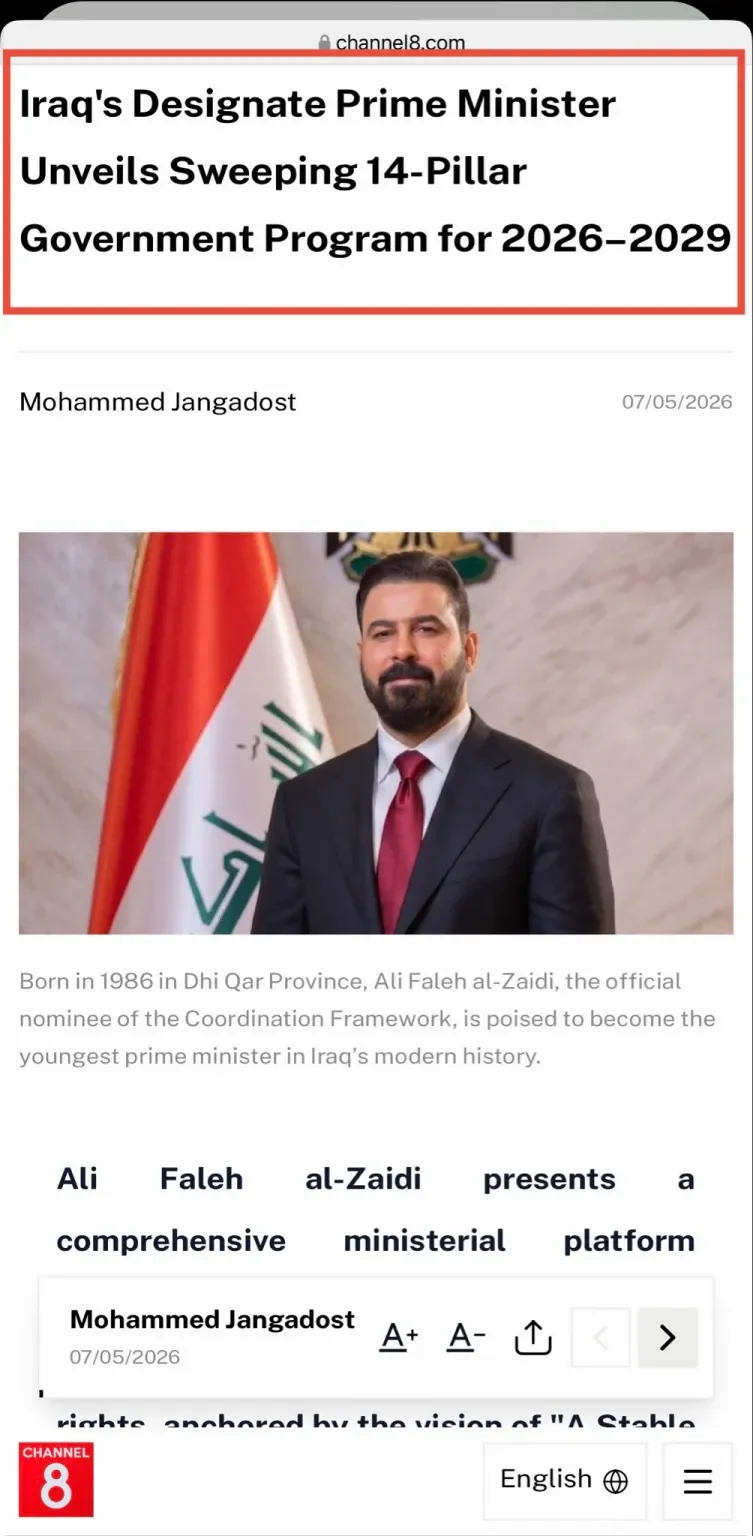
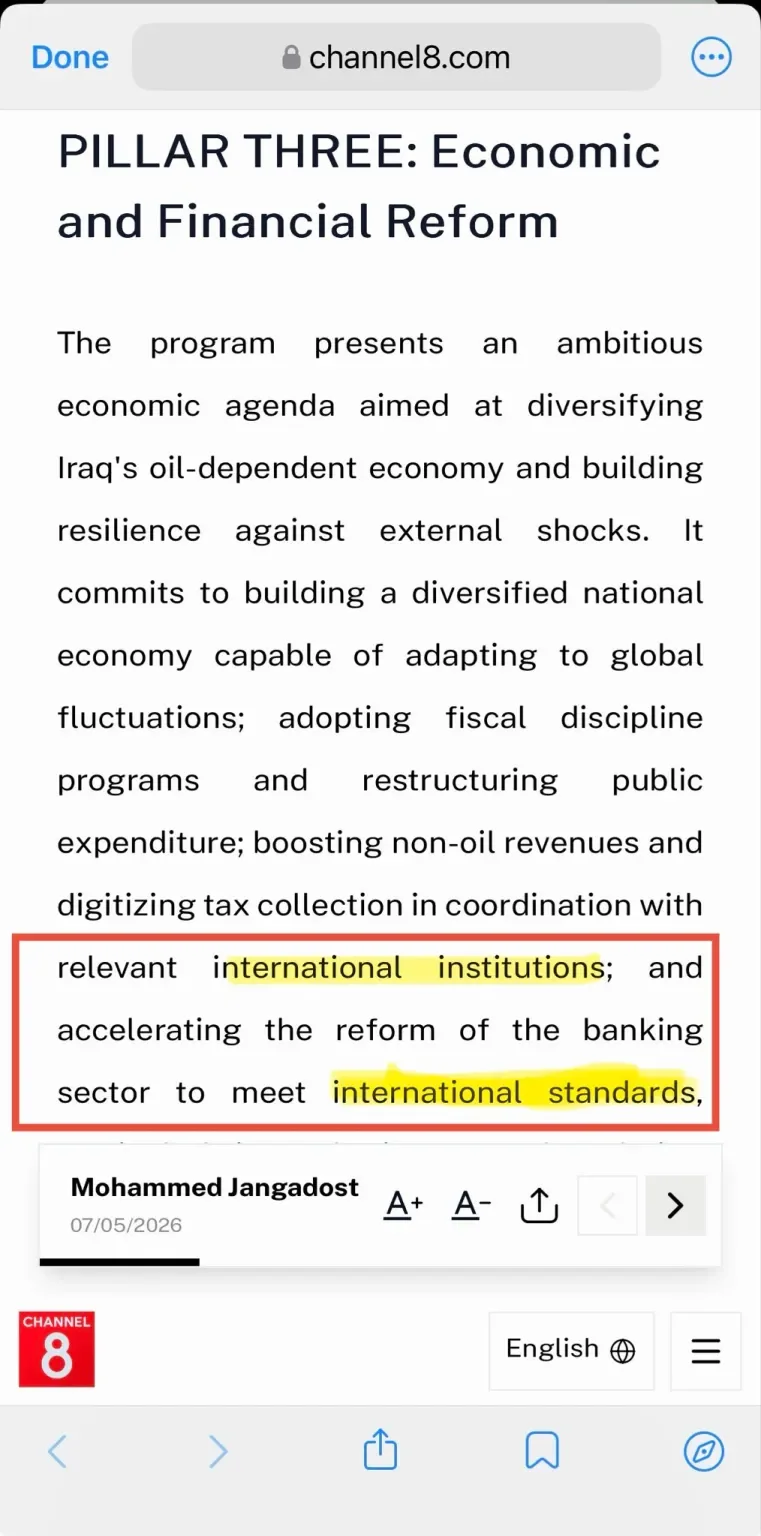
BREAKING NEWS: Iraq’s New Government Expands International Banking Reforms for the Iraq Dinar
Iraq’s incoming government is openly prioritizing:
• International Banking Standards
• International Institutions
• Economic and financial reform
• Banking sector modernization
Freedom Fighter: Iraq’s New Government Expands International Banking Reforms for the Iraq Dinar
5-15-2026
BREAKING NEWS: Iraq’s New Government Expands International Banking Reforms for the Iraq Dinar
Iraq’s incoming government is openly prioritizing:
• International Banking Standards
• International Institutions
• Economic and financial reform
• Banking sector modernization
• Diversification beyond oil
• Fiscal discipline and digital systems
• Integration of the Iraqi Dinar into international banking reforms
This is no longer just rhetoric.
Iraq is continuing to position its banking sector for deeper integration with the international financial system.
Receipts:
Seven Currencies Cracked this Week, the Operation is Running
Seven Currencies Cracked this Week, the Operation is Running
5-15-2026
By David E. Atterton | Reset Intelligence | @EXIT_FIAT
Seven sovereign currencies cracked against the dollar in the same week. India. Indonesia. Turkey. The Philippines. Thailand. Venezuela. Iran. Not seen in generations.
These are not separate events. They are one operation, well planned, years in the making, being executed in real time.
Seven Currencies Cracked this Week, the Operation is Running
5-15-2026
By David E. Atterton | Reset Intelligence | @EXIT_FIAT
Seven sovereign currencies cracked against the dollar in the same week. India. Indonesia. Turkey. The Philippines. Thailand. Venezuela. Iran. Not seen in generations.
These are not separate events. They are one operation, well planned, years in the making, being executed in real time.
The Convergence This Week
The seven currencies share one common theme. They all import their oil through the same chokepoint Iran has been controlling since the war began, and they all price that oil in dollars they must earn from another source. Hormuz disruption since February has bid that dollar up faster than any of them can produce it. Reserve drawdown is the math.
The Basket That Was Always Going To Move
The currencies the book has named for the reset have been positioning for years for exactly the conditions you are watching land this week.
• Iraq’s dinar sits at 1,310 to the dollar – a rate set by an occupying authority during post-war reconstruction. Iraq holds $16 trillion in proven natural resources against that rate. The cabinet vote this week is the boarding pass dinarland has been waiting for.
• Venezuela’s bolivar is the demonstration. 504 official, 560 black market, down 439 percent year on year. Trump named Caracas as the model on Monday.
• Vietnam’s dong trades at 26,339 to the dollar. The State Bank of Vietnam has been running a digital VND pilot since early 2025 – the settlement layer that has to exist before any rate move can land.
• Indonesia’s rupiah is one of the seven that cracked this week at 17,430 to the dollar, a record low. Jakarta has been quietly accumulating gold for two years. That crash is the squeeze that forces the anchor.
The Part The Headlines Do Not Connect
The United States Treasury still books its 261 million ounces of gold at $42.22 per ounce – the statutory price set in 1973. Market is at $4,678.
A single accounting entry to revalue that holding to market lifts the Treasury balance sheet by over a trillion dollars. Without raising a tax. Without selling an asset. Without issuing a bond.
That entry is the off-ramp from 52 years of petrodollar order that does not require a dollar crisis to execute. The Iran severance, the new Fed chair this morning, the CLARITY markup, and the Iraqi cabinet vote are the political and legal conditions that make that entry possible.
This Was All Planned Decades Ago
Future generations will read this period the way we read Bretton Woods, the way we read 1971.
Stay pegged to a dollar whose underlying is being rewritten in real time, or re-anchor to gold, commodities, and the regulated digital settlement layer about to be signed into US law. Iraq is being held at the boarding gate until Washington gives the signal. Vietnam is two yards away. Indonesia is being forced by its own reserve math. Venezuela is the demonstration. Iran is the country whose revenue was cut to force the choice on everyone else.
The Long-Form Architecture
Reset Intelligence published the source-level documentation of this system in March. Head of the Snake. 1,000+ hours of independent research. DOJ filings, Federal Register executive orders, CBI statements, FinCEN advisories, central bank records. It traces the architecture the Treasury Secretary is now reading from.
25% off all formats with code 25XOFF through Sunday: resetintelligence.com/head-of-the-snake
For readers wanting the conversion-side discipline, The Quiet Conversion guide is free with email signup at resetintelligence.com/resources/
The only question history will ask is who saw it while it was actually happening.
Seeds of Wisdom RV and Economics Updates Friday Afternoon 5-15-26
Good Afternoon Dinar Recaps,
Trump-Xi Summit Fails to Calm Markets: Strategic Rivalry Continues Reshaping Global Financial Order
Chinese markets fall as investors conclude the summit produced stability talks rather than meaningful economic breakthroughs
The latest Trump-Xi summit reinforced a growing reality in global finance: the United States and China are no longer simply economic partners, but strategic competitors managing an increasingly fragile coexistence.
Good Afternoon Dinar Recaps,
Trump-Xi Summit Fails to Calm Markets: Strategic Rivalry Continues Reshaping Global Financial Order
Chinese markets fall as investors conclude the summit produced stability talks rather than meaningful economic breakthroughs
The latest Trump-Xi summit reinforced a growing reality in global finance: the United States and China are no longer simply economic partners, but strategic competitors managing an increasingly fragile coexistence.
OVERVIEW (KEY POINTS)
Global markets reacted cautiously after the highly anticipated summit between President Donald Trump and Chinese President Xi Jinping concluded without major breakthroughs on trade, technology restrictions, or geopolitical disputes.
Chinese equity markets fell sharply as investors reassessed expectations that the meeting might produce a more comprehensive economic reset between the world’s two largest economies.
While both leaders emphasized stability and continued dialogue, the absence of concrete agreements involving tariffs, semiconductor restrictions, rare earth exports, and Taiwan reinforced concerns that structural tensions remain unresolved.
The broader implication is significant for the global financial system. Markets increasingly view U.S.-China relations not as a pathway toward deeper globalization, but as a long-term geopolitical rivalry shaping trade, currencies, technology, and global investment flows.
KEY DEVELOPMENTS
1. Chinese Markets Decline After Summit
Investors reacted negatively to the lack of major agreements.
CSI 300 and Shanghai Composite indexes both fell more than 1%
Traders expected progress on tariffs and technology restrictions
Markets viewed the summit as symbolic rather than transformational
2. Technology Competition Remains Unresolved
Semiconductors and AI continue driving strategic tensions.
No major movement on U.S. export controls involving advanced chips
China remains central to global rare earth supply chains
Competition over artificial intelligence and advanced manufacturing intensified concerns
3. Taiwan Continues to Pressure Relations
Taiwan remained one of the summit’s most sensitive issues.
Xi reportedly warned against actions destabilizing cross-strait relations
Washington continues supporting Taiwan’s defense capabilities
Markets remain concerned over long-term military tensions in Asia
4. Energy and Iran Discussions Reflect Global Instability
The summit also focused on broader geopolitical risks.
Both sides discussed keeping the Strait of Hormuz open to shipping
Middle East tensions continue impacting oil prices and inflation expectations
China and the U.S. remain divided over broader Iran strategy
5. Fragile Stability Replaces Expectations of a Reset
Analysts described the summit as an exercise in managing tensions rather than resolving them.
Investors remain concerned over trade imbalances and sanctions
National security increasingly shaping economic policy decisions
Diplomatic communication improved, but structural rivalry remains intact
WHY IT MATTERS
The market response reflects a major shift in investor thinking about the global economy.
In previous decades, summits between U.S. and Chinese leaders often fueled optimism surrounding globalization and deeper economic integration. Today, markets increasingly expect competition, fragmentation, and strategic decoupling instead.
This matters because the United States and China remain deeply interconnected across trade, finance, technology, energy, and manufacturing. Prolonged instability between them affects nearly every major sector of the global economy.
The summit may have reduced short-term fears of escalation, but investors appear increasingly focused on the larger structural competition now shaping the international financial system.
WHY IT MATTERS TO FOREIGN CURRENCY HOLDERS
Dollar and yuan volatility
Technology restrictions could reshape global capital flows
Commodity and energy markets remain vulnerable to U.S.-China rivalry
Safe-haven assets like gold may continue benefiting from uncertainty
IMPLICATIONS FOR THE GLOBAL RESET
Pillars 1: Financial system transformation
The summit reinforced the growing divide between economic interdependence and geopolitical competition, accelerating the shift toward regionalized trade and investment systems.
Pillar 2: Financial Power Is Becoming Strategic Power
Trade policy, semiconductor access, rare earth supplies, and currency influence are increasingly being used as geopolitical tools rather than purely economic instruments.
CONCLUSION
The Trump-Xi summit succeeded in preserving communication between the world’s two largest powers, but it did little to resolve the deeper structural tensions driving global uncertainty.
Markets were looking for concrete signs of long-term stability. Instead, they received confirmation that strategic rivalry remains the defining feature of U.S.-China relations.
As technology competition, trade disputes, energy security, and geopolitical influence become increasingly intertwined, future market volatility tied to Washington and Beijing is likely to remain persistent.
The global financial reset is no longer being shaped solely by economics — it is being driven by the strategic competition between competing centers of global power.
Seeds of Wisdom Team
Newshounds News™ Exclusive
Sources
Modern Diplomacy — "China Markets Fall After Trump-Xi Summit Delivers Few Concrete Breakthroughs"
Reuters — "Trump and Xi Seek Stability but Key Trade Issues Remain Unresolved"
~~~~~~~~~~
Seeds of Wisdom Team RV Currency Facts Youtube and Rumble
Newshound's News Telegram Room Link
RV Facts with Proof Links Link
RV Updates Proof links - Facts Link
Follow the Gold/Silver Rate COMEX
Follow Fast Facts
Seeds of Wisdom Team™ Website
Thank you Dinar Recaps
Iraq News Posted by Tishwash at TNT 5-15-2026
TNT:
Tishwash: The US envoy congratulated al-Zaidi: Trump is fully prepared to work with you and your government.
US Special Envoy Tom Barrack congratulated Iraqi Prime Minister Ali al-Zaidi on Thursday on his government winning a vote of confidence in parliament. Barrack said in a statement: "We congratulate Iraqi Prime Minister Ali al-Zaidi on receiving the confidence of parliament and the approval of his government by the Council of Representatives."
He added: "We are encouraged by your new leadership and look forward to working with you to develop an ambitious agenda that aligns with our shared interests: building a sovereign, prosperous, and stable Iraq that lives in peace with its neighbors and provides opportunities and growth for all its citizens in a productive partnership with the United States."
TNT:
Tishwash: The US envoy congratulated al-Zaidi: Trump is fully prepared to work with you and your government.
US Special Envoy Tom Barrack congratulated Iraqi Prime Minister Ali al-Zaidi on Thursday on his government winning a vote of confidence in parliament. Barrack said in a statement: "We congratulate Iraqi Prime Minister Ali al-Zaidi on receiving the confidence of parliament and the approval of his government by the Council of Representatives."
He added: "We are encouraged by your new leadership and look forward to working with you to develop an ambitious agenda that aligns with our shared interests: building a sovereign, prosperous, and stable Iraq that lives in peace with its neighbors and provides opportunities and growth for all its citizens in a productive partnership with the United States."
He noted that "President Trump, Secretary Rubio, and the United States are fully prepared to work closely with you and your government to achieve our shared goals of prosperity for the Iraqi people and the defeat of terrorism, which has long been an obstacle to their progress." link
************
Tishwash: Al-Zidi's government wins the confidence of the House of Representatives and takes the constitutional oath
The House of Representatives granted confidence to the government of Prime Minister Ali al-Zidi on Thursday during a voting session attended by 270 members of parliament. The Prime Minister and the ministers who were voted on took the constitutional oath, signaling the official start of the new government's duties.
The House of Representatives voted on 14 out of 23 ministries, namely:
14 ministerial portfolios in Ali al-Zaidi's government have gained the confidence of parliament, with the remaining appointments postponed until after Eid al-Adha.
1- Voting unanimously for Faleh Al-Sari as Minister of Finance.
2- Voting by an absolute majority on Basim Muhammad Khudair as Minister of Oil.
3- Voting by an absolute majority for Mohammed Nouri Ahmed as Minister of Industry.
4- Voting by an absolute majority for Ali Saad Wahib as Minister of Electricity.
5- Voting by an absolute majority for Abdul-Hussein Aziz as Minister of Health.
6- Voting by an absolute majority for Sarwa Abdulwahid as Minister of Environment.
7- Voting by an absolute majority for Abdul Rahim Jassim as Minister of Agriculture.
8- Voting by an absolute majority for Mustafa Nizar Jumaa as Minister of Trade.
9- Voting by an absolute majority for Khalid Shawani as Minister of Justice.
10- Voting by an absolute majority on Abdul Karim Abtan as Minister of Education.
11- Voting by an absolute majority to appoint Wahab Salman Mohammed as Minister of Transport.
12- Voting by an absolute majority for Fuad Hussein as Minister of Foreign Affairs.
13- Voting by an absolute majority for Mustafa Jabbar Sand as Minister of Communications.
14- Voting by an absolute majority for Muthanna Ali Mahdi as Minister of Water Resources.
The remaining portfolios are scheduled to be voted on after the Eid al-Adha holiday, and include the ministries of: Interior, Defense, Labor and Social Affairs, Immigration and Displacement, Reconstruction and Housing, Planning, Culture, Education, Youth and Sports, in addition to the deputy prime ministers. link
************
Tishwash: Al-Zaydi: Economic reform, arms control, and e-governance are our government's top priorities.
Prime Minister Ali Faleh al-Zaidi announced his government's priorities on Thursday, while also calling on diplomatic missions to resume their work in Baghdad. The Prime Minister's Media Office stated in a press release received by Mawazin News that "Ali al-Zaidi reviewed the new government's ministerial program, emphasizing its determination to fulfill the aspirations of the Iraqi people, placing the citizen's interest among its top priorities." According to the statement, al-Zaidi said, "The path to reform begins from within by confronting corruption and administrative inefficiency."
He indicated that he would face the challenges based on his belief in the capabilities and patience of the Iraqi people, transforming crises into opportunities and setbacks into milestones in making a difference to enhance services, build robust institutions, and propel Iraq towards e-governance and e-government. Al-Zaidi outlined his steps in "three tracks: first, economic reform and development through economic diversification, genuine investment, and a sound financial and banking system; second, social development, establishing social justice, caring for the most vulnerable groups, protecting children, and empowering women; and third, reforming the security apparatus by monopolizing weapons in the hands of the state, strengthening the capabilities of the security forces, and consolidating their authority." The citizen's trust in democracy."
He noted that "Iraq, with its deep-rooted civilization, human and cultural diversity, and the supreme religious authority it represents, qualifies us to stand and restore the government's standing." He called on all diplomatic missions to "return to their work in Baghdad," and expressed his gratitude to the government of Mohammed Shia' al-Sudani. link
************
Tishwash: Al-Zurfi and Zebari in Washington... and discussions about Iraq at the Atlantic Council
Photos published on the sidelines of the events documented the presence of the head of the Alternative Alliance, Adnan al-Zurfi, and the former Iraqi Foreign Minister, Hoshyar Zebari, at the Atlantic Council seminar held in the American capital, Washington, whose discussions focused on the Iraqi issue. National Security Advisor Qasim al-Araji is expected to join them, as the Atlantic Council announced his participation in the “Iraq Dialogue 2026”.
Earlier, the Atlantic Council announced a visit to Washington by Iraqi National Security Advisor Qasim al-Araji to participate in a major conference entitled “Iraq Dialogue 2026.” Victoria Taylor, a former State Department official who has been in intensive contact with Baghdad recently, said that this occasion is “direct contact between senior Iraqi officials and policymakers in the United States, at a sensitive moment” in the relationship between Baghdad and the US administration. She also announced that participation in the dialogue is open via a registration link.
Victoria Taylor, who now serves as the director of the Iraq Initiative at the Atlantic Council, explained in a post on the X platform, translated by 964 Network , “We are pleased to welcome Qasim al-Araji, the National Security Advisor of the Republic of Iraq, to the Iraq 2026 Dialogue, which will be held in Washington, D.C.”
She added that “his participation reflects the role the conference plays as a high-level platform for direct communication between senior Iraqi officials and policymakers in the United States, at a sensitive moment in bilateral relations.” link
News, Rumors and Opinions Friday 5-15-2026
Note: All intel should be considered as "Rumors" until we receive official announcements ...and “Rates and Dates” could change anytime until we get to the banks/redemption centers.
Ariel: Currency Revaluation in Full Swing
5-15-2026
We Are In The Green
Iraq Cabinet Approved
Kevin Warsh Confirmed
Note: All intel should be considered as "Rumors" until we receive official announcements ...and “Rates and Dates” could change anytime until we get to the banks/redemption centers.
Ariel: Currency Revaluation in Full Swing
5-15-2026
We Are In The Green
Iraq Cabinet Approved
Kevin Warsh Confirmed
China Trip A Success
The Currency Revaluation Is In Full Swing Folks
Eleanor: JUST IN: The Clarity Act ADVANCES out of the Senate Banking Committee in a 15-9 bipartisan vote, with two Democrats voting in favor:
@SenRubenGallego and @Sen_Alsobrooks
Next stop: the full Senate.
Source(s):
• https://x.com/Prolotario1/status/2054975805227254181
https://dinarchronicles.com/2026/05/15/prolotario-currency-revaluation-in-full-swing/
************
Courtesy of Dinar Guru: https://www.dinarguru.com/
Militia Man Take a picture of all these little articles that come out in the last three days and you put it all together and it's like, whoa! [Iraq] is integrating into the global financial system.
Jeff 100+ trillion dinar physically outside of Iraq...The central bank doesn't give two craps about it pertaining to the rate change...Here's its purpose...Basil III states countries can use foreign currencies to asset back their own country's currency...The United States has half of Iraq's money supply...along with all the dinar that we the people have...Once we go to exchange with our banks, our banks will turn around and give all that dinar back to the US Treasury...The United States is going to use all that physical dinar, the old 3 zero notes, to asset back the United States dollar because it's a Basil III compliance step...All the dinar outside of Iraq will be used for countries to asset back their own country's currency.
Stephen If you hold the Iraqi dinar you are a very small select spirit led group of people...I don't know what's coming...There's a lot of prophecies or a lot of opinions that we're going to enter very hard times in the near future. I don't know if or when that's going to happen but I do believe this [Iraqi dinar RV] is going to create a lot of provision and abundance for a certain amount of people to get prepared...
************
From Recaps Archives:
For Dinar - What you will see on Forex or CBI WHEN IT RVs
$ RATE = What you will see on Forex or CBI
$ .86 = 1.162
$ 1.00 = 1.000
$1.17 = 0.854
$1.86 = 0.537
$2.00 = 0.500
$2.50 = 0.400
$3.00 = 0.333
$3.22 = 0.310
$3.46 = 0.289
$3.50 = 0.285
$3.86 = 0.259
$4.00 = 0.250
$4.10 = 0.243
$4.40 = 0.227
$5.00 = 0.200
$5.25 = 0.190
$5.50 = 0.181
$6.00 = 0.166
$7.00 = 0142
$8.00 = 0.125
$8.25 = .0121
$8.50 = .0117
$9.00 = 0.111
$10.00=0.100
*************
Big Day For Dinar Investors !
Dinar For Dummies: 5-14-2026
Today was a big day for dinar investors. The majority of the Iraqi government was approved and the clarity act is 1 step closer to being finalized.
Seeds of Wisdom RV and Economics Updates Friday Morning 5-15-26
Good Morning Dinar Recaps,
UAE Breaks From OPEC Constraints: Gulf Energy Realignment Reshapes Global Oil Power
Abu Dhabi’s pipeline expansion and production flexibility signal a major shift in energy security, export independence, and global market influence
The UAE’s accelerated push to bypass the Strait of Hormuz reflects a broader transformation in global energy strategy as geopolitical instability forces nations to rethink trade security and production control.
Good Morning Dinar Recaps,
UAE Breaks From OPEC Constraints: Gulf Energy Realignment Reshapes Global Oil Power
Abu Dhabi’s pipeline expansion and production flexibility signal a major shift in energy security, export independence, and global market influence
The UAE’s accelerated push to bypass the Strait of Hormuz reflects a broader transformation in global energy strategy as geopolitical instability forces nations to rethink trade security and production control.
OVERVIEW (KEY POINTS)
The United Arab Emirates is rapidly expanding its oil export infrastructure after formally exiting OPEC, giving the country significantly greater flexibility over production and energy strategy.
The move comes after months of instability surrounding the Strait of Hormuz, where shipping disruptions and regional conflict exposed the vulnerability of Gulf energy exports. The UAE is now accelerating pipeline expansion projects designed to bypass the strait entirely.
At the same time, Abu Dhabi is increasing long-term oil production ambitions, with ADNOC targeting five million barrels per day in capacity ahead of schedule and signaling future expansion toward six million barrels daily.
The broader implication is substantial. The UAE’s shift reflects a growing trend where energy-producing nations prioritize national flexibility, infrastructure resilience, and independent export control over traditional cartel coordination.
KEY DEVELOPMENTS
1. UAE Gains Freedom From OPEC Production Quotas
The UAE’s departure from OPEC removes long-standing production limitations.
Abu Dhabi no longer bound by coordinated output caps
Greater flexibility to respond to global demand and pricing conditions
Saudi-led production management structure faces new pressure
2. Pipeline Expansion Reduces Hormuz Dependence
The UAE is accelerating infrastructure designed to bypass the Strait of Hormuz.
Fujairah export corridor becoming strategically critical
Alternative export routes improve resilience during regional conflict
Energy security increasingly tied to infrastructure independence
3. ADNOC Accelerates Production Growth
The UAE is aggressively expanding oil capacity.
ADNOC targeting 5 million barrels per day ahead of schedule
Officials suggest capacity could eventually rise to 6 million barrels daily
Long-term investment signals confidence in future energy demand
4. Gulf Shipping Risks Continue Rising
Commercial shipping remains vulnerable to geopolitical escalation.
Reports indicate some tankers disabled tracking systems to reduce attack risk
Insurance and transport costs continue climbing across Gulf routes
Global markets remain highly sensitive to Hormuz disruptions
5. Energy Security Becomes National Security
Oil infrastructure is increasingly viewed through a geopolitical lens.
Gulf nations focusing on strategic export independence
Energy corridors becoming central to foreign policy planning
Infrastructure investments reshaping regional power balances
WHY IT MATTERS
The UAE’s strategy reflects a deeper transformation in how nations approach energy security and economic resilience.
For decades, Gulf oil exporters depended heavily on shared regional coordination and open maritime trade routes. The recent conflict demonstrated how quickly those systems can become vulnerable during geopolitical escalation.
By building independent export infrastructure and increasing production flexibility, the UAE is positioning itself as one of the most resilient energy suppliers in the region.
This also has broader consequences for inflation, shipping costs, industrial production, and monetary policy worldwide, since stable Gulf energy flows remain critical to the global economy.
WHY IT MATTERS TO FOREIGN CURRENCY HOLDERS
Oil market volatility could continue impacting currency stability
Energy-exporting nations may strengthen reserve positions
Inflation pressures tied to shipping disruptions may persist
Commodity-linked currencies could gain influence during instability
IMPLICATIONS FOR THE GLOBAL RESET
Pillar 1: Energy Infrastructure Replaces Cartel Dependence
Nations are increasingly prioritizing direct control over export routes and supply chains rather than relying solely on multinational energy coordination systems.
Pillar 2: Strategic Trade Corridors Gain Financial Importance
Control over pipelines, ports, and shipping corridors is becoming central to economic power, reserve stability, and long-term geopolitical leverage.
CONCLUSION
The UAE’s accelerated pipeline expansion marks more than an infrastructure project — it represents a strategic shift in how global energy power is organized.
As geopolitical instability reshapes trade routes and export security, countries are investing heavily in systems designed to preserve economic flexibility during crisis conditions.
The move also reflects the gradual weakening of older energy coordination structures as nations prioritize national resilience over collective production management.
In the emerging global financial order, control over energy routes may become just as important as control over currencies themselves.
Seeds of Wisdom Team
Newshounds News™ Exclusive
Sources
Modern Diplomacy — "UAE Accelerates Oil Pipeline Expansion to Bypass Strait of Hormuz"
Reuters — "UAE Expands Fujairah Oil Infrastructure Amid Gulf Shipping Risks"
🌱 A Message to Our Currency Holders🌱
If you’ve been holding foreign currency for many years, you were not foolish.
You were not wrong to believe the global financial system would change.
What failed was not your patience — it was the information you were given.
For years, dates, rumors, and personalities replaced facts, structure, and proof. “This week” predictions created cycles of hope and disappointment that were never based on how currencies actually change.
That is not your failure.
Our mission here is different: • No dates • No rates • No hype • No gurus
Instead, we focus on:
• Verifiable developments • Institutional evidence
• Global financial structure • Where countries actually sit in the process
Currency value changes only come after sovereignty, trade, banking, settlement systems, and fiscal coordination are in place. History and institutions confirm this sequence.
You will see silence. You will see denials. That is not delay — that is discipline.
Protect your identity. Organize your documents. Verify everything.
Never hand your discernment to anyone who cannot show proof.
You deserve truth — not timelines.
Seeds of Wisdom Team
Newshounds News™
~~~~~~~~~~
Seeds of Wisdom Team RV Currency Facts Youtube and Rumble
Newshound's News Telegram Room Link
RV Facts with Proof Links Link
RV Updates Proof links - Facts Link
Follow the Gold/Silver Rate COMEX
Follow Fast Facts
Seeds of Wisdom Team™ Website
Thank you Dinar Recaps
Iraq Economic News and Points To Ponder Friday Morning 5-15-26
When will dollar shipments arrive in Baghdad? Washington ignores the Central Bank, while al-Zidi prioritizes it.
2026-05-14 964 Network The Asharq Bloomberg website published a report in which a senior Iraqi official, who declined to reveal his identity, stated that addressing the crisis of delayed dollar shipments from the United States to Baghdad, amounting to about $10 billion annually, will be among the priorities of Ali al-Zaidi's government, in order to avoid destabilizing the exchange market in light of the sharp decline in oil exports due to the repercussions of the Iran war.
When will dollar shipments arrive in Baghdad? Washington ignores the Central Bank, while al-Zidi prioritizes it.
2026-05-14 964 Network The Asharq Bloomberg website published a report in which a senior Iraqi official, who declined to reveal his identity, stated that addressing the crisis of delayed dollar shipments from the United States to Baghdad, amounting to about $10 billion annually, will be among the priorities of Ali al-Zaidi's government, in order to avoid destabilizing the exchange market in light of the sharp decline in oil exports due to the repercussions of the Iran war.
He confirmed that the Iraqi authorities are trying to find out the reasons for the delay in the latest shipments, but the Central Bank has not yet received any response from the American side.
Washington denies releasing Iraqi dollars: Shipments suspended until further notice
Earlier, the administration of US President Donald Trump suspended dollar shipments to Iraq and froze funding for security cooperation programs with Baghdad, pressuring it to dismantle Iranian-backed armed factions. The US Treasury Department blocked an air shipment of about $500 million in Iraqi oil revenues held in accounts at the Federal Reserve Bank of New York, according to the Wall Street Journal.
According to banking expert Mustafa Hantoush, speaking to Asharq Bloomberg, Washington is expected to resume sending shipments soon, based on a similar precedent in 2023, at a time when the International Monetary Fund expects the Iraqi economy to shrink by 6.8% this year, with central reserves amounting to $100 billion before the war.
A report by the “Al-Sharq Bloomberg” website, as reviewed by 964 Network :
A senior Iraqi official said that addressing the crisis of delayed dollar shipments from the United States to Baghdad will be a priority for the new government to avoid destabilizing the exchange market, especially after the sharp decline in the country's oil exports due to the repercussions of the Iran war.
Iraq receives a portion of its oil revenues in the form of cash shipments in US dollars, estimated at around $10 billion annually. These funds are distributed in installments arriving via chartered flights at Baghdad Airport, while transfers related to financing foreign trade—which have not been affected by the delays—are managed through official banking channels.
The government official, who spoke to Asharq on condition of anonymity, confirmed that the Iraqi authorities are indeed trying to find out the reasons for the delay in the latest shipments, but the Central Bank has not yet received a response from the American side.
The US State Department confirmed in response to an inquiry from Asharq News' Washington bureau that dollar shipments to Iraq remain "suspended." It referred any further inquiries to the Treasury Department and the Central Bank of Iraq.
The Treasury Department did not respond to Al-Sharq's questions about the crisis, while officials at the Central Bank of Iraq could not be reached for comment.
Reuters reported in late April, citing several sources, that the administration of US President Donald Trump had halted a cash shipment worth about $500 million and suspended part of its security cooperation with Baghdad in an attempt to pressure the Iraqi government to reduce the influence of Iranian-backed armed factions, which have launched several attacks on Gulf states since the start of the conflict at the end of February in support of the regime in Tehran.
The Stability Of The Dinar Is At Stake
Although the value of the shipment represents only a small fraction of the total demand for dollars in the Iraqi market, its delayed arrival and the ongoing crisis could affect the stability of the dinar and widen the gap between the official exchange rate and the parallel market rate, which has only fluctuated within a narrow range since the outbreak of the conflict.
Therefore, the official confirmed that the issue will be a priority for Prime Minister-designate Ali al-Zaidi as soon as he officially assumes office. The Iraqi parliament is scheduled to vote tomorrow, Thursday, on granting confidence to the new government.
Iraq is among the countries most affected by the war in the region. The International Monetary Fund (IMF) projects a 6.8% contraction in its economy this year due to its reliance on oil exports through the Strait of Hormuz, which account for 90% of government revenue. A senior IMF official told Asharq Al-Awsat last month that Baghdad's options for dealing with the crisis until a new government is formed focus on reducing spending and temporarily drawing on the central bank's reserves, which stood at approximately $100 billion before the war.
Trump had invited al-Zaidi during a phone call at the end of last month to visit Washington after the government was formed, and wished him success “in forming a new government free of terrorism that can provide a brighter future for Iraq and the United States.”
The Historical Roots Of The Crisis
Iraqi banking expert Mustafa Hantoush told Asharq that he expects Washington to resume sending dollar shipments soon. He added that the United States had previously suspended these shipments temporarily in 2023 without publicly stating the reasons.
The story of relying on the United States to send dollar shipments to Baghdad dates back to 2003, when then-US President George W. Bush issued an executive order during the American occupation following the overthrow of Saddam Hussein's regime.
This order mandated that all of Iraq's oil revenues be transferred to a special account called the "Development Fund for Iraq," managed through the Federal Reserve Bank of New York, ostensibly to protect the funds from lawsuits and use them for reconstruction. Since then, the executive order has been renewed annually, meaning that US approval is required before any funds can be transferred to Baghdad. https://964media.com/681037/
Trump's Envoy Congratulates Al-Zaidi On Gaining Confidence: We Are Ready To Work With The New Iraqi Government –
5/14/2026 Baghdad – One News US President Donald Trump’s envoy, Tom Barrack, congratulated Iraqi Prime Minister Ali Faleh al-Zaidi on his government winning the confidence of the House of Representatives.
Barak said the United States is optimistic about the new leadership in Iraq and looks forward to cooperating with al-Zaidi's government on an ambitious agenda that aligns with the shared interests of both countries.
He added that Washington supports building a sovereign, prosperous and stable Iraq that lives in peace with its neighbors and provides opportunities and growth for all its citizens, within a mutually beneficial partnership with the United States.
Barak emphasized that President Trump, Secretary of State Marco Rubio, and the United States are prepared to work closely with the new Iraqi government to achieve common goals, foremost among them the prosperity of the Iraqi people and the elimination of terrorism. https://1news-iq.net/مبعوث-ترمب-يهنئ-الزيدي-بنيل-الثقة-مستع/
US Backs Cooperation With Iraq After Al-Zaidi Cabinet Approval
2026-05-14 Shafaq News- Washington/ Baghdad The United States is looking to work with Iraq’s new government on a “bold new agenda” focused on stability, prosperity, and economic cooperation, US envoy Tom Barrack said on Thursday after Parliament approved Prime Minister Ali Al-Zaidi’s cabinet and ministerial program.
Barrack added that US President Donald Trump, Secretary of State Marco Rubio, and the US administration are prepared to work closely with Al-Zaidi and his cabinet, while reaffirming support for counterterrorism efforts.
X Ambassador Tom Barrack @USAMBTurkiye
Congratulations to Iraqi Prime Minister Ali al-Zaidi on securing parliamentary confidence and the approval of his government by the Council of Representatives.
We are encouraged by your fresh leadership and look forward to collaborating on a bold new agenda aligned with our shared interests: building a sovereign, prosperous, stable Iraq, at peace with its neighbors, that delivers opportunity and growth for all its citizens in mutually beneficial partnership with the United States.
President Trump, Secretary Rubio, and the United States stand ready to work closely with you and your government to advance our shared goals of prosperity for the Iraqi people and the elimination of terrorism, which is always an impediment to the people’s progress.
Earlier today, Iraq’s Parliament granted confidence to Al-Zaidi’s cabinet and ministerial program, approving 14 ministers while postponing votes on six portfolios, including higher education and interior, following objections to several nominees.
The remarks came as Washington closely monitors the formation of Iraq’s next government. A US State Department spokesperson told Shafaq News that Washington’s future approach toward the incoming administration would depend on the role of Iran-linked armed factions within state institutions. “The US is looking for action, not words… Iraq has a choice to make.”
“Iran’s terrorist militias must have no role in state institutions,” the spokesperson added, stressing that Iraqi state funds should not support such groups and indicating that Washington would “calibrate” its approach to the new government accordingly.
Read more: Al-Zaidi named prime minister: Easy nomination, harder road ahead
https://www.shafaq.com/en/Iraq/US-backs-cooperation-with-Iraq-after-Al-Zaidi-cabinet-approval
US State Department To Alwan News: Washington Supports The New Iraqi Government And Sees It As An Opportunity For Stability And Reform
latest news Thursday, May 14, 2026 Baghdad – One News The US State Department confirmed in a statement to One News that the United States and the White House support the new Iraqi government that is being formed.
The Foreign Ministry indicated that they see in it an opportunity to enhance stability, reform, and consolidate state institutions, noting that the US President has confirmed this on more than one occasion and official statement.
The Foreign Ministry added that the US administration is still holding fast to its clear and firm position that the participation of armed factions or any entities outside the framework of the state in the next government is a red line that is not open to discussion or compromise.
It indicated that Washington will continue its support for Iraq within the framework of a state of institutions, the rule of law, and the strategic partnership between the two countries. https://1news-iq.net/الخارجية-الأميركية-لوان-نيوز-واشنطن-ت/