
Thank you to all the subscribers to our Early Access program…we thank you for your continued support.
We are excited to offer this new service to keep you informed and up-to-date on the latest Dinar and currency news.
Fiat Collapse Incoming? MacLeod Warns of Bond, Dollar & Gold Shock
Fiat Collapse Incoming? MacLeod Warns of Bond, Dollar & Gold Shock
Liberty and Finance: 4-1-2026
Are we witnessing the final act of the fiat currency system?
Join Dunagun Kaiser and Alasdair MacLeod as they break down:
The coming surge in U.S. and G7 bond yields
Fiat Collapse Incoming? MacLeod Warns of Bond, Dollar & Gold Shock
Liberty and Finance: 4-1-2026
Are we witnessing the final act of the fiat currency system?
Join Dunagun Kaiser and Alasdair MacLeod as they break down:
The coming surge in U.S. and G7 bond yields
How the dollar and other major currencies are losing purchasing power
Why gold and silver demand is exploding globally, especially in Asia
The risks for Western investors, pensions, and 401Ks
INTERVIEW TIMELINE:
0:00 Intro
1:30 Bond yields
12:30 Dollar debasement
28:30 Gold outlook
32:30 Macleod Finance
“News Tidbits From TNT” Thursday AM 4-2-2026
TNT:
Tishwash: The US embassy warns of attacks in central Baghdad.
The US Embassy in Baghdad warned on Thursday morning that Iraqi factions may carry out attacks in the center of the Iraqi capital “within the next 24 to 48 hours.”
The embassy issued a security alert to its citizens, published on the X platform, stating that attacks were expected in central Baghdad within the next 24 to 48 hours, and reiterating its call for its citizens to leave.
TNT:
Tishwash: The US embassy warns of attacks in central Baghdad.
The US Embassy in Baghdad warned on Thursday morning that Iraqi factions may carry out attacks in the center of the Iraqi capital “within the next 24 to 48 hours.”
The embassy issued a security alert to its citizens, published on the X platform, stating that attacks were expected in central Baghdad within the next 24 to 48 hours, and reiterating its call for its citizens to leave. link
************
Tishwash: Parliamentary Finance Committee reassures: Iraq has sufficient cash reserves to cover salaries for six months.
Jamal Kojar, a member of the Finance Committee in the Iraqi Parliament, confirmed on Wednesday that Iraq has a cash reserve of around $97 billion, which allows it to secure salaries for 6 months even if revenues stop completely.
In a televised interview, which was monitored by Al-Ghad Press, Kujer said: "There is no doubt that the repercussions of the war have already begun to appear globally.
If you ask a citizen in America, Italy, or even China about fuel and energy prices, you will find a clear impact because energy sources and trade routes have become threatened. As for Iraq, talking about the state's inability to pay salaries at the moment is inaccurate, because the war is still in its early stages."
He pointed out that "Iraq has gone through more difficult crises, such as the war against ISIS (2014-2018) and the Corona crisis, and salaries were not cut."
He added: "If the war continues for more than two additional months, or if Iraq becomes directly involved as a state in the conflict, then the economy and the bank reserves will be exposed to real risks, and we may see an impact on the value of the currency and difficulty in cash withdrawals."
Kojo stressed that "closing the Strait of Hormuz is a catastrophic scenario for global trade routes, not just for Iraq," adding, "We are also awaiting a speech from Trump, which may change the balance of power; he will either push for de-escalation or increase the severity of sanctions, and both will affect the global economy." link
************
Tishwash: Oil production has stopped, and the public is asking, "Where is the liquidity?
The delay in paying employee salaries in recent days has sparked widespread concern among the Iraqi public, especially as the payment coincided with a long Eid holiday followed by heavy rains that disrupted work in several institutions. This has led to various interpretations, some pointing to a potential liquidity crisis amidst the current regional pressures.
This comes after the suspension of official work for two consecutive days, Wednesday and Thursday, as part of the government's celebrations of the national team's qualification for the World Cup finals.
While this move was described as having a popular character and a message of moral support to the public, it also ignited a broad debate among political and economic circles regarding the limits of using official holidays as a tool for responding to events, and whether it aligns with the country's work and production needs.
This comes after a series of government-announced holidays in recent days, following the Eid al-Fitr holiday, due to severe weather and heavy rainfall.
This has increased the number of official holidays in a short period, prompting observers to warn of the repercussions of accumulating holidays on institutional performance and public services.
The official weekend (Friday and Saturday) will exacerbate the suffering of employees already facing long waits for their salaries.
The salary delays come at a highly sensitive time, coinciding with the escalation of the regional conflict, which has directly impacted the Iraqi economy. This is particularly true given the near-complete halt in oil exports due to disruptions in supply routes through the Strait of Hormuz. Many are linking the salary delays to the decline in state revenues, as oil is the primary source of funding for the national budget.
In a country heavily reliant on oil revenues to cover operating expenses, especially salaries, any disruption to exports immediately affects public sentiment and heightens anxiety among citizens, especially in the absence of immediate clarifications to determine the nature of the situation and distinguish between administrative shortcomings and a potential financial crisis.
He pointed out that "the alternatives currently available are not as easy as expected. We have the Kurdistan route and the Aqaba route through Jordan, which are available options, but their capacity is limited compared to Basra. Even Saudi Arabia may open its borders, but the question is: Will these routes remain safe from being targeted in the event of a full-scale war?"
Kujer continued: "I assure citizens that salaries will not be affected in the foreseeable future. Iraq has a cash reserve (about $97 billion) that allows it to secure salaries for 6 months even if revenues stop completely." link
************
Tishwash: A delegation from the Kurdistan Democratic Party arrives in Baghdad to discuss three issues with political parties.
A high-level delegation from the Kurdistan Democratic Party arrived in the capital, Baghdad, on Tuesday afternoon, March 31, 2026.
According to information obtained by Kurdistan 24, the delegation includes: Fadhil Mirani, head of the working body of the party’s political bureau; Fawzi Hariri, head of the Kurdistan Region Presidency’s office; and Nawzad Hadi and Omid Sabah, members of the party’s central committee.
The party delegation is scheduled to discuss the following topics with Iraqi political parties:
Missile and drone attacks targeting the Kurdistan Region.
The formation of the new Iraqi government.
Election of a new president for Iraq.
The Kurdistan Region has been subjected to several missile and drone attacks in the past period, which has caused great concern among the Kurdish political leadership.
The Kurdistan Democratic Party (KDP) consistently seeks, through dialogue, to urge the federal government to uphold its responsibilities in protecting the sovereignty of Iraqi territory and the Kurdistan Region. This delegation's visit is part of ongoing efforts to pressure decision-makers in Iraq to prevent the recurrence of such attacks and maintain security and stability in the region. link
Seeds of Wisdom RV and Economics Updates Wednesday Evening 4-1-26
Good Evening Dinar Recaps,
CLARITY Act Nears Breakthrough: Stablecoin Reward Deal Could Unlock U.S. Crypto Regulation
Lawmakers appear close to resolving a critical dispute over stablecoin rewards, potentially clearing the path for landmark crypto legislation.
Good Evening Dinar Recaps,
CLARITY Act Nears Breakthrough: Stablecoin Reward Deal Could Unlock U.S. Crypto Regulation
Lawmakers appear close to resolving a critical dispute over stablecoin rewards, potentially clearing the path for landmark crypto legislation.
OVERVIEW (KEY POINTS)
Momentum is building around the Digital Asset Market CLARITY Act, as a key sticking point—stablecoin rewards (yield)—may soon be resolved.
According to comments from leadership at Coinbase, a compromise between regulators, banks, and crypto firms could be reached within days, raising expectations that the bill could advance in the Senate this month.
However, despite this optimism, market participants are becoming more cautious, with reduced confidence that the bill will be signed into law in 2026, reflecting ongoing political and regulatory uncertainty.
At the center of the debate is a high-stakes conflict between traditional banking and the crypto industry, with implications for the future of money, payments, and financial control systems.
KEY DEVELOPMENTS
1. Stablecoin Rewards Dispute Nearing Resolution
The biggest obstacle to the bill may soon be resolved.
Disagreement centers on whether crypto platforms can offer rewards (yield) on stablecoin holdings
A deal is reportedly close, with negotiations intensifying this week
This single issue has delayed the entire U.S. crypto regulatory framework
2. Banks vs Crypto: The Core Battle for Deposits
The conflict is fundamentally about who controls money flows.
Banks argue rewards act like interest-bearing accounts without regulation
Crypto firms argue banning rewards would stifle innovation and adoption
At stake: trillions in potential capital migration from banks to digital assets
3. Proposed Compromise: Limited Rewards Structure
Lawmakers are exploring a middle-ground solution.
Allow activity-based or peer-to-peer rewards
Restrict passive interest-like payments on idle balances
This would protect banks while still allowing crypto ecosystem growth
4. Market Reaction Signals High Stakes
Financial markets are already responding to the uncertainty.
Crypto-related stocks dropped sharply when reward restrictions were proposed
Stablecoin incentives are a core driver of user adoption and platform revenue
This is not a minor feature—it is central to the crypto business model
5. CLARITY Act Defines Future Regulatory Structure
Beyond rewards, the bill reshapes the entire crypto landscape.
Defines whether assets fall under SEC or CFTC jurisdiction
Establishes rules for exchanges, custody, and investor protection
This is the foundation for integrating crypto into the U.S. financial system
WHY IT MATTERS
This is one of the most important financial developments underway right now.
The outcome will determine:
Whether crypto becomes fully integrated into the regulated system
Or remains restricted and fragmented
The stablecoin reward debate reveals a deeper truth:
This is not just about crypto—it is about control of deposits, liquidity, and financial influence
WHY IT MATTERS TO FOREIGN CURRENCY HOLDERS
Dollar dominance: Stablecoins extend the U.S. dollar into digital global markets
Yield competition: Crypto rewards challenge traditional banking returns
Capital flows: Money could shift rapidly between banks and blockchain systems
Currency evolution: Stablecoins may become a parallel monetary layer
IMPLICATIONS FOR THE GLOBAL RESET
Pillar 1: Battle for Control of Money Supply Channels
Banks and crypto platforms are competing for where value is stored and how it earns yield
This determines who controls liquidity in the next financial system
Pillar 2: Regulation as the Gateway to System Integration
The CLARITY Act represents a transition point:
From uncertainty and enforcement
To structured, regulated digital finance
Once defined, crypto can operate at institutional scale
CONCLUSION
The potential breakthrough in the CLARITY Act is not just legislative progress—it is a turning point in the evolution of finance.
At its core, the debate over stablecoin rewards reflects a larger shift:
Who will control the future of money—traditional banks or blockchain-based systems?
A compromise may unlock the next phase of crypto adoption, but the outcome will shape how value moves, where it is stored, and who benefits from it.
This is not just regulation—it is the restructuring of the financial system in real time.
Seeds of Wisdom Team
Newshounds News™ Exclusive
SOURCES
Yellow News — "CLARITY Act Stablecoin Deal Could Come Within 48 Hours, Coinbase CLO Predicts"
Reuters — "The Clarity Act and the future digital asset market"
~~~~~~~~~~
Seeds of Wisdom Team RV Currency Facts Youtube and Rumble
Newshound's News Telegram Room Link
RV Facts with Proof Links Link
RV Updates Proof links - Facts Link
Follow the Gold/Silver Rate COMEX
Follow Fast Facts
Seeds of Wisdom Team™ Website
Thank you Dinar Recaps
Iraq Economic News And Points To Ponder Wednesday Evening 4-1-26
IEA: Middle East War Erases 12M Barrels Daily
2026-04-01 Shafaq News- Paris Major disruptions to Middle East energy infrastructure have already withdrawn more than 12 million barrels per day (bpd) from global oil supply, the International Energy Agency (IEA) reported on Wednesday, as ongoing conflict in the region continues to damage key assets.
IEA: Middle East War Erases 12M Barrels Daily
2026-04-01 Shafaq News- Paris Major disruptions to Middle East energy infrastructure have already withdrawn more than 12 million barrels per day (bpd) from global oil supply, the International Energy Agency (IEA) reported on Wednesday, as ongoing conflict in the region continues to damage key assets.
The agency estimated that roughly 40 major energy facilities have been hit, describing the scale of the losses as more severe than the combined impact of the 1970s oil shocks and the 2022 reduction in Russian gas exports.
Warning that supply pressures are expected to intensify in April, with losses likely to match the pace seen in March, the IEA indicated it is assessing further use of strategic oil reserves to help offset the shortfall and support stability in global markets.
On March 11, member countries of the IEA agreed to release a record 400 million barrels of oil from strategic reserves to counter a surge in global crude prices following the closure of the Strait of Hormuz.
https://www.shafaq.com/en/Economy/IEA-Middle-East-war-erases-12M-barrels-daily
Nearly 300 Iraqi Fuel Trucks Cross Into Syria Via Al-Tanf
2026-04-01 Shafaq News- Damascus The first convoy of Iraqi fuel oil arrived in Syria through the Al-Tanf crossing on Wednesday, heading toward the Baniyas oil terminal, a Syrian official told Shafaq News.
Safwan Sheikh Ahmed, director of corporate communications at the Syrian Petroleum Company, said the convoy includes 299 tanker trucks, adding that technical teams began unloading operations to prepare the shipments for export via maritime tankers.
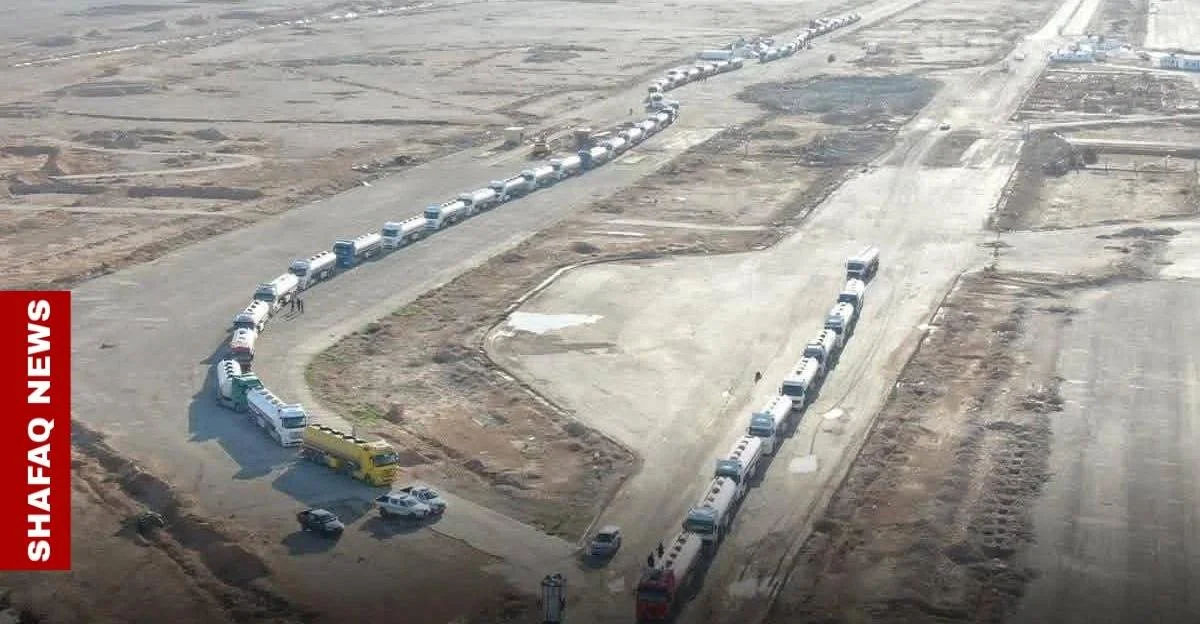
“The move is part of efforts to restore Syria’s role as a regional energy transit corridor and boost transit revenues, with plans to expand the route to include the transport and export of various petroleum products through Syrian ports.”
According to Mujahid Mardhi Al-Dulaimi, the head of Al-Waleed subdistrict in Iraq, more than 150 tanker trucks are waiting to enter Syrian territory, expecting daily crossings to reach around 500 tankers.
Earlier, oil expert and former Oil Ministry spokesperson Asim Jihad told Shafaq News that the shipments involve fuel oil rather than Iraqi crude, noting that “exporting through this method is a temporary necessity with limited volumes.”
https://www.shafaq.com/en/Economy/Nearly-300-Iraqi-fuel-trucks-cross-into-Syria-via-Al-Tanf
Read more: Iraq's energy vulnerability: When a petro-state has no buffer
USD/IQD Exchange Rates Fall In Baghdad And Erbil
2026-04-01 Shafaq News- Baghdad/ Erbil The US dollar closed Wednesday’s trading lower in Iraq, hovering around 154,000 dinars per 100 dollars.
According to Shafaq News market survey, the dollar traded in Baghdad's Al-Kifah and Al-Harithiya exchanges at 154,500 dinars per 100 dollars, down from the morning session’s 154,750 dinars.
In the Iraqi capital, exchange shops sold the dollar at 155,000 dinars and bought it at 154,000 dinars, while in Erbil, selling prices stood at 154,450 dinars and buying prices at 154,250 dinars.
https://www.shafaq.com/en/Economy/USD-IQD-exchange-rates-fall-in-Baghdad-and-Erbil-6
IEA: Middle East War Erases 12M Barrels Daily
2026-04-01 Shafaq News- Paris Major disruptions to Middle East energy infrastructure have already withdrawn more than 12 million barrels per day (bpd) from global oil supply, the International Energy Agency (IEA) reported on Wednesday, as ongoing conflict in the region continues to damage key assets.
The agency estimated that roughly 40 major energy facilities have been hit, describing the scale of the losses as more severe than the combined impact of the 1970s oil shocks and the 2022 reduction in Russian gas exports.
Warning that supply pressures are expected to intensify in April, with losses likely to match the pace seen in March, the IEA indicated it is assessing further use of strategic oil reserves to help offset the shortfall and support stability in global markets.
On March 11, member countries of the IEA agreed to release a record 400 million barrels of oil from strategic reserves to counter a surge in global crude prices following the closure of the Strait of Hormuz.
https://www.shafaq.com/en/Economy/IEA-Middle-East-war-erases-12M-barrels-daily
Iraq Drops To Last Place Among Turkiye Importers In February
2026-04-01 Shafaq News- Baghdad/ Ankara Iraq fell to the bottom of Turkiye’s top importers list in February, with imports dropping to $774 million from $1.009 billion a year earlier, according to Turkish statistical data (TURKSTAT).
Germany ranked first with $1.855 billion, followed by the United Kingdom at $1.245 billion, and the United States at $1.238 billion. Italy came fourth with $1.111 billion, while France and Spain followed with $928 million and $839 million, respectively.
The data showed Turkish exports were largely driven by manufacturing, alongside agriculture, forestry, fishing, and mining sectors, which together accounted for 94% of total exports.
https://www.shafaq.com/en/Economy/Iraq-drops-to-last-place-among-Turkiye-importers-in-February
Everything is Crashing, When will it Bottom?
Everything is Crashing, When will it Bottom?
Heresy Financial:4-1-2026
The current stock market collapse has left many investors feeling lost and uncertain about the future. With the S&P 500 in correction territory, down about 10%, it’s natural to feel a sense of fear and doubt. However, as a seasoned investor, it’s essential to look beyond the noise and focus on the facts.
Missed expectations can be a significant source of doubt and anxiety for investors, even when the fundamentals are sound. As the video highlights, using the biblical parable of the wise and foolish builders, it’s essential to be aware of the expectations that drive market sentiment.
Everything is Crashing, When will it Bottom?
Heresy Financial: 4-1-2026
The current stock market collapse has left many investors feeling lost and uncertain about the future. With the S&P 500 in correction territory, down about 10%, it’s natural to feel a sense of fear and doubt. However, as a seasoned investor, it’s essential to look beyond the noise and focus on the facts.
Missed expectations can be a significant source of doubt and anxiety for investors, even when the fundamentals are sound. As the video highlights, using the biblical parable of the wise and foolish builders, it’s essential to be aware of the expectations that drive market sentiment.
When these expectations aren’t met, it can lead to a sharp reaction. By understanding the expectations that are driving the market, investors can better navigate the inevitable ups and downs.
In times of market volatility, it’s easy to get c----t up in the drama and emotional responses to market fluctuations. However, as the video emphasizes, it’s crucial to focus on objective data rather than getting swayed by tweets, news headlines, or hopeful narratives.
By examining key data points such as hedge fund capitulation, extreme fear indexes, and technical indicators, investors can gain a more nuanced understanding of the market’s trajectory.
Some of the data points highlighted in the video suggest that the current selling pressure may be nearing exhaustion, potentially signaling an upcoming market bottom. For example, the percentage of financial stocks above their 50-day exponential moving average can provide valuable insights into market sentiment.
By staying focused on the data, investors can make more informed decisions and avoid getting caught up in emotional responses to market fluctuations.
The video also underscores the importance of maintaining a long-term perspective, even in the face of significant market downturns. By examining historical market data, including periods known as “lost decades,” investors can gain a deeper understanding of the market’s potential trajectory.
While these periods are rare, they are possible, and the video highlights the importance of strategies like reinvesting dividends and dollar-cost averaging to mitigate losses and lead to gains over time.
The example of the 2000-2013 market is a case in point. Despite a “lost decade” in nominal terms, investors who continued to contribute regularly and reinvest dividends did not suffer a lost decade in practical terms. By maintaining a long-term view and sticking to a disciplined investment strategy, investors can weather volatility and capitalize on buying opportunities.
The video also touches on the resilience of certain sectors, such as energy, which has performed well despite the broader market decline. High short interest in these sectors could fuel a short squeeze, providing opportunities for investors.
Additionally, Treasury yields nearing 5% indicate systemic stress that might prompt emergency Federal Reserve intervention, which historically supports risk assets.
In conclusion, navigating a turbulent market requires a disciplined approach, emotional preparedness, and a deep understanding of the underlying market dynamics. By understanding missed expectations, focusing on data over drama, and maintaining a long-term view, investors can better navigate the inevitable ups and downs of the market.
As the video from Heresy Financial highlights, by staying informed and sticking to a well-thought-out investment strategy, investors can capitalize on buying opportunities and achieve their long-term financial goals.
For further insights and information, we recommend watching the full video from Heresy Financial. By staying informed and maintaining a disciplined approach, investors can navigate even the most turbulent of markets with confidence.
The UNTHINKABLE is Happening to the Petrodollar...Right Now
The UNTHINKABLE is Happening to the Petrodollar...Right Now
Taylor Kenny: 4-1-2026
What if the real crisis isn’t oil—but the end of dollar dominance?
The Strait of Hormuz could be a warning sign for the dollar, your savings, and the future of the global financial system.
The UNTHINKABLE is Happening to the Petrodollar...Right Now
Taylor Kenny: 4-1-2026
What if the real crisis isn’t oil—but the end of dollar dominance?
The Strait of Hormuz could be a warning sign for the dollar, your savings, and the future of the global financial system.
CHAPTERS:
00:00 Strait of Hormuz Threatens the Dollar System
00:29 Why This Is Bigger Than Oil
01:27 Iran’s Yuan Toll Changes Everything
01:56 How the Petrodollar System Really Works
03:16 Is the Dollar System a Ponzi?
04:34 The Debt Doom Loop Is Already Here
05:33 This Shift Started Years Ago
06:01 China’s Petro Yuan and Alternative Oil Settlement
07:13 BRICS, SWIFT Alternatives, and Dollar Weaponization
09:03 The Fiat Currency Endgame
10:00 How to Protect Your Wealth Now
Seeds of Wisdom RV and Economics Updates Wednesday Afternoon 4-1-26
Good Afternoon Dinar Recaps,
Trump Faces Major Legal Barrier to NATO Exit: Congress Holds the Key to U.S. Withdrawal
Efforts to withdraw the United States from NATO face significant legal and constitutional obstacles, highlighting limits on presidential authority in global alliances.
Good Afternoon Dinar Recaps,
Trump Faces Major Legal Barrier to NATO Exit: Congress Holds the Key to U.S. Withdrawal
Efforts to withdraw the United States from NATO face significant legal and constitutional obstacles, highlighting limits on presidential authority in global alliances.
OVERVIEW (KEY POINTS)
Recent reporting confirms that any effort by Donald Trump to withdraw the United States from the North Atlantic Treaty Organization (NATO) would face a major legal hurdle: Congressional approval is required.
This stems from legislation passed with bipartisan support that restricts a president’s ability to unilaterally exit NATO, reinforcing Congress’s role in foreign policy decisions.
The issue is significant not just politically, but structurally—because it highlights limits on executive power at a time when global alliances are under pressure and being reevaluated.
KEY DEVELOPMENTS
1. Law Requires Congressional Approval to Exit NATO
A critical legal barrier is now in place.
U.S. law requires either a two-thirds Senate vote or an act of Congress to withdraw from NATO
This was passed to prevent unilateral presidential withdrawal
This means no president can exit NATO on their own authority
2. Constitutional Conflict: Who Controls Treaties?
The issue raises deeper constitutional questions.
The Senate approves treaties under the Constitution
But the Constitution does not clearly define how treaties are exited
This creates ongoing debate between:
Executive authority (President)
Legislative authority (Congress)
3. NATO’s Strategic Role Under Scrutiny
The debate reflects broader concerns about global alliances.
NATO has been a cornerstone of Western military coordination
Critics argue it imposes financial and strategic burdens on the U.S.
Supporters argue it provides collective security and global influence
4. Growing Political Divide Over Global Commitments
The issue is gaining traction among voters.
Some Americans favor reduced involvement in international alliances
Others believe alliances like NATO are essential for national security
This divide is shaping future policy debates
5. Withdrawal Would Have Major Global Financial Impact
Exiting NATO would not just be a military decision.
It could shift global power balances
Impact defense spending and currency flows
Alter trade, energy security, and geopolitical alliances
WHY IT MATTERS
This development highlights a critical reality:
Even major shifts in global policy cannot happen quickly or unilaterally
The requirement for Congressional approval means:
U.S. global commitments are structurally anchored
Sudden geopolitical realignments are slowed by design
This creates stability—but also friction when policy direction changes.
WHY IT MATTERS TO FOREIGN CURRENCY HOLDERS
Global stability: NATO underpins much of the current Western financial system stability
Currency strength: The U.S. dollar is tied to military and geopolitical influence
Capital flows: Alliance shifts could redirect global investment patterns
Risk perception: Reduced U.S. involvement could increase market volatility
IMPLICATIONS FOR THE GLOBAL RESET
Pillar 1: Sovereignty vs Global Alliances
This issue reflects a broader shift:
Nations are reevaluating global commitments vs national priorities
This tension is central to any global financial restructuring
Pillar 2: Institutional Constraints Slow Systemic Change
Even when political momentum exists, structural barriers remain.
Legal frameworks prevent rapid transformation
Change occurs through layered institutional processes
This suggests the reset is gradual, not sudden
CONCLUSION
The idea of the United States leaving NATO is not just a political question—it is a legal and constitutional challenge.
While there may be growing debate about America’s role in global alliances, the system is designed to ensure that such decisions are deliberate, negotiated, and not made unilaterally.
This reflects a broader truth about the global system:
Even in times of major change, institutional structures shape the pace and direction of transformation.
The future of global alliances—and the financial system tied to them—will not be decided by one leader alone, but through a complex balance of power across institutions.
Seeds of Wisdom Team
Newshounds News™ Exclusive
SOURCES
Reuters — "U.S. law limits president’s ability to withdraw from NATO"
Associated Press — "Congress backs measure requiring approval to exit NATO"
~~~~~~~~~~
Seeds of Wisdom Team RV Currency Facts Youtube and Rumble
Newshound's News Telegram Room Link
RV Facts with Proof Links Link
RV Updates Proof links - Facts Link
Follow the Gold/Silver Rate COMEX
Follow Fast Facts
Seeds of Wisdom Team™Website
Thank you Dinar Recaps
Ariel: A Field Report on Current Matters
Ariel: A Field Report on Current Matters
4-1-2026
A Field Report On Current Matters: This Will Be A Mixed Bag
From years of pattern recognition across naval intelligence signals, central banking backchannels, and deep geopolitical operations, the events aligning for April 1, 2026 represent a deliberate acceleration point in the slow reclamation of sovereign monetary and operational control under Continuity of Government (COG) protocols grounded in the Law of War.
The New Republic framework restoring asset-backed monetary authority, transparent settlement rails, and law-and-order primacy over legacy fiat and proxy networks is not theoretical.
Ariel: A Field Report on Current Matters
4-1-2026
A Field Report On Current Matters: This Will Be A Mixed Bag
From years of pattern recognition across naval intelligence signals, central banking backchannels, and deep geopolitical operations, the events aligning for April 1, 2026 represent a deliberate acceleration point in the slow reclamation of sovereign monetary and operational control under Continuity of Government (COG) protocols grounded in the Law of War.
The New Republic framework restoring asset-backed monetary authority, transparent settlement rails, and law-and-order primacy over legacy fiat and proxy networks is not theoretical.
It is the operational base for every move: Ripple’s full federal banking charter activation via OCC rule changes effective April 1 grants the XRP Ledger direct custody and bridging capabilities at the national level.
This turns XRP into the practical on-ramp for foreign currency exchanges involving Iraqi Dinar, Vietnamese Dong, and even Iranian Rial positions as those nations signal market-opening toward American liquidity channels.
Senator Cynthia Lummis has publicly targeted CLARITY Act markup post-Easter with Senate passage by end of April, providing the legal safe harbor for DeFi developers, validators, and node operators while keeping innovation onshore.
Trump’s public stance that he may not strictly “need” the bill given Ripple’s banking progress underscores the dual-track strategy: regulatory clarity for the broad ecosystem paired with immediate operational rails already live. Does that make sense to you? Because you know what happens tomorrow right?
The silent operation over the past decade has methodically removed or neutralized major assets some through natural attrition, others through legal, financial, or operational means while optics are managed for public absorption.
The April convergence (Ripple bank activation, CLARITY markup push, Iranian corporate threats, Russian energy compression, royal visit theater) is the stage where pawns and mid-tier pieces are cleared to isolate higher-value targets.
The New Republic base restores gold-standard-adjacent sovereign authority, transparent rails via XRP bridging, and uninterrupted executive function via contingency nodes like the East Wing complex.
Legacy networks will attempt fracture bank runs, liquidity seizures, hybrid disruptions precisely because they see the end of their ability to touch or control the flows.
The chess is private where it must be, public where optics demand. Emotions are being gamed on all sides, but the mechanical outcome favors the side that secured king-control pieces first.
April 1 is not the beginning of disorder; it is the visible acceleration of order reasserting itself through new rails while the old guard exhausts its remaining levers.
The harvest from suppressed positions continues. The New Republic framework law, order, asset sovereignty is the operational constant driving every action. Donald Trump has a mission statement and he is bringing us back to glory.
Read Full Article: https://www.patreon.com/posts/field-report-on-154448336
https://dinarchronicles.com/2026/03/31/prolotario-a-field-report-on-current-matters/
News, Rumors and Opinions Wednesday 4-1-2026
Freedom Fighter: Iraqi Dinar, Vietnamese Dong, Chinese Yuan, Venezuelan Bolivar
4-1-2026
Freedom Fighter@FreedomFight12
Iraqi Dinar • Vietnamese Dong • Chinese Yuan • Venezuelan Bolivar
The Strait of Hormuz isn’t just about oil flow — it’s about who controls settlement.
If fuel routes are disrupted and countries are forced to source elsewhere, payment systems begin to shift. That’s where the Chinese yuan enters — already being used in energy trade — and where emerging market currencies like the Iraqi dinar, Vietnamese dong, and Venezuelan bolívar become part of a broader repositioning.
Freedom Fighter: Iraqi Dinar, Vietnamese Dong, Chinese Yuan, Venezuelan Bolivar
4-1-2026
Freedom Fighter@FreedomFight12
Iraqi Dinar • Vietnamese Dong • Chinese Yuan • Venezuelan Bolivar
The Strait of Hormuz isn’t just about oil flow — it’s about who controls settlement.
If fuel routes are disrupted and countries are forced to source elsewhere, payment systems begin to shift. That’s where the Chinese yuan enters — already being used in energy trade — and where emerging market currencies like the Iraqi dinar, Vietnamese dong, and Venezuelan bolívar become part of a broader repositioning.
This is how currency power transitions happen:
Not overnight — but through pressure on trade routes, supply chains, and settlement choices.
This isn’t just geopolitics.
It’s a CURRENCY realignment in motion.
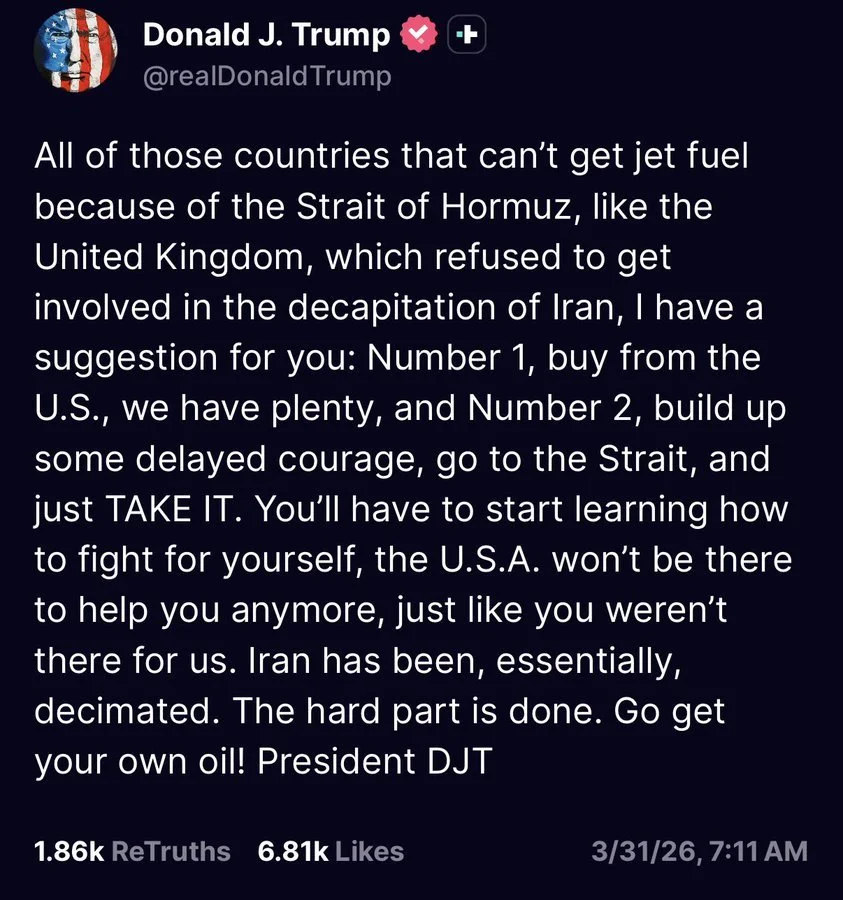
The Kobeissi Letter:PRESIDENT TRUMP: “All of those countries that can’t get jet fuel because of the Strait of Hormuz, like the United Kingdom, which refused to get involved in the decapitation of Iran, I have a suggestion for you: Number 1, buy from the U.S., we have plenty, and Number 2, build up some delayed courage, go to the Strait, and just TAKE IT. You’ll have to start learning how to fight for yourself, the U.S.A. won’t be there to help you anymore, just like you weren’t there for us. Iran has been, essentially, decimated. The hard part is done. Go get your own oil!”
Source(s): • https://x.com/FreedomFight12/status/2038978193063817614
************
Courtesy of Dinar Guru: https://www.dinarguru.com/
Reset Intelligence PMF convoy just confirmed on camera entering Iran through Khorramshahr. Whether they're calling it aid, loyalty, or retreat...The [Iran] militia network is physically leaving Iraqi soil.
Jeff Question: "Are we close?" I think we're reasonably close. We've just got to see what happens with the war..The war is the critical part of this because at the end of the day everything in Iraq has been paused and delayed until the war reaches an end...As long as they can reach some type of agreement or bring the war to an end April will be legendary...
Steve Whenever you hear the HCL law has officially passed...that is huge news. Some people speculate the Iraqi dinar revaluation will happen just before the HCL law is passed. It's kind of like the chicken or the egg argument. Which one is going to go first? They're both very closely correlated.
************
First Phase Of The Economic Plan Is Working,Next Phase Being Prepared,Fed Narrative Trap
X22 Report: 3-31-2026
EU inflation is beginning to spike, it most likely will get a lot worse as times goes on. More and more people are moving out of California, then numbers are worse than originally thought.
The Fed is trying to push the narrative that inflation is going to be terrible, this will backfire. The people are receiving tax refunds over 10%, this is the first part of the plan.
Seeds of Wisdom RV and Economics Updates Wednesday Morning 4-1-26
Good Morning Dinar Recaps,
Ripple and the Banking System: Quiet Moves Toward Federal Integration Signal Structural Financial Shift
While viral claims of a U.S. bank charter are unverified, Ripple’s positioning toward regulated banking pathways reflects a deeper transformation underway.
Good Morning Dinar Recaps,
Ripple and the Banking System: Quiet Moves Toward Federal Integration Signal Structural Financial Shift
While viral claims of a U.S. bank charter are unverified, Ripple’s positioning toward regulated banking pathways reflects a deeper transformation underway.
OVERVIEW (KEY POINTS)
Recent viral reports claiming that Ripple has become a federally chartered U.S. bank are not confirmed by regulators. There has been no official approval from the Office of the Comptroller of the Currency or the Federal Reserve supporting this claim.
However, the underlying narrative is not entirely misplaced. Ripple—and firms like it—have been actively positioning toward deeper integration with the regulated financial system, including exploring or pursuing bank-like licensing pathways and institutional access frameworks.
This signals something far more important than a headline:
The gradual convergence of blockchain infrastructure and the U.S. banking system is already underway.
KEY DEVELOPMENTS
1. No Confirmed Federal Bank Charter or Fed Membership
The core viral claim remains unverified.
No official confirmation that Ripple is a federally chartered bank
No evidence of Federal Reserve membership or direct account access
No April 1, 2026 regulatory event tied specifically to Ripple
This is not a completed transition—it is still in the positioning phase.
2. Ripple Has Explored Banking and Regulatory Pathways
Ripple’s strategy has consistently moved toward regulated finance.
Expansion into custody, payments, and liquidity infrastructure
Alignment with regulated institutions and compliance frameworks
Industry-wide trend of firms seeking:
Bank charters
Trust licenses
Access to central bank systems
This is where the “bank narrative” originates—but it has been misinterpreted as already complete.
3. OCC and Regulatory Frameworks Are Opening the Door
The Office of the Comptroller of the Currency has enabled:
Federally chartered banks to custody digital assets
Integration of crypto services into regulated banking structures
This creates a pathway where:
Banks adopt crypto infrastructure
Or crypto firms move toward bank-like status over time
4. The Strategic Goal: Access to Core Financial Rails
The real objective is not branding—it is infrastructure access.
Federal Reserve systems (payments, settlement, liquidity)
Institutional custody frameworks
Integration into global financial plumbing
Control and access to these systems is far more important than the label “bank.”
5. Market Anticipation Is Running Ahead of Reality
The viral claim reflects growing expectations.
Investors are anticipating a breakthrough moment
In reality, the shift is incremental, regulatory, and controlled
WHY IT MATTERS
This is a transitional phase in the financial system.
The key shift is not whether Ripple becomes a bank—it is that:
Blockchain firms are moving into regulated finance
Banks are adopting blockchain infrastructure
This creates a hybrid system, where distinctions between the two begin to blur.
WHY IT MATTERS TO FOREIGN CURRENCY HOLDERS
Payment systems: Faster, blockchain-based settlement may reshape cross-border currency flows
Currency competition: Digital infrastructure increases global monetary competition
Asset custody: Institutional crypto custody expands how value is stored globally
Liquidity flows: Integration with banking systems could accelerate capital movement worldwide
IMPLICATIONS FOR THE GLOBAL RESET
Pillar 1: Infrastructure Over Identity
The real transformation is not about becoming a “bank”—it is about controlling or accessing financial infrastructure layers.
This includes:
Payment rails
Liquidity networks
Settlement systems
Pillar 2: Gradual Integration Before Full Transition
The system is not flipping overnight.
Instead, it is moving through stages:
Regulatory clarity
Institutional adoption
Infrastructure integration
Eventual system-wide transformation
CONCLUSION
The claim that Ripple is now a U.S. bank is not accurate today—but it points toward a very real directional shift.
Ripple and similar firms are not suddenly becoming banks.
They are strategically positioning themselves inside the regulated financial system, step by step.
The bigger story is not a headline—it is a process:
The merging of blockchain infrastructure with traditional banking is already in motion.
And when that process reaches full scale, it will not look like disruption—
it will look like a completely redesigned financial system operating under new rules.
This is how structural financial change actually happens—quietly, incrementally, and then all at once.
Seeds of Wisdom Team
Newshounds News™ Exclusive
SOURCES
Office of the Comptroller of the Currency — "Banks Can Provide Cryptocurrency Custody Services"
Ripple Insights — "Ripple Expands Global Custody Capabilities"
~~~~~~~~~~
🌱 A Message to Our Currency Holders🌱
If you’ve been holding foreign currency for many years, you were not foolish.
You were not wrong to believe the global financial system would change.
What failed was not your patience — it was the information you were given.
For years, dates, rumors, and personalities replaced facts, structure, and proof. “This week” predictions created cycles of hope and disappointment that were never based on how currencies actually change.
That is not your failure.
Our mission here is different: • No dates • No rates • No hype • No gurus
Instead, we focus on:
• Verifiable developments • Institutional evidence
• Global financial structure • Where countries actually sit in the process
Currency value changes only come after sovereignty, trade, banking, settlement systems, and fiscal coordination are in place. History and institutions confirm this sequence.
You will see silence. You will see denials. That is not delay — that is discipline.
Protect your identity. Organize your documents. Verify everything.
Never hand your discernment to anyone who cannot show proof.
You deserve truth — not timelines.
Seeds of Wisdom Team
Newshounds News
~~~~~~~~~~
Seeds of Wisdom Team RV Currency Facts Youtube and Rumble
Newshound's News Telegram Room Link
RV Facts with Proof Links Link
RV Updates Proof links - Facts Link
Follow the Gold/Silver Rate COMEX
Follow Fast Facts
Seeds of Wisdom Team™ Website
Thank you Dinar Recaps
Iraq Economic News And Points To Ponder Wednesday Morning 4-1-26
The Minister Of Finance Has Directed That The Accounting And Banking Departments Continue Operating To Complete The Payment Of Employee Salaries.
Money and Business Economy News – Baghdad Finance Minister Taif Sami directed on Wednesday that work continue in the accounting and banking departments to complete the payment of employee salaries for the month of March.
The Minister Of Finance Has Directed That The Accounting And Banking Departments Continue Operating To Complete The Payment Of Employee Salaries.
Money and Business Economy News – Baghdad Finance Minister Taif Sami directed on Wednesday that work continue in the accounting and banking departments to complete the payment of employee salaries for the month of March.
Sami told the Iraqi News Agency, as reported by "Economy News," "We have directed the continued operation of the accounting and banking departments to complete the payment of employee salaries for the month of March in the remaining spending units."https://www.economy-news.net/content.php?id=67395
Marvel Technology Shares Jump 11% After Nvidia Acquires A $2 Billion Stake
Money and Business Shares in Marvel Technology jumped more than 11% after Nvidia announced plans to invest $2 billion in the semiconductor company, amid a race among companies to meet the growing demand for artificial intelligence technologies.
The agreement allows Marvel Technology to be integrated into Nvidia's AI ecosystem, making it easier for customers to develop their infrastructure. The two companies will also collaborate on developing silicon photonics technology.
“It’s time for a shift in inference,” said Nvidia CEO Jensen Huang in the statement. “The demand for token generation is mounting, and the world is racing to build AI factories. With Marvel Technology, we are enabling customers to leverage Nvidia’s AI architecture ecosystem and scale to build specialized AI computing.”
In recent months, Nvidia has made a series of $2 billion investments in technology companies, including Synopsys, CoreWave, Coherent, and Lumentum. Most recently, Nvidia invested $2 billion in Nebius Group, where the AI cloud computing company unveiled plans on Tuesday to build one of the largest data centers in Europe.
The leading chipmaker has been one of the biggest beneficiaries of the artificial intelligence boom that has swept Wall Street in recent years, thanks to its graphics processing units (GPUs) that support large language models.
Marvel Technology is another major winner in the race, with its shares surging this month after the company issued strong forecasts and called for accelerated revenue growth through 2027 as demand for artificial intelligence increases.
Marvel Technology CEO Matt Murphy said, "Our expanded partnership with Nvidia reflects the growing importance of high-speed connectivity, optical connectivity, and accelerated infrastructure in scaling AI."https://www.economy-news.net/content.php?id=67374
Syria Is Preparing To Open Its Second Border Crossing With Iraq.
Money and BusinessEconomy News - Baghdad Officials from the Syrian General Authority for Ports and Customs conducted an inspection tour of the Al-Yarubiyah border crossing with Iraq in Al-Hasakah Governorate, as part of monitoring the rehabilitation work and raising operational readiness in preparation for its reopening.
Khaled Al-Barad, the assistant head of the authority, accompanied by a delegation of directors of the central directorates, conducted a field tour to see the reality of the work being carried out at the port, and to follow up on the implementation of maintenance and equipment plans.
The Syrian General Authority for Ports and Customs stated on its Facebook page that the tour included reviewing the infrastructure maintenance work being carried out by the Directorate of Facilities and Maintenance, which includes rehabilitating service facilities and improving the readiness of squares, internal roads, passenger halls and customs, in addition to raising the efficiency of technical and logistical equipment to ensure that crossing traffic is accommodated in an organized and safe manner.
The authority explained that the rehabilitation and maintenance work is expected to be completed during the coming period, with the opening of the crossing scheduled for the beginning of next May, in a step aimed at supporting trade and strengthening economic ties, in addition to facilitating the movement of citizens through this vital crossing with Iraq.
She emphasized that these efforts are part of a plan to rehabilitate border crossings and raise their operational efficiency, in line with the requirements of the current stage and to enhance the readiness of the infrastructure to serve transit traffic.https://www.economy-news.net/content.php?id=67364
60 Oil Tankers Crossed Through The Al-Walid Border Crossing And Headed To Revive The Haditha-Aqaba Pipeline.
Money and Business Economy News – Baghdad Anbar Provincial Council member Adnan al-Kubaisi announced on Tuesday that more than 60 trucks loaded with Iraqi oil have begun crossing through the al-Walid border crossing, expecting the number of trucks transporting oil to rise to between 600 and 700 in the coming period.
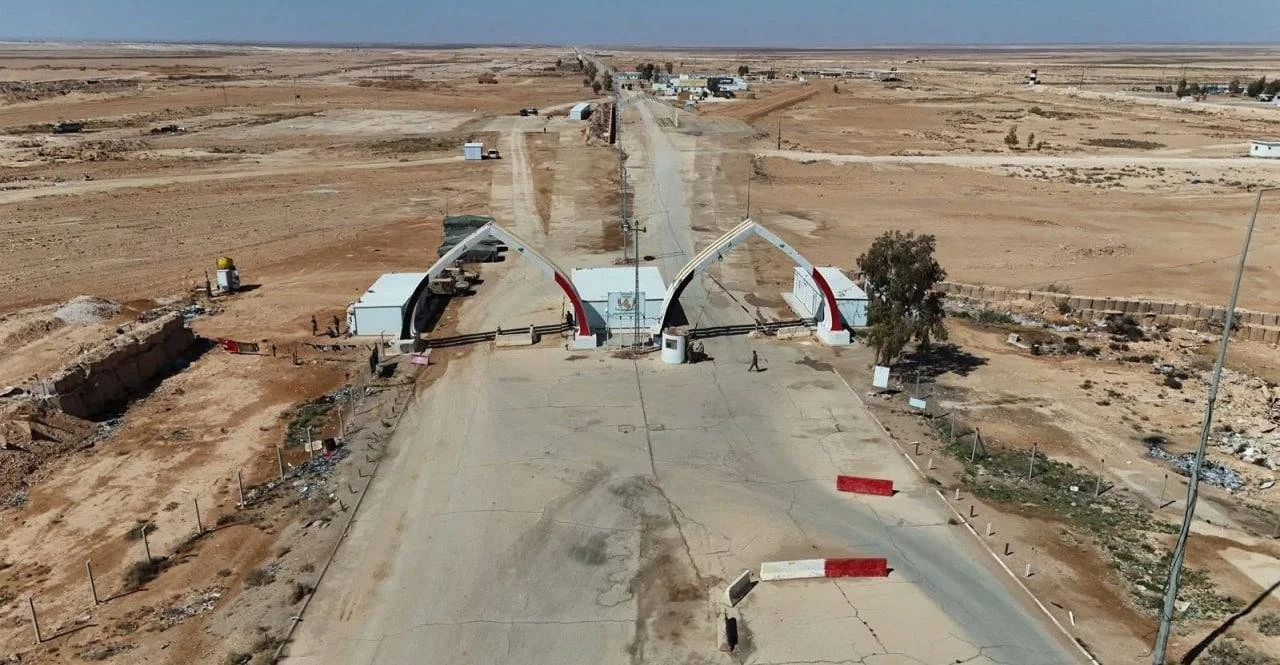
Al-Kubaisi said, "There is a trend to resume the mechanism of exporting oil through the Syrian and Jordanian ports in quantities that may exceed 200,000 barrels per day, as was the practice before 2003 using tankers."
He added that "the next stage may witness parliamentary action to compel the government to implement the modern Aqaba pipeline project, given its strategic importance in diversifying oil export outlets."
Al-Kubaisi pointed out that "the project was previously approved but faced objections, but there is currently pressure to reactivate it and proceed with its completion, given the economic benefits it provides, as well as its positive impact on Anbar Governorate, especially with regard to the petrodollar file." https://www.economy-news.net/content.php?id=67362
Qatar Central Bank Issues Government Bonds Worth 3 Billion Riyals With A Return Of 4.5% Annually
Banks The Qatar Central Bank issued government bonds worth 3 billion riyals for terms of 5 and 3 years.
The new issuance was distributed in two tranches, with a value of 1.5 billion riyals for each issuance, and a return rate of 4.5%.
According to a statement from the Central Bank, the first issue is due on August 24, 2030, while the second issue is due on January 16, 2029.
It is noted that the outstanding balance of government bonds in Qatar amounted to 61.98 billion riyals at the end of March 2026, representing 47% of the total value of public debt instruments amounting to 131.5 billion Qatari riyals. https://www.economy-news.net/content.php?id=67383
The Dollar Index And The Upward Trap Amid The Growing Shock Of Regional War
Dr. Haitham Hamid Mutlaq Al-Mansour Economy News – Baghdad Recent warnings from Morgan Stanley indicate the possibility of the dollar falling into an upward trap during the current regional war, pointing to a clear contradiction in the behavior of financial markets.
The US dollar may rise strongly in crises, but this rise may not necessarily reflect sustainable economic strength, but rather a short-term response to a geopolitical shock whose effects will soon be reversed.
At the outset of crises, investors globally flock to the dollar as a safe haven, a highly liquid asset, and the world's reserve currency. This explains why the US dollar accounts for approximately 58-60% of global central bank reserves and is used in roughly 80% of international trade.
This sudden surge in demand drives the dollar index (DXY) upward, often resulting in gains of 3% to 7% during the initial weeks of major geopolitical shocks.
As the war escalates and oil prices soar—sometimes jumping 15% to 25%—the demand for the dollar, driven by energy demand, intensifies, further bolstering its short-term gains.
Conversely, the euro faces significant pressure, as the Eurozone imports over 60% of its energy needs. Consequently, rising oil and gas prices increase the import bill and strain the trade balance, typically leading to a 2% to 5% decline in the euro in the short term during energy crises.
This disparity widens the temporary gap between the two currencies and creates the impression that the dollar is entering a strong upward trend.
However, according to Morgan Stanley, this rally could be misleading. As the global oil price shock continues, markets are rapidly correcting the inflationary impact of rising energy costs.
With the general price level rising as a reflection of this shock, economic entities anticipate interest rate hikes and continued tight monetary policy, which quickly supports the dollar. At this point, markets will focus on the immediate effect of inflation.
But the more profound impact of slowing economic growth is quickly underestimated. Economic modeling suggests that every 10% increase in oil prices can shave roughly 0.2% to 0.4% off global growth over a year.
If prices remain above $100 a barrel, growth in the Eurozone could fall below 1%, with increasing recession expectations, which would then impact the US economy, slowing it from around 2% to 1% or less.
Herein lies the paradox. The strong dollar, which surged in response to the shock of war, is gradually becoming a source of internal pressure on the US economy. A 5% to 10% appreciation of the dollar leads to a 3% to 5% decline in the profits of multinational corporations due to the exchange rate effect, and it also weakens the competitiveness of exports.
As signs of a slowdown increase, the US Federal Reserve may be forced to adjust its course, either by halting interest rate hikes or even lowering them, which would hinder one of the most important monetary policy tools used to support the dollar.
Historically, data shows that the dollar tends to rise at the start of crises and then lose momentum. In past crises, such as the oil shock or major geopolitical tensions, the dollar made initial gains but subsequently declined by 4% to 8% over three to six months as market focus shifted from fear to economic fundamentals.
Accordingly, the "upside trap" occurs when investors enter at high levels, driven by the momentum of the crisis, while the true supporting factors have already peaked. As attention shifts from inflation to growth, and from the shock to the fallout, investment moves in the opposite direction, signaling the onset of a slowdown and recession.
At present, the dollar appears outwardly stable, supported by three pillars: demand for it as a safe haven, a liquid asset, and a global reserve currency; high energy prices; and the Federal Reserve's continued relatively hawkish stance. However, these same pillars contain elements of their own erosion.
The longer the war continues and the higher oil prices rise, the greater the pressure on global economic growth will become, and markets willgradually begin to reprice away from the crisis and toward fundamentals.
Therefore, if oil prices remain above $100 and growth indicators gradually begin to emerge, the probability of a dollar decline rises to between 60% and 75% within a period of 3 to 6 months. In this scenario, the dollar typically falls by 4% to 8% from its peak.
Domestically, a 5% rise in the dollar leads to a 3% to 5% decrease in US corporate profits, a 2% to 4% drop in exports, and a reduction of approximately 0.2% to 0.4% in overall GDP growth due to increased costs.
If the dollar rises by 10%, these effects nearly double, and the relationship becomes non-linear and reversible, pushing the economy toward recession and prompting the Federal Reserve to ease monetary policy.
In short, the dollar's rise during this war may shift from strength to weakness, as it is driven by temporary precautionary demand rather than a fundamental improvement in economic activity.
If signs of a global slowdown stabilize, this rise could transform from a source of strength into a point of decline, thus reshaping the relationship between the dollar, the euro, and global markets in the post-shock era.
“News Tidbits From TNT” Wed. Morning 4-1-2026
TNT:
Tishwash: A delegation from the Kurdistan Democratic Party arrives in Baghdad
An informed source reported today, Tuesday (March 31, 2026), that a delegation from the Kurdistan Democratic Party has arrived in Baghdad.
The source told Baghdad Today that "a delegation from the Kurdistan Democratic Party arrived in the capital, Baghdad, to discuss the missile and drone attacks targeting the Kurdistan Region, in addition to a number of political issues related to the internal Iraqi situation."
TNT:
Tishwash: A delegation from the Kurdistan Democratic Party arrives in Baghdad
An informed source reported today, Tuesday (March 31, 2026), that a delegation from the Kurdistan Democratic Party has arrived in Baghdad.
The source told Baghdad Today that "a delegation from the Kurdistan Democratic Party arrived in the capital, Baghdad, to discuss the missile and drone attacks targeting the Kurdistan Region, in addition to a number of political issues related to the internal Iraqi situation."
The source indicated that "the delegation includes Fadel Mirani, head of the working body in the political office, Fawzi Hariri, head of the office of the presidency of the region, Nawzad Hadi, member of the central committee, and Omid Sabah, member of the central committee."
He added, "The delegation is scheduled to hold a series of meetings with Iraqi political forces to discuss the issue of missile and drone attacks that targeted areas in the region during the past weeks, in addition to the issue of forming the new Iraqi government, and the dialogues related to electing a new president for the Republic of Iraq during the next stage."
The delegation's visit comes amid continued regional tensions resulting from the war between Iran on one side, and the United States and Israel on the other, and the accompanying repeated targeting in Kurdistan. The visit also coincides with broad internal political activity to resolve the requirements for forming the government and agreeing on a candidate for the position of President of the Republic. link
************
Tishwash: MP: The session to elect the president is not yet decided, and postponement is possible.
Former MP, Arif Al-Hamami, confirmed on Tuesday that the session scheduled for April 11 to elect the President of the Republic has not yet been decided, noting that setting the date came as a result of initial understandings that have not reached the stage of final confirmation.
Al-Hamami told Al-Maalouma that “the Iraqi parliament’s setting of a session on April 11 to elect the president is still not decided among the political forces, and it cannot be confirmed that it will be held at this time,” indicating that “postponing the date remains very possible in light of the lack of mature agreements.”
He added that “Iraq is going through a difficult phase and multifaceted challenges, which requires a clear political decision to complete the formation of the government, starting with the election of the President of the Republic, up to the assignment of the candidate of the largest bloc, in order to proceed with managing the current crises, especially the financial and economic files.”
Al-Hamami indicated that “next week will witness a series of important meetings in Baghdad between various political forces,” noting that “these meetings may lead to outcomes that push towards greater consensus regarding the April 11th session, including the forces of the Coordination Framework, in preparation for electing the President of the Republic and tasking the candidate of the largest bloc.” link
************
Tishwash: The oil speculation market and the Iraq crisis
The equation for determining the equilibrium price of crude oil globally is burdened with variables. Economic growth and its role in stimulating demand on one hand, and production levels and their role in the size of supply on the other hand, lead to determining the equilibrium price.
These are data that represent (internal) variables in the function. In addition, there is another set of variables that affect the determination of that price level, including wars, political events, supply chains, in addition to expectations related to major economies, alternative energy sources, weather seasons, and others, all of which are considered (external) variables in the function.
What concerns us here is that variable that operates silently and in the shadows, which is the oil speculation market. What is this market? How does it work? What is its size? And the important question is, can Iraq invest in it during its current crisis?
It is a financial market where securities, such as oil futures contracts, are traded. These contracts are speculated upon to generate financial returns by investing in fluctuations in global oil prices.
This market includes various types of investors, such as hedge funds, banks, and other financial institutions. The New York, London, and Shanghai stock exchanges are among the most important of these markets.
What is striking about this market is the volume of trades taking place in it. In contrast to the actual daily oil production, which is estimated at about (100) million barrels, the value of contracts traded in the market is between (10 - 30) times, i.e., from one billion to three billion barrels.
This reflects the high levels of financial returns achieved by this trading and the extent of its impact on the course of the oil market in general, and thus its role in determining the equilibrium price of crude oil globally.
Like other variables that make up the oil structure in Iraq, and given the absence of a specialized oil financial center in Iraq and the nature of the oil policy of SOMO and behind it the Iraqi Ministry of Oil, which focuses on selling only real oil without a financial trading aspect, this means that Iraq does not achieve a presence in this market.
Iraq’s oil does not enter those markets in the form of contracts with different maturities that are subject to speculation, but rather it is sold through direct contracts, and this is a deficiency in the general structure of Iraqi oil policy.
The events taking place in the region, especially the decision to close the Strait of Hormuz, which is considered the oil lifeline for Iraq since we export the majority of our oil through it, have put Iraq in a very critical phase that may lead to a financial crisis in light of the disruption of oil exports.
Therefore, it is necessary to pay attention to the characteristics of this financial market and to urge those concerned in the Iraqi Ministry of Oil to find ways to communicate with these markets and offer futures contracts at competitive prices as much as possible to find a financial resource that addresses the current problem of the cessation of most oil exports.
There should be a lesson learned from what is happening now, and we should adopt future policies that work to create an active role for Iraq in the oil financial speculation market. link
************
Tishwash: A Chinese-Pakistani initiative to de-escalate tensions in the Middle East: an immediate ceasefire, securing the Strait of Hormuz, and a comprehensive peace process.
China and Pakistan announced a joint initiative aimed at restoring peace and stability in the Gulf region and the Middle East, following official talks held Tuesday in Beijing between Chinese Foreign Minister Wang Yi and his Pakistani counterpart, Muhammad Ishaq Dar.
The two sides exchanged views on the rapidly evolving situation in the region, amid escalating regional tensions. They agreed to propose a five-point initiative based on a set of practical steps to contain the crisis and prevent its further escalation.
The initiative includes a call for an immediate cessation of hostilities, emphasizing the need for a comprehensive ceasefire and urgent action to prevent the conflict from spreading. It also calls for facilitating the unimpeded delivery of humanitarian aid to affected areas.
Furthermore, the initiative stresses the importance of launching peace negotiations as soon as possible, emphasizing respect for the sovereignty and territorial integrity of states, particularly Iran and the Gulf states, and affirming that dialogue and diplomacy are the only viable means of resolving disputes.
The initiative urges all parties to commit to resolving their differences peacefully and to refrain from the use of force or the threat of force during the negotiation process.
On another front, China and Pakistan emphasized the need to protect civilians and non-military targets, stressing adherence to international humanitarian law and the cessation of attacks on vital infrastructure, including energy, water, and electricity facilities, as well as peaceful nuclear facilities.
The initiative also focused on the importance of securing waterways, particularly the Strait of Hormuz, a vital artery for global trade and energy supplies, calling for ensuring the safety of ships and their crews and restoring the smooth flow of maritime navigation as quickly as possible.
The initiative reaffirmed the primacy of the UN Charter and the necessity of strengthening multilateralism and supporting the UN's role in reaching a comprehensive peace framework that guarantees lasting stability in the region, in accordance with the principles of international law. link
Seeds of Wisdom RV and Economics Updates Tuesday Evening 3-31-26
Good Evening Dinar Recaps,
Debt Growth Outpaces Economy: Powell Warns U.S. Fiscal Path “Will Not End Well”
Federal Reserve Chair signals rising concern as national debt accelerates beyond economic growth, creating long-term systemic risk.
Good Evening Dinar Recaps,
Debt Growth Outpaces Economy: Powell Warns U.S. Fiscal Path “Will Not End Well”
Federal Reserve Chair signals rising concern as national debt accelerates beyond economic growth, creating long-term systemic risk.
OVERVIEW (KEY POINTS)
In remarks delivered this week, Jerome Powell issued a clear and unusually direct warning about the direction of U.S. fiscal policy. While he emphasized that the current debt level is not an immediate crisis, he stressed that the trajectory is unsustainable and increasingly dangerous.
The United States national debt has now reached approximately $39 trillion, continuing a rapid upward trend.
Powell’s central concern is not simply how large the debt is today—but that it is growing “substantially faster” than the overall economy, creating a widening imbalance that cannot be maintained long-term.
His warning was blunt:
👉 “The level of the debt is not unsustainable, but the path is not sustainable… it will not end well.”
This signals a critical shift in tone from the Federal Reserve—highlighting structural fiscal risk rather than short-term crisis.
KEY DEVELOPMENTS
1. Debt Nears $39 Trillion and Rising Rapidly
The scale of U.S. borrowing continues to accelerate.
National debt has climbed to roughly $39 trillion
Debt levels have increased sharply in recent years due to deficits, stimulus, and war-related spending
2. Core Warning: Debt Growing Faster Than the Economy
Powell’s primary concern is the imbalance between debt and growth.
Debt is expanding “substantially faster” than GDP
This creates a structural divergence that compounds over time
👉 This is the key issue—not just how much debt exists, but how fast it is growing relative to income (GDP).
3. Interest Costs Becoming a Major Risk Factor
As debt rises, so does the cost to service it.
Interest payments are projected to exceed $1 trillion annually
This becomes one of the fastest-growing parts of the federal budget
4. Powell Calls for Policy Action “Fairly Soon”
The warning includes urgency—but not panic.
Powell emphasized the need for policy adjustments before crisis conditions emerge
Focus is on stabilizing the path, not immediate debt reduction
5. Not a Crisis—Yet, But a Structural Imbalance
Powell made a clear distinction:
Current debt level = manageable (for now)
Future trajectory = unsustainable without change
WHY IT MATTERS
This is one of the most important financial signals coming from a central bank leader right now.
When debt grows faster than the economy:
The system must borrow increasingly just to sustain itself
Interest costs compound faster than income
Fiscal flexibility shrinks over time
Eventually, this forces difficult choices:
Higher taxes
Reduced spending
Monetization (money creation)
Or financial system restructuring
This is why Powell’s warning is significant—it highlights a mathematical imbalance, not a political opinion.
WHY IT MATTERS TO FOREIGN CURRENCY HOLDERS
Currency stability: Rising debt pressures confidence in long-term dollar strength
Inflation risk: Debt expansion increases likelihood of monetary expansion
Interest rates: Higher debt → higher yields needed to attract buyers
Global flows: Investors may begin diversifying away from debt-heavy systems
IMPLICATIONS FOR THE GLOBAL RESET
Pillar 1: Debt Sustainability Crisis Building Beneath the Surface
The issue is no longer the size of debt—but its growth dynamics.
This signals a slow-moving shift toward debt restructuring, monetization, or systemic change.
Pillar 2: Transition from Growth-Driven to Debt-Driven System
When debt outpaces economic growth, the system becomes increasingly:
Dependent on borrowing
Sensitive to interest rates
Vulnerable to shocks
This is a hallmark of late-stage financial cycles and often precedes major monetary transitions.
CONCLUSION
Powell’s message was not alarmist—but it was deeply consequential.
The United States is not facing an immediate debt crisis—but it is moving along a path that becomes harder to correct over time.
The real risk is not today’s $39 trillion debt level—it is the trajectory where debt continues to outgrow the economy year after year.
That imbalance quietly builds until it forces policy change, market repricing, or systemic reset.
This is not a sudden collapse scenario—it is a slow structural shift that eventually demands a new financial framework.
Seeds of Wisdom Team
Newshounds News™ Exclusive
SOURCES
Yahoo Finance — "Jerome Powell says $39 trillion national debt path ‘will not end well’"
Moneycontrol — "Fed Chair warns U.S. debt growing faster than economy"
~~~~~~~~~~
Seeds of Wisdom Team RV Currency Facts Youtube and Rumble
Newshound's News Telegram Room Link
RV Facts with Proof Links Link
RV Updates Proof links - Facts Link
Follow the Gold/Silver Rate COMEX
Follow Fast Facts
Seeds of Wisdom Team™ Website
Thank you Dinar Recaps