The Luddites Were Wrong In 1811 The AI Doomsayers Will Be Wrong Today
The Luddites Were Wrong In 1811. The AI Doomsayers Will Be Wrong Today
Notes From the Field By James Hickman (Simon Black) Sovereign Man February 24, 2026
In 1779, in a textile workshop in the English village of Anstey, a young apprentice named Ned Ludd was put to work on a knitting machine — one of the large mechanical frames that wove thread into stockings. He was too slow. His master had him whipped for it.
So Ned grabbed a hammer and smashed the machine to pieces.
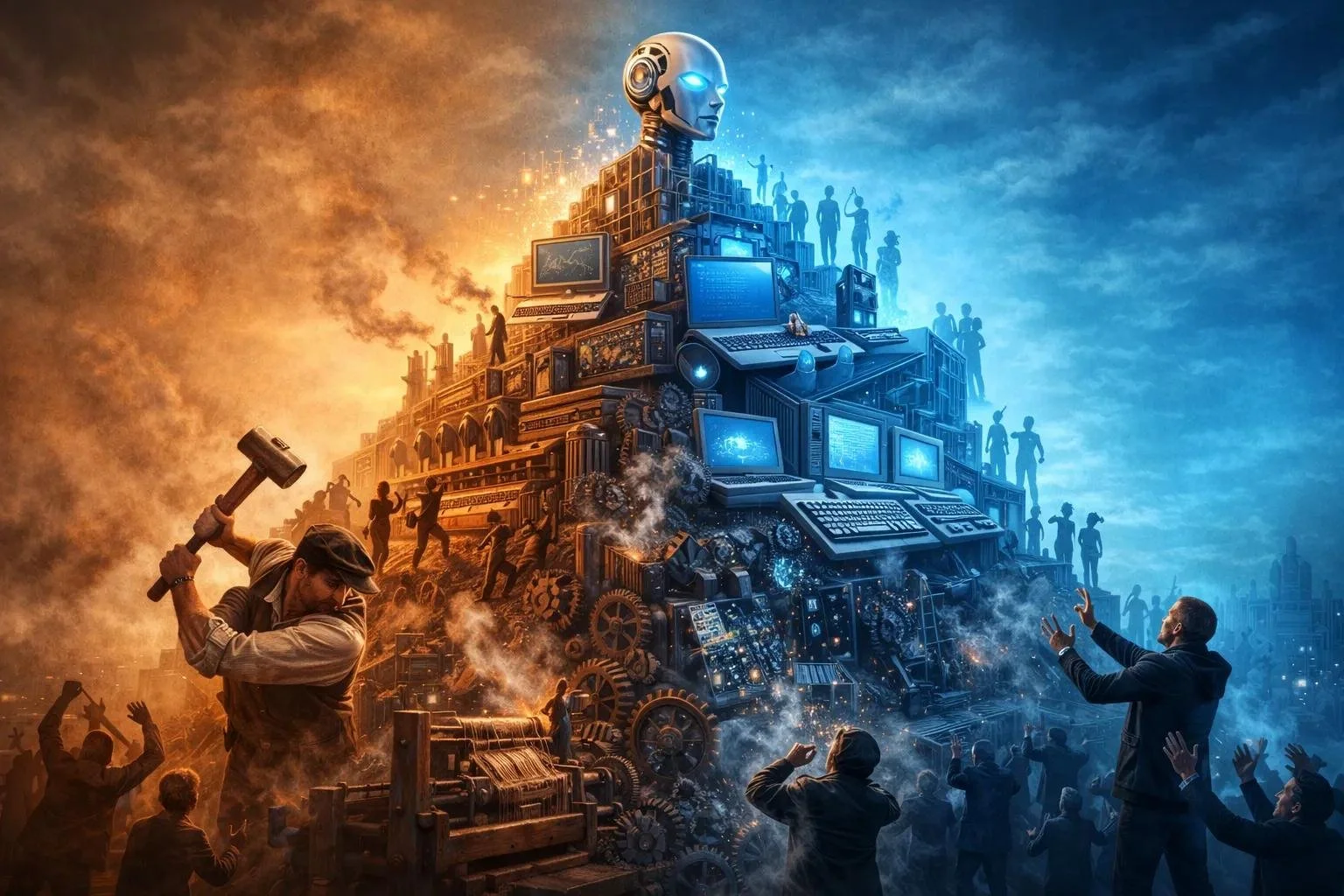
The story spread across England’s textile country. Over the next thirty years, Ned Ludd became a folk hero for every worker who felt threatened by the new machines that were pouring into their factories.
Now, the story is probably a myth — there’s no hard evidence Ned Ludd ever actually existed. But it didn’t matter. The movement that took his name was very real.
In March 1811, textile workers across England’s industrial heartland began breaking into factories at night, smashing power looms with sledgehammers. They called themselves Luddites. Over 200 machines were destroyed in the first month alone.
It was all motivated by fear; workers were terrified that machines would take their jobs and steal their livelihoods.
But think about the world back then: in the early 1800s when the Luddites were smashing looms, roughly 90% of the world’s population lived in what today would be considered extreme poverty.
Life expectancy in England was only about 35. One in three children didn’t make it to their fifth birthday. Houses were tiny. Food was scarce. Clean drinking water was a luxury. Heating your home meant an open fire, and most of the warmth went up the chimney. Indoor plumbing didn’t exist. Neither did antibiotics, electricity, or refrigeration.
That was normal life in 1811. But fast forward just over two hundred years.
Extreme global poverty has fallen from 90% to under 10%. Life expectancy has more than doubled. The poorest American today — not the wealthy, the average person — has access to more information, nutrition, comfort, and opportunity than the richest king on earth could have imagined in 1811.
Our homes are bigger. Our food is more plentiful. Our energy supplies are more abundant… and far more efficient.
And the reason is technology.
Every major leap in human prosperity has followed the same basic mechanism: new technology makes people more productive. More productivity increases supply of goods and services. More supply means lower prices. Lower prices mean more prosperity for everyone.
At the same time, there is always some short-term pain. Entire vocations and industries disappear… and that sudden change can be both difficult and scary.
But think about it— in literally EVERY major technological advancement throughout history, overall employment went UP. Economies prospered. Workers prospered.
That’s the great fear sweeping the world right now regarding artificial intelligence, and a lot of people are worried.
Earlier this month, for example, a viral essay by an AI startup CEO tore across the Internet and was viewed more than 80 million times.
His thesis: AI will have a COVID-level impact on the world, and the industry right now is the equivalent of being back in January 2020. Everything feels normal at the moment. But he believes that life will be unrecognizable (just like during Covid) in just a few months.
But while Covid was temporary, he believes the AI impact will be permanent.
Amazingly enough, due to this one viral essay, investors began dumping their stocks, triggering a major selloff.
Cybersecurity stock CrowdStrike, for example, dropped roughly 16% in days. Travel companies like TripAdvisor are down nearly 30%.
Financial firms like Charles Schwab and Raymond James fell 7% to 9% in a single session. Software giants like Salesforce and ServiceNow have shed a quarter to a third of their value.
All told, roughly $2 trillion in market value has been wiped off software stocks alone.
The logic behind the selloff is: if AI can scan code for security vulnerabilities, why do you need CrowdStrike? If an AI agent can plan your entire trip, book flights, and find the best hotel, why do you need TripAdvisor? If a chatbot can manage a portfolio or draft a financial plan, why are you paying Raymond James?
Investors looked at these industries and decided that AI wasn’t just going to help these companies — it was going to replace them. And they sold.
It’s amazing how overblown this is.
People said the same things about the Industrial Revolution — that machines would make human labor obsolete and destroy the working class.
They said it about personal computers in the 1980s — that automation would wipe out office jobs.
They said it about the Internet in the late 1990s — that e-commerce would obliterate entire sectors of the economy.
Every single time, the prophets of technological doom were wrong.
The reality is that, of course, some industries and vocations go away. But advances in technology have never led to sustained, long-term, widespread unemployment.
New industries emerge. New skills become valuable. The economy adapts. And the overall standard of living goes up.
But all along the way, there are always the self-interested evangelists insisting that THIS time is different. THIS technology is uniquely disruptive.
Yes, AI is obviously a massive advancement. It’s going to reshape industries. And plenty of businesses that exist today won’t survive the transition. That’s the nature of progress.
But the idea that we’re all going to be starving in the streets because a chatbot can draft a legal brief or scan code for security bugs is ludicrous.
Technology always makes people more prosperous and better off. It might not be crystal clear right now exactly how that plays out with AI. Early stages of a technology boom are never clear.
But the notion that one person’s viral essay could wipe trillions from global financial markets is peak paranoia.
The Luddites were wrong in 1811. The AI doomsayers will be wrong today.
To your freedom, James Hickman Co-Founder, Schiff Sovereign LLC
P.S. Technology has never destroyed prosperity. But reckless governments have — over and over again, for thousands of years.
The US national debt is over $38 trillion. Annual deficits are running at nearly $2 trillion. And neither party has any intention of doing anything about it.
Every month in Schiff Sovereign Premium, we dig into exactly where this is heading — the debt, the dollar, the historical parallels — and how to position yourself to benefit from what comes next.