The Canary In The Coal Mine In The Treasury’s God-Awful Annual Report
The Canary In The Coal Mine In The Treasury’s God-Awful Annual Report
Notes From the Field By James Hickman (Simon Black) March 25, 2026
A few days ago, the United States Treasury Department quietly published the “Financial Report of the United States Government for fiscal year 2025”. No press conference. No prime-time coverage. Just a PDF uploaded to a government website. It is, arguably, the most important financial document published in the country each year— the government's own accounting of what it owns versus what it owes.
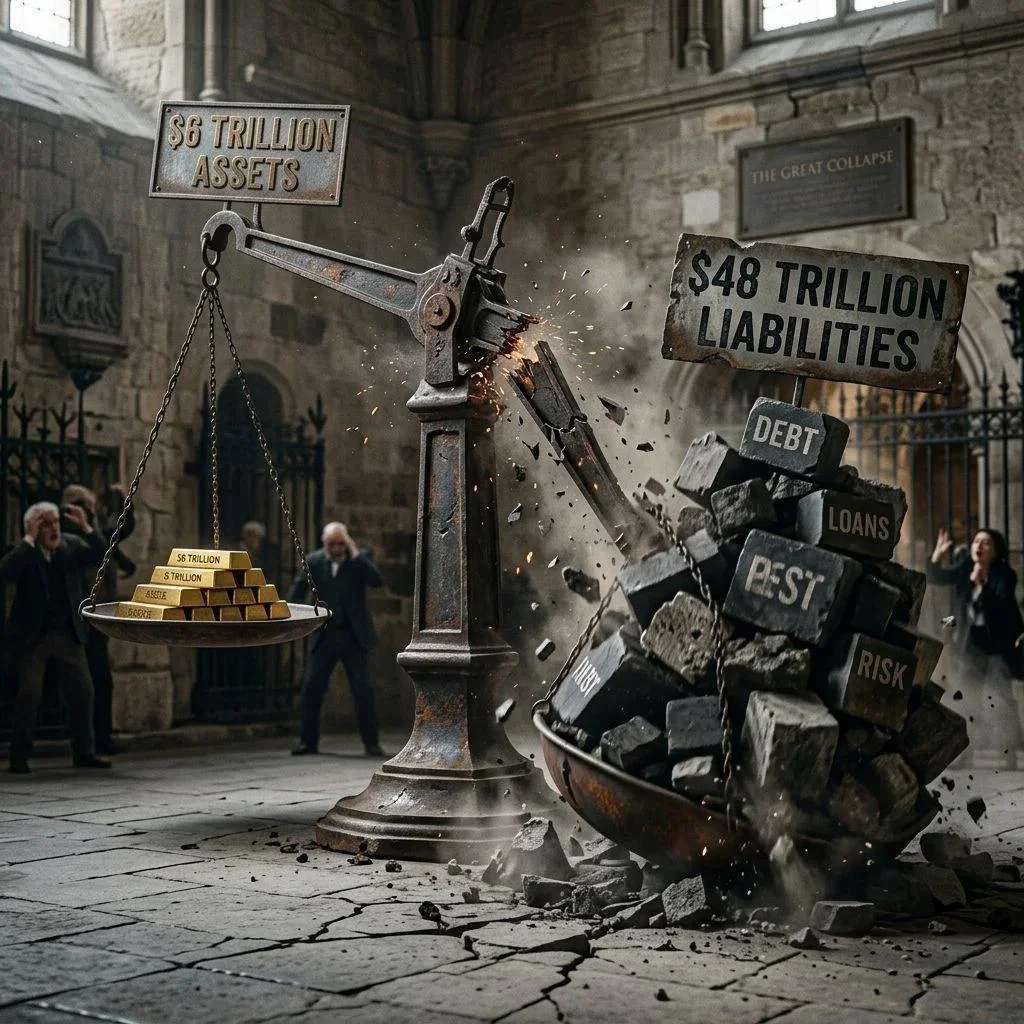
And the numbers are devastating.
The bottom line is that the government is reporting assets of $6 trillion, versus liabilities of nearly $48 trillion.
That gives it a “net worth” of NEGATIVE $42 trillion, which is the worst financial position on record.
Now, in fairness— and I've pointed this out before— governmental accounting is not always grounded in the real world.
The report, for example, places no value on the potential trillions (if not tens of trillions) of dollars' worth of natural resources in the ground. And it assigns relatively little value to other hard assets like real estate.
But there's no sugar-coating it. The fiscal situation is absolutely atrocious, and it gets worse every year.
The good news may be that the people in charge at least seem to understand this; Treasury Secretary Bessent acknowledges in his introduction that the situation is bad and that it needs to be improved quickly.
He writes, "Getting our fiscal house in order is not only an economic imperative, it is also essential to preserving the strength and credibility of the United States at home and abroad."
And he discusses how they'd like to do it — through "reining in government spending and growing the economy," through deregulation, as well as "energy abundance."
Hallelujah. That is the exact formula to fix this looming fiscal crisis.
For the Treasury Secretary to even admit this is borderline unprecedented.
I've read through the Treasury Secretary's introduction to these annual financial reports going back a couple of decades.
In 2002, for example, Secretary John Snow (who clearly knows nothing) wrote a very bland intro letter about accounting rules, with no acknowledgment of mounting military spending or the recession.
By 2007, Secretary Hank Paulson was beaming about how great the economy was, with no mention unsustainable discretionary spending— and this was only months before the entire financial system nearly collapsed.
In 2014, Secretary Jack Lew bragged about a slight decline in the budget deficit, even as the national debt was spiraling out of control.
And by 2023, Janet Yellen took a victory lap about how white-hot her economy was, completely ignoring the skyrocketing national debt and inflation fueled by COVID-era deficit spending.
This current report is the first time I've seen a Treasury Secretary seriously acknowledge the problem.
The obvious question then, is, having correctly identified both the problem and the solution, are they actually going to be able to execute?
I certainly hope so. Unfortunately many of the things he mentions, like tax reform, regulatory reform, and spending discipline, fall exclusively under the authority of Congress. And the majority of those 435 people are unserious about spending cuts.
There are a few things that the administration can execute on its own. Energy policy is one of them, and as we've said before, they have done quite a bit to boost nuclear energy.
Obviously a lot is riding on what happens with Iran when it comes to oil. A peace deal could potentially drive more foreign investment into US Treasuries, which would result in lower interest rates and lower inflation— and buy America time to restore its fiscal responsibility.
But it could also go the other way and drastically erode confidence in the United States.
So we're really at a tipping point right now.
If Iran ends poorly, we could likely see foreign countries avoiding US Treasuries— putting more pressure on the Federal Reserve to ‘print’ money to finance the deficit. That would end up generating a lot more inflation.
The bigger problem is that Social Security is set to run out of money in six years. So, if Iran ends poorly and there’s no serious fiscal reform, I think that 6-year window is when the US would see major economic consequences.
One canary in the coal mine is rising interest rates. Right in front of our eyes, the 10-year and 30-year Treasury yields have been rising to near their highest levels in twenty years.
This is the opposite of what's supposed to happen.
In the past, during times of crisis (including war), the world rushed into US Treasury bonds as the “risk free” asset. And yields plummeted due to the surge in demand.
Now it’s the opposite. Since the war began a few weeks ago, the 10-year yield has gone from 3.97% to 4.39%. Yields are up, not down. That’s the opposite of what normally happens in a crisis.
The jury is still out, and I sincerely hope they’re able to conclude a great deal.
But if confidence continues to erode and yields keep rising, the Federal Reserve will be under enormous pressure to step in with a new Quantitative Easing program. In other words, they’ll ‘print’ money to buy US government bonds and finance the deficit.
And as we saw during the pandemic, when the Fed created roughly $5 trillion out of thin air, that led to 9% inflation.
Bottom line, it’s definitely time to be thinking about a Plan B.
To your freedom, James Hickman Co-Founder, Schiff Sovereign LLC
PS- If you have little confidence in the government solving these problems, the sensible response is to prepare.
That means owning real assets whose value doesn't depend on the government's promises.
It means not keeping all of your savings in a single currency, in a single country, under the jurisdiction of a single government.
And it means having a real Plan B — a second residency or citizenship, a foreign bank account, a legal structure that gives you options if things deteriorate faster than expected.
We cover these strategies in depth in our Plan B Confidential research— step-by-step guidance on how to diversify internationally, protect your wealth across borders, and build the kind of optionality that lets you sleep at night regardless of what happens next.