Good Afternoon Dinar Recaps,
GLOBAL DEBT RESET WATCH: HOTTER U.S. INFLATION SENDS TREASURY YIELDS HIGHER AS GOLD AND CURRENCIES REACT
A stronger-than-expected inflation report is raising pressure on the Federal Reserve, government borrowing costs, and global financial markets.
OVERVIEW
U.S. consumer prices rose 0.4% in October, exceeding economists’ expectations of 0.3%.
The two-year Treasury yield climbed to 4.74%, while the U.S. dollar strengthened and gold fell approximately 2.3%.
Markets increased expectations of another Federal Reserve rate hike in December, adding uncertainty to the global financial outlook.
WHY IT MATTERS
Inflation is more than a domestic economic issue. It influences interest rates, government borrowing, currency values, investment decisions, and the movement of capital around the world.
The October report delivered a warning that inflation remains difficult to control. The Federal Reserve's challenge is balancing the need to contain rising prices against the risk that higher interest rates could place additional pressure on an already heavily indebted economy.
For the global financial system, this matters because the United States dollar and Treasury securities remain central to international finance. Changes in U.S. interest-rate expectations can affect borrowing costs and investment decisions far beyond American borders.
KEY DEVELOPMENTS
1. Inflation Comes In Above Expectations
The U.S. Bureau of Labor Statistics reported that the Consumer Price Index (CPI) increased 0.4% in October, following a 0.6% increase in September. Economists had expected a 0.3% rise.
Core inflation, which excludes food and energy, also increased 0.3%, continuing the same monthly pace recorded in August and September.
The report showed continued increases in food, shelter, and energy costs. The energy index rose 0.7% in October, following a much larger 5.2% increase in September.
One important reporting limitation: The government shutdown in October 2025 prevented the collection of comparison data, so the BLS could not publish the usual year-over-year inflation rate for October 2026.
2. Treasury Yields Climb as Rate Expectations Shift
The inflation report triggered a sharp reaction in the bond market.
The two-year U.S. Treasury yield, which is particularly sensitive to expectations for Federal Reserve policy, climbed to approximately 4.74%. The ten-year yield approached 4.99%.
Higher Treasury yields can make government borrowing more expensive and influence interest rates throughout the financial system, including mortgages, business loans, and corporate financing.
Investors are now assigning a much greater likelihood to another Federal Reserve rate increase in December, with some considering the possibility of a larger increase if inflation remains persistent.
3. The Dollar Strengthens While Gold Retreats
The stronger inflation reading pushed the U.S. dollar higher as investors reassessed the outlook for American interest rates.
Gold moved in the opposite direction, falling approximately 2.3% to $4,043.73 an ounce in the market reaction reported by Reuters.
This illustrates an important relationship: when investors expect higher interest rates, interest-bearing assets can become more attractive relative to gold, which does not pay interest.
However, gold's longer-term role as a reserve asset and store of value is not determined by one day's price movement. Central-bank demand, geopolitical uncertainty, inflation expectations, and confidence in currencies remain important factors.
WHY IT MATTERS TO FOREIGN CURRENCY HOLDERS
For foreign currency holders, the relationship between U.S. interest rates, the dollar, and global capital flows deserves attention.
When U.S. interest rates rise, dollar-denominated investments may become more attractive to international investors. This can strengthen demand for the dollar and place pressure on other currencies.
At the same time, higher borrowing costs can create challenges for countries and businesses carrying substantial dollar-denominated debt.
The important distinction is that currency movements reflect economic conditions, interest-rate expectations, trade, and investor confidence. A stronger dollar or a decline in gold does not, by itself, signal an upcoming currency revaluation.
The goal is to understand the changing financial environment—not to mistake market volatility for proof of a reset.
GLOBAL FINANCIAL RESET — THE FIVE PILLARS
Pillar 1 – Debt
Higher Treasury yields increase the cost of financing government debt and can raise borrowing costs throughout the global economy. For heavily indebted countries, persistent higher rates can make debt management more difficult.
Pillar 2 – Trade
A stronger U.S. dollar can affect international trade by making dollar-priced goods and commodities more expensive for some foreign buyers. Currency movements can also influence export competitiveness and trade balances.
Pillar 3 – Assets
Gold's decline following the inflation report demonstrates how quickly market expectations can affect asset prices. Gold, government bonds, and other reserve assets remain important components of the global financial system.
Pillar 4 – Technology
Higher interest rates can increase financing costs for technology companies and infrastructure projects, including AI development and data-center construction. The cost and availability of capital will influence how quickly these investments expand.
Pillar 5 – Energy
Energy prices remain an important influence on inflation. Although the October energy index increased, the pace was considerably slower than September's rise. Continued changes in oil, gasoline, and electricity costs will influence future inflation readings and central-bank decisions.
THE BOTTOM LINE
The latest inflation report reminds us that the United States remains a powerful influence on global financial conditions. Rising yields, changing dollar demand, and gold-price movements demonstrate how closely debt, currencies, and assets are connected.
For those watching the global financial reset, the message is clear: the evolution of the financial system is being shaped not only by new technologies and payment networks, but also by the way the world manages debt, inflation, and confidence in money.
Seeds of Wisdom Team
SOURCES

November 8, 2026
Okie was transported by ambulance to the hospital after experiencing difficulty breathing.
November 9, 2026
Salty called the hospital this morning, but no new information was available regarding Okie's condition.
🙏 GOOD NEWS! OKIE HEALTH UPDATE
November 9, 2026
We have some wonderful news to share!
Okie experienced a severe COPD flare-up, but thankfully, the medical team was able to get it under control, and he was released from the hospital last night to return home.
❤️ Thank you all for your prayers, love, and concern for Okie.
Please continue to keep him in your prayers as he rests and recovers.
🙏 God is on the throne, and prayer changes things!
Thank you for the prayers, today and always. ❤️
🙏 Okie's Community

🙏 OKIE HEALTH UPDATE ❤️
November 9, 2026
Okie called Salty today, and he is still not feeling well. He sounded very weak and has been struggling with his health for several days.
Although he is now home from the hospital following a severe COPD flare-up, he still has a ways to go in his recovery.
❤️ Okie personally thanked everyone for their prayers and wants you to know he still needs them.
Please continue to lift him up in prayer for healing, strength, and comfort.
🙏 God is on the throne, and prayer changes things.
Thank you all for your continued love and prayers for Okie. ❤️
🙏 Okie's Community
🙏 OKIE HEALTH UPDATE ❤️
November 10, 2026
Salty called Okie and posted at 12pm ET.
I just spoke to Okie and he is not well. He will call back later. Thank you always for prayers
You can send Okie a prayer in Okie's Community Telegram Room.
*******
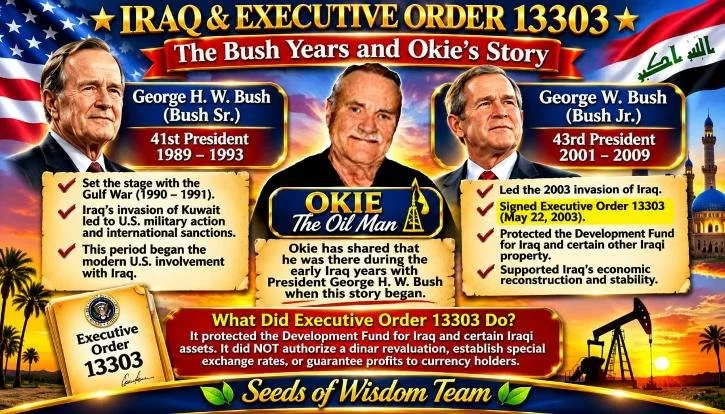
Bush Sr. vs. Bush Jr. and Executive Order 13303
🇺🇸 George H. W. Bush (Bush Sr.) — 1989–1993
Led the United States during the 1990–1991 Gulf War after Iraq’s invasion of Kuwait. This period involved international sanctions on Iraq.
🇺🇸 George W. Bush (Bush Jr.) — 2001–2009
Led the 2003 invasion of Iraq. On May 22, 2003, he signed Executive Order 13303, published in the Federal Register.
The order protected the Development Fund for Iraq and certain oil revenues/proceeds under U.S. jurisdiction from court attachments, lawsuits, and judgments so reconstruction funds would not be seized by old creditors. It did not authorize any dinar revaluation.
Timeline
Bush Sr. — Gulf War and sanctions.
Bush Jr. — Iraq reconstruction and EO 13303.
Specific attachment protections from the order were later ended in 2014 by EO 13668. The broader Iraq stabilization national emergency has been continued annually, most recently in May 2026.
Okie 13303 Audio
https://t.me/c/1322423591/46640
EO PDF
https://t.me/c/1322423591/46641
Official Federal Register
https://www.federalregister.gov/documents/2003/05/28/03-13412/protecting-the-development-fund-for-iraq-and-certain-other-property-in-which-iraq-has-an-interest
Check the record. Skip the hype. Enjoy the day
~~~~~~~~~~
RV Facts with Proof - Step 1🌱 Link
RV Intel Highlights - Step 2🔥 Link
Start Here room with over 110 RV Topics Link
Ask Your ❓Questions❓ in the Q & A Room Link
Seeds of Wisdom Team Rooms Directory Link
Follow the Gold/Silver Rate COMEX
Follow Fast Facts
Seeds of Wisdom Team™ Website
Seeds of Wisdom Team™ Rumble
Thank you Dinar Recaps