Rob Cunningham: Do we Actually Own What we Paid for?
10-4-2026
DO WE ACTUALLY OWN WHAT WE PAID FOR?
That is what modern tokenization can help answer more clearly.
In plain English, tokenization means creating a digital representation of a real asset or legal right on a shared, neutral, transparent, electronic ledger. The asset could be a share of stock, a bond, real estate, gold, intellectual property, or another recognized property interest.
The important part isn’t the token. The important part is what the token lawfully represents.
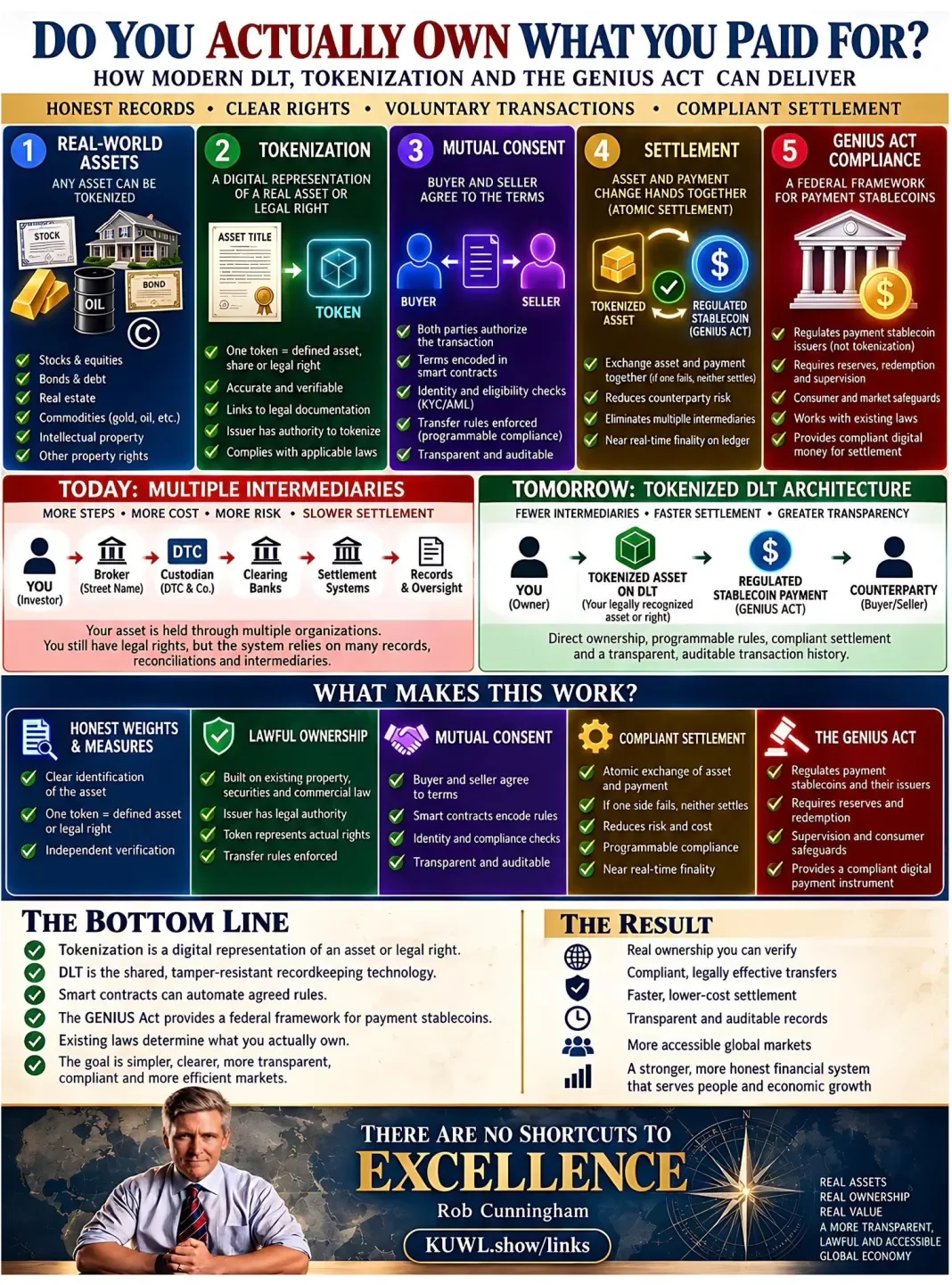
An honest system should make five things easy to establish:
1 – WHAT is it? The asset must be clearly identified. One token should correspond to a defined asset, quantity, share, or legal right – not something vague or duplicated.
2 – WHO owns it? The records should clearly establish who holds the relevant legal or beneficial rights. The blockchain record alone does not automatically create legal title to every kind of real-world asset; applicable property, securities, commercial, and other laws still matter.
3 – DID both sides agree? A transaction should occur according to disclosed terms accepted by the parties, with whatever identity, authorization, transfer, and compliance requirements the law requires.
4 – DID the trade actually settle? Ideally, the asset and payment change hands together—often called atomic settlement. That can reduce the risk that one side delivers while the other side doesn’t.
5 – CAN everyone verify what happened? A well-designed DLT (Distributed Ledger Technology) system can provide a durable, auditable transaction history, while permissions and privacy controls determine who can see what.
Where the GENIUS Act fits:
The GENIUS Act establishes a federal framework for payment stablecoins and their issuers, including requirements involving reserves, redemption, supervision, and related safeguards.
Tokenized asset + regulated payment instrument + legally effective transfer rules = the potential for faster, more transparent digital settlement.
The law governing the underlying asset still determines whether the buyer actually acquired ownership, a security entitlement, a contractual claim, beneficial ownership, or some other right.
Traditional system vs. tokenized system
Today’s financial system frequently uses intermediaries – brokers, custodians, clearing organizations, depositories and banks. For example, U.S. securities are held through intermediaries governed by an established legal framework defining customer and intermediary rights.
What DLT (Distributed Ledger Technology) changes is the number of records, reconciliations and intermediaries lurking, holding, leveraging, collateralizing and extracting value from our assets.
Instead of:
Person → broker → custodian/depository → clearing → settlement → records
properly designed markets will increasingly move toward:
Owner → digitally represented legal right → buyer
with payment and transfer occurring together on interoperable infrastructure
That means fewer reconciliation steps, faster settlement, greater auditability, programmable compliance and lower counterparty risk.
The Whole Concept
Imagine selling your house.
Today, proving ownership, transferring title and transferring money involve multiple organizations, databases, documents and reconciliations.
Now imagine a legally recognized digital instrument that says:
1 This specific asset exists
2 These are the rights attached to it
3 This person currently holds those rights
4 These are the conditions under which they may transfer
5 Both parties authorize the transaction
6 Payment and transfer occurred together
7 Here is the permanent record
That is The Promise
• DLT is the recordkeeping technology
• Tokenization is the digital representation of the asset or right
• Smart contracts can automate mutual consenting rules
• Stablecoins can provide one form of digital payment
• Law determines what the parties actually own and whether the transfer is legally effective
Technology makes it easier to know what exists, who owns what, what was agreed to.
Source(s):
• https://x.com/KuwlShow/status/2106496313307119823
https://dinarchronicles.com/2026/10/03/rob-cunningham-do-we-actually-own-what-we-paid-for/