Despite Government Denials, A Member Of The Finance Committee Confirms The Imminent Removal Of Zeros From The Dinar.
Baghdad Today – Baghdad Jamal Kojar, a member of the Finance Committee in Parliament, confirmed today (Tuesday , August 25 , 2026) that there is a government trend towards officially removing zeros from the Iraqi dinar and issuing a new paper currency.
According to The New Arab Network, as translated by Baghdad Today, Kujer said, “The government believes that removing zeros from the currency will bring great benefits to the country, explaining that there are requirements with ‘international’ standards that will be achieved by removing the zeros, including the transition to electronic currency trading, which will bring benefits in terms of combating corruption and developing commercial trading,” according to the network.
He added that "the Iraqi market also needs small denominations for local use, which is not currently possible with the presence of zeros," stressing that "the main goal is to prevent currency smuggling abroad, and to limit its circulation outside the Iraqi banking system, and thus reduce corruption."
He explained that “all criminal activities in the world are carried out through money that is traded outside the country’s banking system,” adding, “The government may put in place safeguards that enhance transparency in financial transactions by digitizing the currency after removing zeros from it, which helps in the process of combating financial corruption.”
The network also indicated that "the Iraqi government received recommendations from international bodies, including the United States, to remove zeros from the Iraqi currency, arguing that this would help to strengthen confidence in the Iraqi dinar and thus contribute to attracting more foreign investments," while also confirming in its report that the Central Bank of Iraq "has not yet provided a timetable for implementing the process of removing zeros," as it described it.
It should be noted that "government statements issued earlier denied the existence of efforts to remove zeros from the Iraqi currency, after the Minister of Communications, Mustafa Sand, announced that there was a government intention to remove them." https://baghdadtoday.news/305203-.html
Al-Baiji: The New Iraqi Currency Is Ready... And The Law To Remove Zeros Will Reach Parliament Soon.
August 26, 2026L The Independent - The file of reforming the Iraqi currency has entered a more sensitive stage, after statements by the member of the Parliamentary Finance Committee, Mansour Al-Baiji, regarding the readiness of a new Iraqi currency, and the imminent arrival of the draft law to remove zeros to the House of Representatives for legislation and voting.
According to what Al-Baiji said in a television interview, the government and the Central Bank of Iraq have completed some of the technical preparations related to the new currency, noting that the value of the currency that was prepared and printed amounts to about $250 million, and that its release into the market will be linked to the approval of the legal framework by the House of Representatives.
These statements come at a time when the issue of restructuring the Iraqi currency has returned to the forefront of economic discussion, after years of studies and proposals that addressed the project of removing three zeros from the dinar.
But the importance of the current development does not lie merely in issuing new banknotes, but rather in the mechanism that the state will adopt to move from the current currency to the new currency, which is the point that may determine the success of the process or turn it into a source of monetary instability if it is not managed carefully.
From an old project to a potential legislative decision
The idea of removing zeros is not new to Iraqi monetary policy. The Central Bank of Iraq published studies in the past outlining a plan to remove three zeros, explaining that the process is of an accounting and organizational nature, and does not automatically mean an increase in wealth or purchasing power for citizens.
Official data confirms that the Central Bank is the legally authorized entity to issue Iraqi currency, determine its denominations and designs, and make arrangements for its issuance.
Therefore, talk of a new currency must be separated from the concept of raising the value of the dinar.
Removing zeros, in essence, means changing the unit of account for the currency. If three zeros are removed, an amount of one million dinars might become one thousand new dinars, while the nominal economic value remains the same if the transaction is carried out at a fixed conversion rate.
This means that a citizen does not become richer simply by changing the shape of the numbers.
Why does the project need a law?
The transition from the old currency to a new currency on the scale of the Iraqi economy cannot be merely an administrative decision to issue new banknotes.
The state needs to determine the conversion rate, the dual circulation period, the mechanism for currency exchange, and address contracts, salaries, deposits, loans, prices, taxes, and accounting and banking systems.
Therefore, Al-Baiji's statements acquire political and economic importance, if true, regarding referring the law to remove zeros to parliament.
The scenario suggests that the government may adopt a transitional period of up to two years to replace the old money with the new.
Economically, the two-year period seems closer to a gradual reform model than a sudden replacement model, as it gives banks, companies and citizens time to adjust their systems, accounts, contracts and cash transactions.
$250 million... what does it mean?
The figure mentioned by the congressman, which is $250 million as the value of the printing, needs to be read carefully.
The value of printing in dollars does not mean that the state will add $250 million to its reserves, nor does it mean that the value of the dinar will jump against the dollar by a similar amount.
According to statements attributed to the deputy, it is a cost or value associated with the process of preparing and printing the new banknotes.
The economic value of a currency is determined primarily by monetary policy, fiscal policy, the size of liquidity, reserves, inflation, economic activity, and public confidence in the banking system.
Herein lies the most important point: the success of removing zeros is not measured by the appearance of the new banknote, but rather by the ability of the central bank and the government to maintain monetary stability during the transition phase.
The central bank faces its toughest test yet.
The official website of the Central Bank of Iraq currently displays the banknotes in circulation and the legal frameworks related to the currency. The law also confirms that the Central Bank is the entity responsible for issuing currency.
This makes the central bank the key player in any large-scale currency replacement process.
If the law is passed, he will have to define practically:
The conversion rate between the two currencies.
New currency denominations.
Joint trading period.
Authorized banks and exchange centers.
Ceilings and mechanisms for replacing large sums of money.
Anti-money laundering and counter-terrorism financing measures.
The mechanism for dealing with cash funds located outside the banking system.
A plan to withdraw the old currency from circulation.
How to protect citizens from forgery and fraud.
The issue of large sums is of particular importance, especially since Al-Baiji’s statements spoke of a special mechanism for replacing old money, particularly large sums.
Why might two years be necessary?
If the new currency enters circulation, the biggest challenge will not be printing the paper, but managing the transition process.
Iraq has a highly cash-based economy, so withdrawing huge amounts of old dinars and replacing them with a new currency in a short period of time could create pressure on banks, exchange companies, and cash centers.
Adopting a transition period of up to two years could allow the process to be divided into stages.
From an economic standpoint, the state could begin by gradually introducing the new currency, while keeping the old currency valid for circulation for a specific period, then reducing its use until it is withdrawn completely.
However, the success of this mechanism depends on the transparency and clarity of the instructions for the public.
Removing zeros does not automatically mean an increase in the value of the dinar.
This point will be the most sensitive in the Iraqi market.
If, for example, the exchange rate before the removal of zeros reflected a certain value of the dinar against the dollar, then removing three zeros does not mean that the dinar has actually risen against the dollar.
The Central Bank of Iraq presented in its official data the price of the dollar at 1310 dinars per dollar in data published during 2026.
Therefore, renaming the monetary unit should not be confused with revaluing the currency.
The two decisions are completely different.
Removing zeros can make accounting, pricing, and financial data easier, but it does not by itself create new production, additional reserves, or an increase in purchasing power.
The real test: inflation and confidence
From a global economic perspective, currency reform succeeds when it is part of a broader program for financial and monetary stability.
However, if banknotes are changed without addressing inflation, budget deficits, or weak confidence in the banking system, the underlying problem will remain even if the numbers on the banknotes change.
Therefore, in the next phase, markets will be watching more than just the announcement of the new currency.
Fiscal policy will monitor the size of government spending, the growth of the money supply, foreign reserves, exchange rate stability, and the percentage of banking system use in payment transactions.
These indicators will be more important than the color or design of the banknote.
What does this mean for the citizen?
For the average citizen, the hypothetical scenario of removing zeros means that old money will not become worthless once the new currency is launched, provided a clear legal replacement mechanism is approved.
If the government adopts a two-year transition period as stated in the declarations, the replacement is expected to be gradual, in accordance with instructions issued by the competent authorities.
But citizens will need to be wary of the informal market, especially since any currency change usually creates a suitable environment for rumors and fraud, such as selling alleged banknotes as the “new currency” or claiming the existence of unofficial exchange rates.
Economic reading
If the law to remove zeros is indeed referred to the House of Representatives, then Iraq will have moved from the stage of study and discussion to the stage of possible legislation.
However, the process cannot be considered valid before the issuance of the law and official instructions from the competent authorities.
Here, a distinction must be made between three levels:
First: Printing or preparing new banknotes.
Second: Enacting a law that allows for the currency restructuring process.
Third: Actual implementation and currency exchange in the market.
Moving from level one to level three may take months or years, depending on the law and the timetable that the authorities will set.
The central bank itself, in the official pages we reviewed, did not publish any announcement specifying an official date for the removal of zeros or the launch of a new currency with these details. Furthermore, recent reports on the matter indicated that no implementation date has yet been announced. https://mustaqila.com/البعيجي-العملة-العراقية-الجديدة-جاهز/
Why Does Iraq Seem More Vulnerable To American Targeting And Pressure Than Other Countries That Deal With Iran?
Baghdad - One News - 8/26/2026 Although Iraq is not Iran’s largest economic partner, it appears to be one of the countries most exposed to American pressure tactics in the new economic campaign against Tehran, not only because of the volume of trade between the two countries, but also as a result of a more complex equation that combines Iran’s need for the Iraqi market, the Iraqi economy’s connection to the dollar and the American financial system, and the continued entanglement between Baghdad and Tehran in trade, energy, and financial transfers.
On August 24, the U.S. Treasury Department launched Operation Economic Paragon, announcing a campaign targeting the networks, facilitators, and financial channels that Iran uses to smuggle oil, circumvent sanctions, and obtain revenue, while expanding the risks of secondary sanctions to foreign entities that continue activities linked to Tehran.
Although Washington did not name Iraq as the primary target of the campaign, a Reuters analysis suggested that Iraq could provide a model for how the United States might use its influence to pressure Iran’s trading partners, particularly through the card of access to the dollar-based financial system.
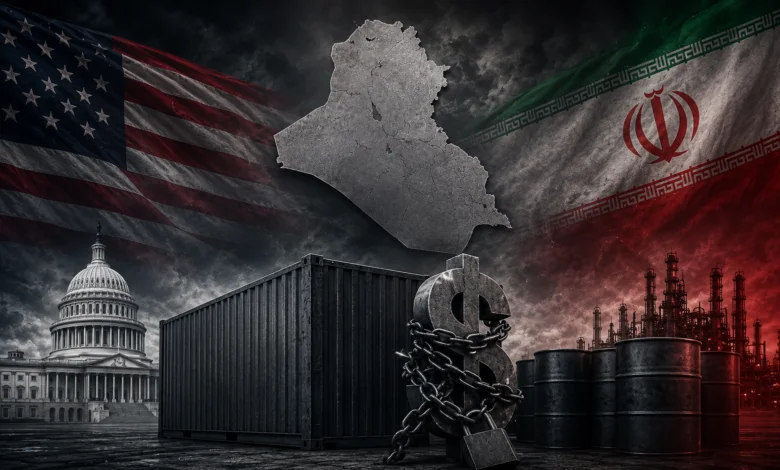
Iraq's unique situation lies in the fact that Washington possesses leverage over it that it does not have with many of Iran's major partners. According to Reuters, Iraq holds more than $100 billion of its reserves in the United States, and its dollar oil revenues are primarily channeled through the Federal Reserve Bank of New York, giving Washington significant financial leverage over Baghdad.
Herein lies the difference between Iraq's situation and that of China, even though Beijing's oil dealings with Tehran are far more extensive. China possesses a massive economy, broader financial and trade tools, and a greater capacity to absorb pressures, while Iraq relies more heavily on the flow of dollars, its oil revenues, and access to the international financial system.
Thus, the fundamental question becomes: Who deals with Iran the most? Rather: Where can American pressure tools have the greatest impact?
On the other hand, it is difficult for Iraq to quickly and without internal costs disentangle its economic ties with Iran, as the relationship goes beyond traditional trade to include gas, energy, goods, markets and the movement of funds, which makes any tightening of dealings with Tehran likely to have repercussions on the economy and services within Iraq.
Hence the Iraqi dilemma: Baghdad needs to maintain a significant part of its economic relations with Iran, but at the same time it needs to keep its channels open with the global financial system, which is centered on the dollar.
The American pressure does not start from scratch. In recent years, Washington has used its financial tools against Iraqi banks that it accused of conducting transactions linked to Iran, in conjunction with tightening procedures for foreign transfers, financial compliance, combating money laundering and dollar smuggling.
This precedent means that the United States does not necessarily need to impose sanctions on the entire Iraqi economy in order to exert effective pressure; it can target specific banks, companies, intermediaries and transfer channels, or tighten compliance requirements to make financial dealings with Iran more difficult and costly.
Conversely, Iraq's importance to Iran increases as other economic and financial outlets become more limited, due to the long border, the large market, and the volume of trade between the two countries.
Herein lies the fundamental paradox: the more Washington restricts Iran’s access, the more Tehran needs Iraq, and the more important Iraq becomes to Iran, the more sensitive Washington becomes to the movement of money, banks, and trade between the two countries.
Therefore, Iraq may become one of the main testing grounds for the new economic campaign, not necessarily by targeting the Iraqi state, but by tightening control over banks, transfers, companies and intermediaries that Washington believes provide a lifeline for the Iranian economy.
But the United States faces a delicate dilemma: Iraq is not an adversary, but a strategic partner whose economy it does not want to push into a widespread crisis. Reuters notes that Washington, despite its previous actions against Iraqi banks, has avoided steps that could inflict significant damage on the Iraqi economy.
Therefore, the most likely scenario, in the event of increased pressure, is to target the points of contact between the Iraqi and Iranian economies rather than targeting the Iraqi economy as a whole.
In conclusion, Iraq does not appear to be more vulnerable to pressure because it deals more with Iran, but rather because it is located at a sensitive intersection between two economies: Iran needs it more as its isolation intensifies, and Iraq needs the American financial system no matter how extensive its relations with Tehran become.
Therefore, the greatest danger to Baghdad may not lie in comprehensive American sanctions, but rather in the gradual transfer of the economic war on Iran to Iraqi banks, the dollar, remittances, energy, and trade, making Iraq one of Tehran's most vulnerable partners to American pressure tactics.
#OneNews#The_First_News_Platform_in_Iraq