2026... The Year Of The Difficult Dollar: How Did The Central Bank's Decisions Shake Iraq's Markets?
November 14, 2026Last updated: November 15, 2026
The Central Bank of Iraq entered the last quarter of 2026 facing one of the most sensitive monetary phases, after the first ten months of the year ended with the decision to raise the official price of the dollar, and the controversy surrounding liquidity and foreign reserves escalated, and fears grew that the cost of monetary measures would be transferred to commodity prices, trade activity, and the purchasing power of citizens.
The developments were not just ordinary fluctuations in the exchange market, but revealed a complex relationship between monetary policy and the government’s financing needs in an economy that is heavily dependent on oil revenues and imports, while large sectors of business activity still depend on cash and dollar transactions.
The most significant shift came on October 7, 2026, when the Central Bank announced an adjustment to the official exchange rates, setting the purchase price of the dollar from the Ministry of Finance at 1,500 dinars, its sale to banks at 1,510 dinars, and to the public at 1,520 dinars, compared to a previous selling price to the public of 1,320 dinars.
As a result, the official selling price of the dollar to the public increased by about 15.15%, an increase that has implications beyond the banking market to reach imports, trade costs and commodity pricing.
But the most important economic question is not just about the size of the increase, but about the reasons for its timing, the extent to which banking and commercial institutions are prepared to implement it, and whether it has addressed the fundamental imbalances in the economy or provided a monetary response to accumulated financial pressures.
First: The October decision... a monetary shift or a response to a financial crisis?
The Central Bank announced the adjustment of the exchange rate as a step to enhance economic stability, support national production, and encourage local industry, stressing the ability of its foreign reserves to meet foreign trade financing demands.
However, the official explanation faced questions after statements made by the Central Bank's media director, Haider Ghazi, on October 7, in which he spoke about using significant portions of the reserves through deducting remittances to secure the salaries of more than nine million beneficiaries.
The official noted that exchange rate discussions included levels as high as 1,900 dinars to the dollar, before settling on a price of 1,500 dinars to buy dollars from the Ministry of Finance.
These statements raise a fundamental issue concerning the dividing line between monetary stability and the requirements for financing public spending.
Raising the price of the dollar against the dinar increases the amount of dinars that the public treasury receives when converting its dollar revenues, but in return it raises the dinar cost of imports, and may put pressure on the prices of goods and services that depend on foreign sources.
Hence the fundamental paradox: the measure that provides additional resources in dinars for the budget may at the same time impose new burdens on consumers and importing companies.
This does not mean that the decision to adjust the exchange rate was without economic justification, but it makes its evaluation linked to the extent to which its stated objectives were achieved, the size of the burdens resulting from it, and the accompanying policies to protect the market.
Second: Ten months of rising dollar... the parallel market preceded the official decision
The pressure on the dollar did not begin in October, but rather successive waves appeared during the preceding months.
According to data reported by Shafaq News Agency from the Eco Iraq Observatory, the parallel market witnessed six major waves of increase during 2026, before the dollar reached about 168,000 dinars per 100 dollars in October.
Dollar's rise points in the parallel market during 2026
Prices monitored by the Eco Iraq Observatory and reported by Shafaq News; some values are approximate and not monthly averages.
The values for March and September represent approximate levels observed in the report, and are not official closing prices.
These developments show that the rise in the dollar's price was not solely a result of the October decision, but came after months of pressure on the exchange market.
On September 19, the Central Bank issued a statement attributing the rise in local exchange rates to speculation, expectations, and exploitation of geopolitical conditions, while affirming the adequacy of its reserves and the continued financing of foreign trade.
However, this explanation opens another door to economic accountability: if reserves are sufficient and official financing is ongoing, why did a gap remain between the official rate and the parallel rate?
Part of the gap can be explained by the different conditions for obtaining dollars, the extent to which traders are able to meet the requirements for foreign transfers, cash demand outside banking channels, as well as speculation.
However, determining the actual weight of each factor requires detailed data on accepted and rejected applications, reasons for rejection, transfer execution periods, and the distribution of funding among banks.
Herein lies one of the gaps in assessing monetary policy: the abundance of dollars at the level of reserves does not necessarily mean easy access to every business activity that needs it.
Third: What does the central bank's balance sheet reveal?
The tables of the Central Bank’s financial position as of September 30, 2026, provide important indicators of the movement of assets and liabilities prior to the decision to adjust the exchange rate.
Total assets 202.93 trillion dinars
issued currency 108.31 trillion dinars
Book gold reserves 30.51 trillion dinars
bank deposits 29.32 trillion dinars
The figures are from the Central Bank’s published financial statements dated September 30, 2026, and do not represent the total for the entire ten months.
Comparing September with August reveals the following results:
Index August 2026 September 2026
Total assets 203.28 trillion 202.93 trillion
Gold at book value 32.66 trillion 30.51 trillion
Balances held at central banks 9.85 trillion 9.09 trillion
Balances held in foreign banks 20.76 trillion 19.80 trillion
issued currency 108.00 trillion 108.31 trillion
It is noted that the book value of gold decreased by about 2.15 trillion dinars during one month, and that balances with central and foreign banks decreased, compared to an increase in the issued currency.
These changes should not be automatically interpreted as realized losses or net depletion of reserves, as they may be affected by valuation fluctuations, exchange rates, and asset movements. Furthermore, total assets do not equal usable foreign reserves.
However, these figures make publishing more detailed data on the movement of reserves and their components during the year essential for assessing the bank’s ability to meet future demand.
Fourth: The issue of money transfers... Who bears the responsibility for the confusion of importers?
The issue of foreign remittances was one of the most prominent points of friction between monetary policy and the commercial sector during October.
Following the change in the exchange rate, importers complained about demands to pay price differences on previous transactions, and Baghdad witnessed protests by traders and gold company owners in front of the Central Bank.
Economic reports indicated that some importers faced concerns about financial losses due to the transition from the previous price to the new price, even though their transaction procedures had begun before October 7th.
On October 10, the Central Bank confirmed that it was monitoring remittances that had been previously financed at the old rate, and refused to charge their owners exchange rate differences when it was proven that they had been purchased and covered at the previous rate.
Then, on the twentieth of the same month, it was announced that the transfer requests for imports that were halted before the amendment would be completed, provided that they met the approved controls.
The Parliamentary Investment and Development Committee also confirmed on October 19 that previous transactions must be carried out at the old price, and that traders should not be asked for new differences.
But this file raises three regulatory questions:
How many transfers were actually delayed during the transition to the new rate?
What is the total amount of money that banks have requested from merchants in the form of additional differences?
Have all complaints been addressed, and have measures been imposed on the offending banks?
The verifiable data did not provide comprehensive numerical answers to these questions.
Announcing the processing of remittances remains an important step, but it does not replace publishing the results of the bank audit, especially since commercial confidence does not depend on the issuance of instructions alone, but on their equal application and speed of implementation.
Fifth: Did the budget benefit at the expense of purchasing power?
The computational effect of adjusting the exchange rate can be illustrated through a hypothetical example of converting $1 billion of government revenue into dinars.
The computational impact of converting one billion dollars
At a price of 1300 dinars 1.3 trillion
At a price of 1500 dinars 1.5 trillion
Additional account difference
200 billion dinars
This is an illustrative example only, and not an estimate of actual government revenues or net budget gains.
This means that raising the price at which the Ministry of Finance buys dollars provides more dinars for every dollar that is transferred, but it does not create new dollar resources.
On the other hand, an importer who needs one million dollars will pay, according to the public selling price of 1520 dinars instead of 1320 dinars, an additional amount that, mathematically, amounts to 200 million dinars, if these two prices apply to his transaction.
The increase does not mean that the prices of all goods will rise by the same percentage; the response varies according to old inventory, competition, profit margins, the proportion of imported components, and the ability of companies to absorb costs.
But it means that the decision has made a direct change in the pricing equation, and that measuring its true impact requires comparing the prices of food, medicine, appliances and industrial supplies before and after the adjustment.
Sixth: Foreign reserves... between the Central Bank's assurances and the IMF's warnings
In September and October 2026, the Central Bank of Iraq confirmed that its foreign reserves were sufficient to cover requests for financing foreign trade, bank cards, and the needs of travelers.
However, the International Monetary Fund had warned in its 2025 consultation report of escalating financial risks in Iraq as a result of expanding public spending and dependence on oil, and at that time estimated that total reserves would fall from $100.3 billion in 2024 to $79.2 billion in 2026.
Two things must be distinguished here: the $79.2 billion figure is a previous IMF forecast, not an actual balance confirmed at the end of October 2026 , while the central bank's assurances reflect the institution's position on its ability to meet demand.
This means that judging the adequacy of reserves requires up-to-date actual data that includes net foreign assets, corresponding liabilities, the volume of imports, and oil flows.
Having large reserves does not eliminate the need for fiscal policy adjustments, because continuing to use monetary resources to address spending imbalances can increase future pressures.
Seventh: Bank reform... Has the structure changed, or has only the dollar exchange rate changed?
The challenges facing the central bank are not limited to the exchange rate, but also include the banking system’s ability to finance companies and individuals, develop electronic services, enhance confidence in deposits, and link Iraqi banks to the international financial system.
In a technical assistance report published in 2026, the International Monetary Fund noted the limited transmission of monetary policy decisions to the Iraqi economy, due to excess liquidity and underdeveloped financial markets. It called for improved coordination between fiscal and monetary policies, continued reform of state-owned banks, and enhanced correspondent banking relationships.
These observations are of particular importance because changing the exchange rate alone does not address the structural problems in the banking system.
A bank that fails to provide fast and reliable services to a merchant may indirectly push him to seek alternatives outside official channels, even when foreign currency is theoretically available.
On October 10, the Central Bank announced that it would work in coordination with banks and electronic payment companies to launch special foreign trade cards for small traders.
This step, if implemented with clear controls, could contribute to bringing an additional segment of importers into regulated banking channels.
However, as of the date of this report, the official information that could be verified is not sufficient to confirm that the service has actually been launched or to determine its final limits and the number of beneficiaries.
Eighth: What did the central bank succeed in, and what remained subject to questioning?
A more accurate picture of performance during the first ten months can be obtained by separating the announced actions from the measurable results.
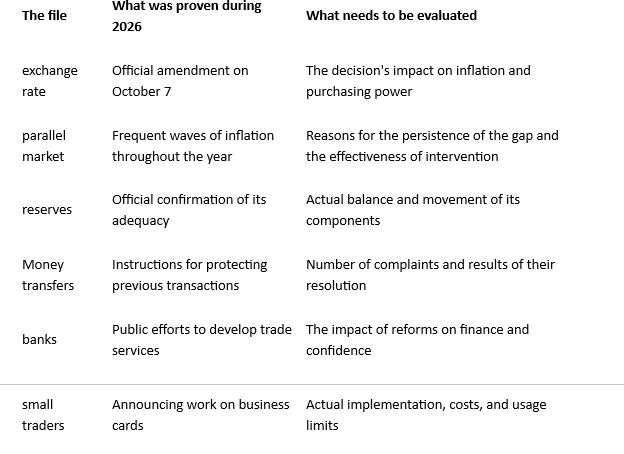
This comparison shows that the central bank took important measures during the year, but at the same time faced problems in transmitting the effect of monetary policy to the markets, and implementation frictions when adjusting the exchange rate.
The continued rise of the parallel dollar alone cannot be considered conclusive evidence of the bank's failure, just as the availability of reserves alone cannot be considered sufficient evidence of the success of monetary policy.
Performance is measured by a set of interrelated indicators, including price stability, payment efficiency, the soundness of the banking system, the ability to withstand shocks, and the clarity of decisions for citizens and businesses.
Ninth: What awaits the Iraqi market in the remainder of 2026?
The Iraqi market enters the final weeks of the year facing three possible economic paths.
The first scenario: a gradual improvement in the dollar market. This could be achieved if traders have easier access to official transfers, waiting times decrease, and the need to buy dollars from the parallel market diminishes.
The second scenario: continued price pressures. This could occur if new import costs are passed on to consumers, particularly in sectors highly dependent on foreign goods.
The third scenario: continued tension between monetary policy and fiscal needs. This possibility is linked to the size of government spending, oil revenues, and financing needs, and not solely to the decisions of the central bank.
These paths do not represent definitive predictions, but rather probabilities that depend on actual data and policies that will be adopted during the coming period.
Tenth: Questions that the central bank should answer
This investigation presents the Central Bank of Iraq and regulatory bodies with a set of economic questions that require documented answers:
What was the actual size of foreign reserves at the end of October 2026, and how has it changed since the beginning of the year?
What is the size of the amounts used to deduct government transfers during the first ten months?
What economic factors led to the adjustment of the exchange rate to the levels adopted in October?
Has a preliminary study been conducted on the impact of the decision on consumer prices and imports?
How many commercial transfers were delayed as a result of the transition to the new rate, and what was the size of the amounts affected?
What measures were taken against the banks that violated the instructions for implementing previous transfers?
What is the timeline for launching trade finance tools for small traders?
How will the bank measure the impact of adjusting the exchange rate on the gap between the official and parallel markets?
What are the practical steps to reform state-owned banks and improve their ability to finance the private sector?
Will the bank issue a comprehensive assessment of the results of the 2026 decisions, including financial and monetary indicators before and after the adjustment?
https://mustaqila.com/2026-عام-الدولار-الصعب-كيف-هزت-قرارات-البن/