Iraq Economic News and Points To Ponder Late Sunday Evening 8-9-26
"The Most Widely Discussed Scenario" Removing Zeros To Withdraw Looted Funds And Address Salary Issues... Experts Warn Against A "Makeover".
2026-08-09 | Baghdad - 964 Economic and financial experts are discussing proposals to solve the liquidity crisis and salary delays plaguing Iraq, most notably changing the currency and removing zeros from the Iraqi dinar, or introducing additional denominations that correspond to the noticeable expansion in the size of the circulating money supply.
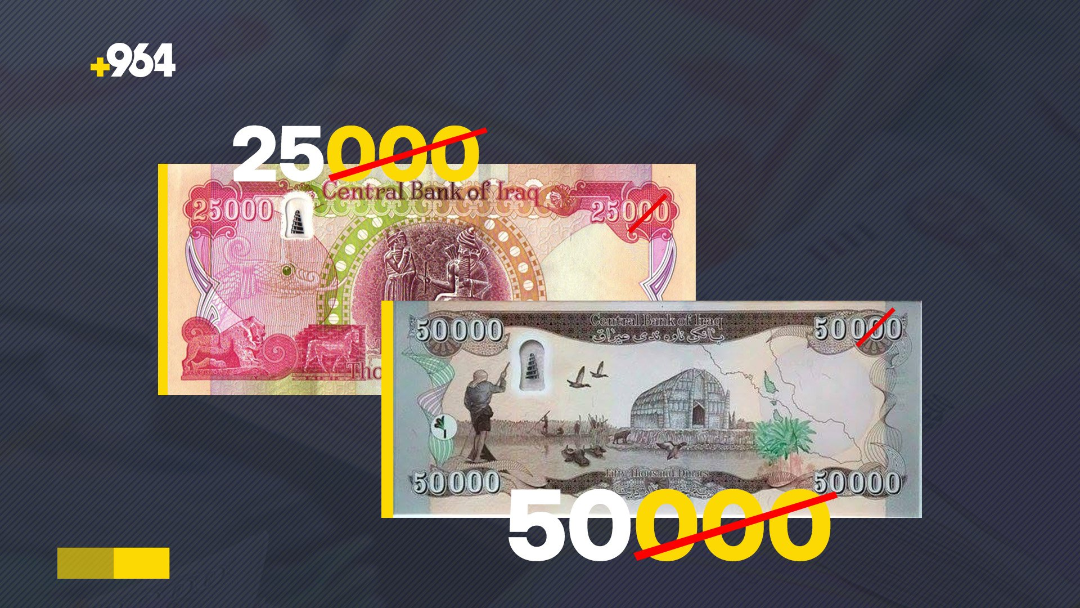
However, they agree on one point that confirms that these measures in economic equations are merely cosmetic solutions, “more like makeup,” that may treat the symptoms but not the causes of the problem.
They warn that the large looted fortunes often do not remain in the form of local currency that can be traced, but rather have been converted into real estate, foreign assets, and accounts in safe financial havens, and are therefore immune to the government’s internal measures.
Financial expert Nabil Al-Abadi calls for the need to avoid treating the proposal to change the national currency as a purely technical or monetary measure, explaining that this issue reflects the depth of the structural crisis that the economy is suffering from, and cannot be a substitute for the required financial, monetary and economic reforms.
He adds in a statement to the official newspaper, which was followed by Network 964 , that changing the currency is not a solution in itself, but rather a mirror reflecting the state of the economy, warning against confusing the treatment of symptoms with the treatment of the causes of the problem.
Al-Abadi explains that removing zeros, as the most widely discussed scenario, essentially represents a reorganization of monetary units and a simplification of arithmetic and accounting operations, without necessarily meaning an increase in the citizen's purchasing power or a rise in the real value of the currency.
He points out that changing the currency cannot be dealt with as a tool to recover looted funds, but may turn into a double-edged sword in some contexts if it is not managed within a comprehensive reform system.
He warns that large looted fortunes often do not remain in traceable local cash, or have long since migrated to real estate, foreign assets and accounts in safe financial havens, indicating that their transformation makes them largely immune to any internal monetary measures.
He continues: “The biggest challenge in such measures is managing the transitional phase, especially with regard to psychological expectations in the market and the possibility of some traders and speculators exploiting the transition period to raise prices under various pretexts, which may lead to inflationary pressures and dissipate the expected administrative benefits of the process of removing zeros.
He stressed that the success of any step in this direction requires the existence of solid monetary and economic stability before its implementation, and not considering it as a means to achieve that stability.”
He emphasizes that the essence of a currency's strength is not related to its form or the number of zeros it contains, but rather to the strength of the institutions and the economy upon which it is based.
Al-Abadi makes any project to change the currency contingent on genuine financial reform that reduces chronic imbalances in the general budget, along with strengthening the independence of the Central Bank and ensuring its ability to manage monetary policy away from financial pressures, as well as building a productive economy capable of diversifying sources of income and generating foreign currency, explaining that a strong currency is a reflection of a strong economy and not its creator.
He concludes that addressing economic imbalances requires moving from superficial solutions to fundamental reforms that include public finance, the banking sector, production and investment, and diversifying revenue sources, noting that changing the currency without reforming these issues could turn into a costly and confusing procedure for the citizen and the market, without addressing the root of the economic problem.
Economic researcher Imad Al-Muhammadawi considers the proposal to change the currency or issue a new currency denomination to withdraw illicit funds from circulation a theoretically positive proposal, noting that it is insufficient to reduce corruption or compensate for the shortage of liquidity.
Al-Muhammadi explains that, from an economic standpoint, the problem is not the form of the currency, but rather how to convince those who possess large sums of money to disclose their source when exchanging it. He points out that if the currency is changed without strict banking and tax auditing procedures, those with illicit funds can exchange it like the rest of the citizens, and thus the main purpose of the project is lost.
He adds that there is no consensus with the proposal, for several reasons, foremost among them the hesitation that the procedure will turn into a tool for freezing legitimate funds if the specified and explained mechanisms for proving the source of funds are not followed, as well as the possibility of exploiting some loopholes by corruption networks to circumvent the change before it begins, accompanied by its impact on the monetary system of citizens, if it is done suddenly, not to mention the cost and complexities of currency replacement.
Turning these proposals into effective tools depends on them being accompanied by a system that requires large sums to be deposited in banks, their sources to be verified and linked to banking and tax data, with a time period granted for replacement, and serious work to uncover the source of the funds.
He points out that changing the currency, identifying illicit funds, and exchanging banknotes will not solve the crises unless it is accompanied by a regulatory system capable of uncovering the source of the funds and prosecuting their owners.
He adds that it could be an opportunity to regulate monetary masses and bring funds circulating outside the banking system into the formal financial system by establishing clear and transparent rules.
He points out that the lack of consensus on the proposal does not mean its rejection, but rather requires the establishment of legal, banking and regulatory guarantees, and an integrated system to detect those who manipulate public funds and the corrupt, and to know the source of the funds before granting it legitimacy, stressing that if the conditions are met, the project will gain its importance and the purpose for which it was created. https://964media.com/706039/
The KRG’s Ministry Of Finance Has Reportedly Informed Its Federal Counterpart That It Cannot Transfer The Agreed-Upon 120 Billion Dinars
Zoom News @zoomnewskrd The KRG’s Ministry of Finance has reportedly informed its federal counterpart that it cannot transfer the agreed-upon 120 billion dinars in non-oil revenues to Baghdad, citing a sharp decline in revenues, marking the third consecutive month it has failed to make the transfer. As a result, the Iraqi government is set to deduct the amount from the funds allocated for the July salaries of Kurdistan Region civil servants, who have yet to be paid.
https://x.com/zoomnewskrd/status/2086538760007622960
Iraq Steps Up Digital Transformation Of Banking And Customs
Business Iraq Iraqi News August 9, 2026 Iraq’s Finance Minister Falih Sari and Central Bank Governor Nizar Nasser Hussein discussing during the meeting.
Baghdad (IraqiNews.com) — Iraq is speeding up preparations to digitize its financial and customs systems, with Finance Minister Falih Sari and Central Bank Governor Nizar Nasser Hussein considering tighter integration of electronic payments, customs processes, and government financial data.
The conference, which included members from the United Nations Conference on Trade and Development (UNCTAD), aimed to accelerate electronic linkages between Iraq’s customs and payment systems.
Sari urged authorities to speed up implementation as part of measures to modernize financial management, streamline trade processes, and create a more efficient environment for companies and investors.
The talks also focused on increasing cooperation between fiscal and monetary agencies, including digital data interchange and upgrading Iraq’s banking infrastructure, while maintaining financial stability and meeting government financial responsibilities.
The revisions are part of Iraq’s larger transition from cash-heavy and paper-based institutions to a more integrated digital financial infrastructure.
Baghdad sees modernization of banking, payments, and customs as more crucial as the government strives to bring its financial system closer to international norms, increase transparency, and make it simpler for Iraqi and foreign enterprises to do business.
The drive also supports broader banking changes in Iraq, as the government seeks deeper connectivity with the international financial system and encourages private sector development.
https://www.iraqinews.com/iraq/iraq-steps-up-digital-transformation-of-banking-and-customs/
The Ministry Of Finance And The Central Bank Agree On Measures To Enhance Financial And Monetary Stability
Information/Baghdad...Finance Minister Faleh Sari emphasized to the Governor of the Central Bank of Iraq, Nizar Nasser Hussein, on Sunday that the current circumstances necessitate continuous coordination.
A statement from the Ministry of Finance, received by the Information Agency, indicated that “Finance Minister Faleh Sari met with the Governor of the Central Bank of Iraq, Nizar Nasser Hussein, where they discussed the financial and economic situation in light of the current challenges.”
The Minister stressed that "the current circumstances require continuous coordination between fiscal and monetary policy to help manage financial flows efficiently and ensure the fulfillment of the state's obligations, while continuing to work on reforming the financial system and developing public finance management tools."
He also pointed to "the importance of enhancing data exchange between the Ministry of Finance and the Central Bank, and accelerating digital transformation, which will raise the efficiency of financial institutions and support their ability to respond to economic changes."
For his part, Nizar Hussein explained that “the Central Bank operates according to a methodology focused on supporting monetary stability, developing banking operations, and keeping pace with the needs of the national economy,” emphasizing the importance of coordination with the Ministry of Finance on economic and financial matters.
The statement added that "both sides agreed to continue joint work on measures to enhance financial and monetary stability and ensure the regularity of the state's essential obligations." End/25