Iraq and Vietnam News Posted by Tishwash at TNT 7-30-2026
TNT:
Tishwash: this is a really long report that goes into other parts of that area so if you want to read the rest just click the link it will take you there
Ascott Accelerates Vietnam Expansion With Nine Signings in 1H 2026, Growing Portfolio by Over 30%
Signs four new projects with longstanding partner Sun Group and five with owners new to Ascott, adding over 3,200 units
Deepens presence in Hanoi, Ho Chi Minh City and Hai Phong, expands along the coast in Da Nang and Phu Quoc, and enters Quy Nhon for the first time
Debuts The Crest Collection in Vietnam, with signings spanning seven brands
Expects signing momentum to continue in 2H 2026 link
************
Tishwash: Iraq Launches Starlink Satellite Internet Services Nationwide
At a Glance
Iraq officially activates Starlink satellite internet services.
The project utilizes low Earth orbit technology to connect rural areas, bypassing damaged ground-based infrastructure.
Iraq’s Communications and Media Commission announced the official launch of Starlink internet services across the country.
Key Statements and Focus Area
CMC Executive Authority Head confirmed the launch, enabling citizens to utilize the service under new regulatory guidelines.
The initiative is part of a broader technology initiative backed by the Prime Minister.
Baligh Abu Kalal, Head of the CMC's Executive Authority, stated on Wednesday that “the Starlink service has now been officially launched in Iraq.”
This announcement follows the completion of technical and legal procedures that spanned several months. Moving forward, citizens can utilize the service in accordance with established regulatory guidelines.
The official launch follows a landmark licensing agreement signed by Abu Kalal in Washington on July 17, under a broader technology initiative backed by Prime Minister Ali Faleh al-Zaidi.
The deployment aims to overcome Iraq’s historical broadband deficits by utilizing low Earth orbit (LEO) satellite technology to instantly connect remote and rural regions without relying on fragile ground infrastructure.
Technical negotiations took several months because Baghdad mandated strict data sovereignty, implementing dedicated API monitoring systems for the Iraqi National Security and Intelligence services. link
FYI:
Starlink is a global satellite internet service developed by Elon Musk’s SpaceX. The primary objective of the project is to deliver high-speed internet to every corner of the world, particularly to remote areas that lack access to standard internet lines or suffer from weak communications infrastructure.
According to technical data, standard download speeds on the Starlink service range between 25 and 220 Mbps, while upload speeds consistently average between 15 and 35 Mbps.
Regarding the financial cost, the monthly subscription fee for users inside Iraq is expected to be above $50, which is considered a reasonable price relative to its performance capability.
To date, SpaceX has deployed a massive constellation featuring over 10,800 active Starlink satellites in orbit, moving steadily toward its ultimate long-term target of 42,000 satellites.
Operating in LEO, Starlink delivers an ultra-responsive latency of 25 to 60 milliseconds. While local, regional fiber-optic networks can offer slightly lower latency and higher top-tier consistency in heavily urbanized zones, Starlink bridges the digital divide seamlessly by providing instant, high-speed connectivity to rural and infrastructure-depleted areas without any reliance on ground-based cabling.
************
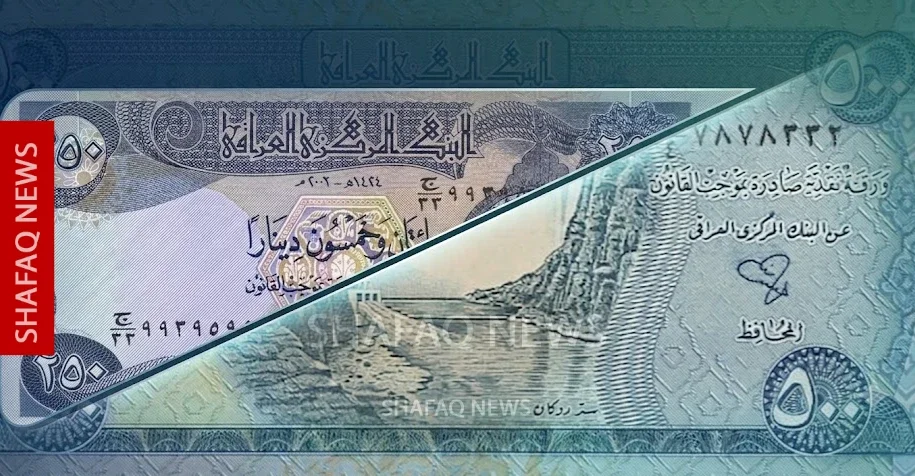
Tishwash: these are the ones they use now not the ones we are waiting for
Why have small denominations disappeared from the markets? Al-Zaydi's advisor reveals the reasons.
The Prime Minister's financial advisor, Mazhar Muhammad Salih, revealed on Wednesday the reasons for the scarcity of small denominations of currency in Iraqi markets, stressing that this is mainly related to their paper nature and the high speed of their circulation, which leads to their deterioration within a short period of time.
Saleh told Shafaq News Agency that issuing currency in its various denominations is one of the core tasks of the Central Bank of Iraq, which is responsible for managing the currency and providing the necessary liquidity to meet the needs of economic activity and ensure the smooth flow of payments and the stability of cash transactions.
He explained that small denominations of currency represent the primary tool for conducting low-value daily transactions, which makes them the most commonly traded among citizens and markets, and therefore the most susceptible to wear and tear.
Saleh added that Iraq, unlike many countries that rely on coins for small denominations, still uses paper denominations, noting that the lifespan of these denominations does not exceed about one year according to international standards, due to the intensity of their use and their continuous transfer between hands, at a time when reliance on paper money remains high while electronic payment methods continue to grow.
He pointed out that the Central Bank has accurate indicators and statistics to measure the demand for different denominations of currency, and it is the first entity to sense the market’s need to issue or reprint any denomination, especially the small denominations, which are characterized by their rapid circulation compared to the large denominations, which tend to be more towards saving or hoarding.
The government advisor concluded his remarks by saying that "providing small denominations is not just about issuing currency, but also represents one of the indicators of efficient cash management, and contributes to ensuring the smooth flow of economic activity and the stability of the payments system," stressing that "these denominations are continuously monitored by the Central Bank of Iraq."
Iraqi markets are experiencing ongoing suffering due to the scarcity of small denominations of currency, such as 250 and 500 dinars, which puts citizens and shop owners in front of frequent difficulties in completing daily buying and selling transactions.
Sellers often resort to compensating for the shortage by giving alternative goods such as gum, tissues, or sweets instead of returning the change as in the markets, while others are forced to round up or down prices, which provokes consumer dissatisfaction. link
Tishwash: Coordination framework: Iraq's security and sovereignty cannot be violated or compromised under any circumstances.
The Coordination Framework affirmed that "Iraq's security and sovereignty are inviolable and cannot be compromised under any circumstances, and it rejects turning Iraq into an arena for regional and international conflicts."
A statement from the Coordination Framework's media office indicated that "the Framework held an emergency meeting Wednesday evening at the Government Palace to discuss the American-Saudi attacks on Iraq's sovereignty."
According to the statement, the Coordination Framework condemned the aggression targeting Iraqi territory, which resulted in the martyrdom of several members of the Popular Mobilization Forces and the injury of others, in a blatant violation of Iraq's sovereignty and territorial integrity, and in contravention of the principles of international law and the UN Charter.
The Framework expressed its astonishment at this attack, especially given the government's adoption of a balanced foreign policy based on building cooperative and partnership relations with its regional neighbors and the international community.
He offered his sincere condolences to the families of the martyrs and wished a speedy recovery to the wounded. He affirmed that Iraq's security and sovereignty are inviolable and cannot be compromised under any circumstances, and he rejected turning Iraq into an arena for regional and international conflicts.
He emphasized that "the attacks targeting Iraq and violating its sovereignty do not serve regional and international efforts aimed at containing the crisis and de-escalating tensions, but rather contribute to complicating the situation and threaten security and stability in the entire region." link
***************
Tishwash: Al-Aboudi: Three factions have begun handing over their weapons to the state, and talks are underway with Washington and Tehran to support the monopoly of arms.
National Security Advisor Qasim al-Aboudi revealed new developments in the file of restricting weapons to the state, stressing that the government held talks with the United States and Iran to support this path, while announcing that three factions have begun procedures to hand over their weapons to official institutions.
Al-Aboudi said in a televised statement that Prime Minister Ali Faleh al-Zaidi’s visit to Washington contributed to developing the course of Iraqi-American relations and moving them to the framework of economic partnership and security cooperation, indicating that the two sides agreed to resume training programs and security coordination, as well as discussing a number of joint files.
He explained that the issue of restricting weapons to the state requires dialogue with the various concerned parties, noting that some factions were linking their continued possession of weapons to the presence of American forces, and that an understanding regarding the end of their presence removes one of the justifications that were being put forward in this context.
He added that the government discussed the issue with the Iranian side, noting that Tehran expressed its readiness to support efforts to restrict weapons after being convinced of the withdrawal of US forces, stressing that Baghdad emphasized during the meetings its rejection of the use of Iraqi territory or targeting it in any conflict.
Al-Aboudi stressed that the government is committed to ending the presence of any weapons outside the framework of the state, noting that the next phase will witness new steps to strengthen the authority of official security institutions and consolidate the state’s monopoly on weapons. link