Gold Is Cheap. The World's Biggest Buyers Know Something We Don't
Matthew Jones (Kitco Commentary) - Gold has fallen again.
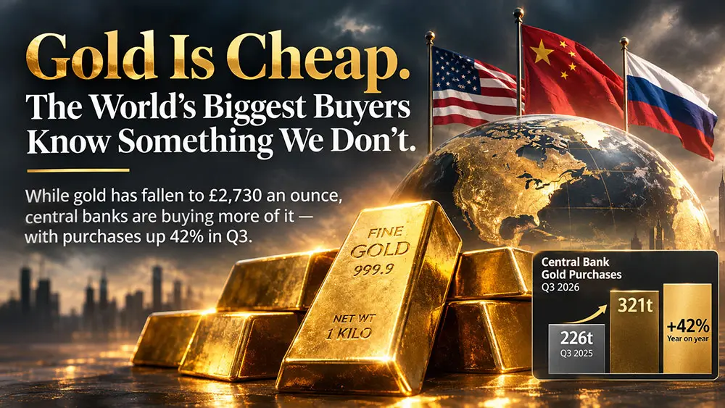
As I write, the price has slipped to approximately £2,730 per ounce, leaving investors wondering quite what it will take to reverse its recent decline.
War, geopolitical instability, unprecedented sovereign debt, currency debasement, cyber threats and growing concerns about the resilience of the global financial system.
One might reasonably ask what more gold needs.
Yet while private investors are questioning why gold continues to fall, something rather interesting is happening elsewhere.
The world's central banks are buying more of it. Considerably more.
And perhaps that tells us something about how differently the world's largest financial institutions view gold.
Central Bank Buying Surges 42%
According to the World Gold Council's latest figures, central banks and other official institutions purchased a net 321 tonnes of gold during the third quarter of 2026 — an increase of 42% compared with the same period last year.
That takes total net purchases for the first nine months of 2026 to approximately 675 tonnes, 6% higher than the corresponding period in 2025.
Meanwhile, global private bar and coin demand fell 19% year on year during the third quarter.
Think about that contrast.
Private buyers have become more hesitant, while central banks have accelerated their accumulation.
These are not institutions renowned for making impulsive investment decisions or chasing the latest market trend.
They manage national reserves, assess geopolitical risks and consider monetary stability over decades rather than weeks.
So why are they buying so much gold?
And perhaps more importantly, what do they believe they will need it for?
What If We've Been Looking at Gold the Wrong Way?
Most private investors evaluate gold through its price.
If it rises, confidence increases. If it falls, questions follow.
But consider the position of a central bank accumulating gold as part of a long-term strategic reserve programme.
Its primary objective may not be to see the price rise next month, next quarter or even next year.
Its objective may be to accumulate as much physical gold as possible before its strategic importance increases.
And suddenly, falling prices look rather different.
If you believe gold will play a much greater role in the global monetary system ten years from now, acquiring it more cheaply today represents an opportunity.
Indeed, the last thing a substantial buyer necessarily wants is to pay progressively higher prices while still accumulating.
They believe it is worth more.
They just don't necessarily want to pay more.
The World's Largest Powers Understand Gold
The United States remains the world's largest official holder of gold, with approximately 8,133 tonnes.
China and Russia also maintain substantial reserves, having pursued significant accumulation programmes over the longer term.
These countries have very different political systems, economic priorities and geopolitical ambitions.
Yet they share an appreciation of gold's unique monetary characteristics.
Gold is not another government's liability.
It cannot be created through monetary policy.
It requires no promise of repayment, and physical gold held directly does not depend upon the solvency of a bank or financial institution.
That makes it particularly valuable in a world increasingly defined by sovereign debt, geopolitical confrontation and concerns about financial-system resilience.
Of course, not every major central bank is buying. Nor does their continued ownership demonstrate any coordinated effort to influence gold prices.
But it does raise a legitimate question.
If gold is becoming less important, why are so many monetary authorities increasing their exposure to it?
What Might Gold Be Worth in the Next Monetary System?
Consider China's longer-term economic ambitions.
Through its international trade relationships, Belt and Road infrastructure programme and efforts to expand the use of the renminbi in cross-border transactions, Beijing has been seeking greater financial independence from the dollar-dominated system.
Gold could play an increasingly important supporting role in that process.
Not necessarily through the introduction of a fully gold-backed currency, but potentially through greater use of gold as a reserve asset, collateral or component of international settlement arrangements.
Other nations may pursue similar diversification for their own reasons.
Meanwhile, the underlying challenges facing established monetary systems remain substantial.
Government borrowing continues. Debt-servicing costs remain elevated. Inflation has eroded purchasing power, and technological developments are creating new vulnerabilities within increasingly digitised financial infrastructure.
None of this guarantees that gold will rise.
But it does help explain why nations might place considerable strategic importance on owning an asset that exists independently of those systems.
And unlike paper currencies, gold cannot simply be manufactured to meet demand.
New mine supply takes years to develop.
The quantity of physical gold available is finite at any given moment.
So if more nations eventually decide they want a greater proportion of their reserves held in gold, an obvious question emerges.
Where will all that additional gold come from?
Perhaps Falling Prices Are Part of the Opportunity
Gold's recent weakness has understandably unsettled investors.
TO READ MORE: https://www.kitco.com/opinion/2026-11-20/gold-cheap-worlds-biggest-buyers-know-something-we-dont