Ever Wonder Where $7 TRILLION Goes? So Does the Government
Ever Wonder Where $7 TRILLION Goes? So Does the Government
Notes From the Field By James Hickman (Simon Black) March 17, 2026
On March 10, a nonpartisan Washington think tank called the Committee for a Responsible Federal Budget published a report called: "Break Glass: A Plan for the Next Economic Shock."
It points out that the United States has never entered an economic downturn as indebted as it is today— meaning there is essentially zero fiscal space to respond to the next crisis. When the financial crisis hit in 2008, national debt stood at roughly 35% of GDP. By the time it was over, debt had ballooned to about 70%.
Then, when COVID hit in 2020, debt was already at 80% of GDP. By the time that was over, it had surged past 100%.
Today the official national debt is almost at 130% of GDP. That's well beyond the World War II record.
Each economic crisis starts from a worse position, requires more borrowing, and leaves the country deeper in the hole.
None of this should be surprising to anyone who's been paying attention. We've been writing about this for years.
We said it in 2019 when everything was going great— record stock market, record tax revenue, healthy economy— and the government still ran a trillion dollar deficit.
We wondered out loud— if the government still runs a $1 trillion deficit when everything is great, how bad will the deficit be when there’s an actual crisis?
We didn’t have to wait long to find out; Covid hit shortly thereafter, causing the government deficit to surge to $5+ trillion.
So what happens when the next recession hits? Where does the money come from?
The CRFB's proposed emergency plan gives you the answer. First, freeze Social Security, Medicare, and all discretionary spending — no cost-of-living adjustments, no growth, nothing.
Then, freeze tax brackets too, so that inflation quietly pushes more Americans into higher brackets.
And on top of all that, phase in a brand new "deficit reduction surtax": an additional tax on income above $100,000 that ratchets up every year until deficits fall to 3% of GDP.
Of course this would all be so politically toxic that the report concedes nothing will be done until... a crisis forces it.
But that doesn’t mean Americans aren’t already feeling the consequences of higher deficits.
Last year, a Yale Budget Lab report found that federal deficit spending since 2015 has pushed interest rates up by nearly a full percentage point.
The government borrows so much money that it crowds out private lending, forcing everyone else to pay more. You’re essentially competing with the government for a loan.
For a new homebuyer, that single percentage point adds $76,014 in extra costs over a 30-year mortgage — roughly $2,534 per year, or about $211 every single month. Auto loans cost an extra $670. Small business loans cost an extra $7,723.
So when a young couple can't afford their first house, or a small business owner pays more to expand, part of that cost is a direct, measurable consequence of Washington's borrowing binge.
The national debt isn't an abstract number on a screen in Washington. It's higher interest rates on mortgages, auto loans, and credit cards.
And the government borrowing is only accelerating.
Over the past year, the debt grew by $2.7 trillion; that’s a sharp increase from the $1.8 trillion federal deficit in fiscal year 2025.
So not only is the national debt growing, but the rate at which the national debt is growing... is growing. (If you’re a math wonk, the second derivative is positive.)
At the current trajectory, the debt will cross $39 trillion by the end of this month. And $40 trillion by the summer... not long after America celebrates its 250th birthday.
What’s crazy is that the people in charge of tracking all of this spending can't figure out where the money goes.
On March 5, a government auditor reported that the Office of Management and Budget cannot even produce a complete inventory of federal programs, despite being legally required to do so.
It’s not that the OMB is lazy or incompetent; it’s that there are simply too many federal programs... and the complex web of spending makes it virtually impossible to tally up all the various offices, agencies, sub-departments, committees, special advisory boards, emergency programs, etc. that exist in the federal government.
Congress makes things much worse when they appropriate annual funding for some program— sort of ‘fire and forget’. So decades go by since a program was originally created...yet it continues to receive money each year even though nobody knows what it’s for.
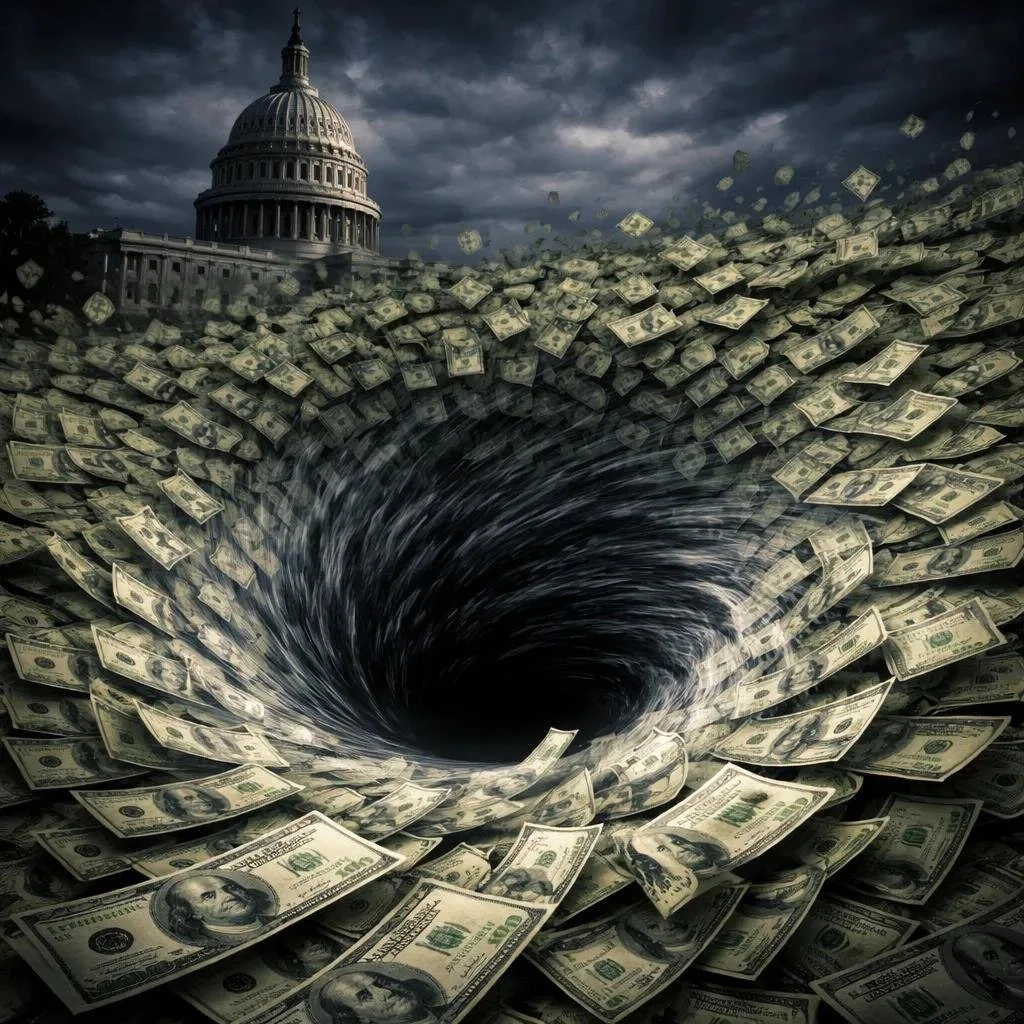
Bottom line, the government now spends $7 trillion each year. And they can’t figure out where it goes.
We've spent the last 16 years helping people build a Plan B— because even back in 2010, the trajectory of fiscal spending was obvious.
Look, the world’s not coming to an end. But it would be naive and foolish to think there won’t be consequences to such a dismal financial situation. There already are.
And it’s important to think about this, because the earlier you start preparing, the more options you’ll have to mitigate the consequences.
To your freedom, James Hickman Co-Founder, Schiff Sovereign LLC