Rob Cunningham: The Emerging Blockchain-based Financial System
Rob Cunningham: The Emerging Blockchain-based Financial System
7-29-2026
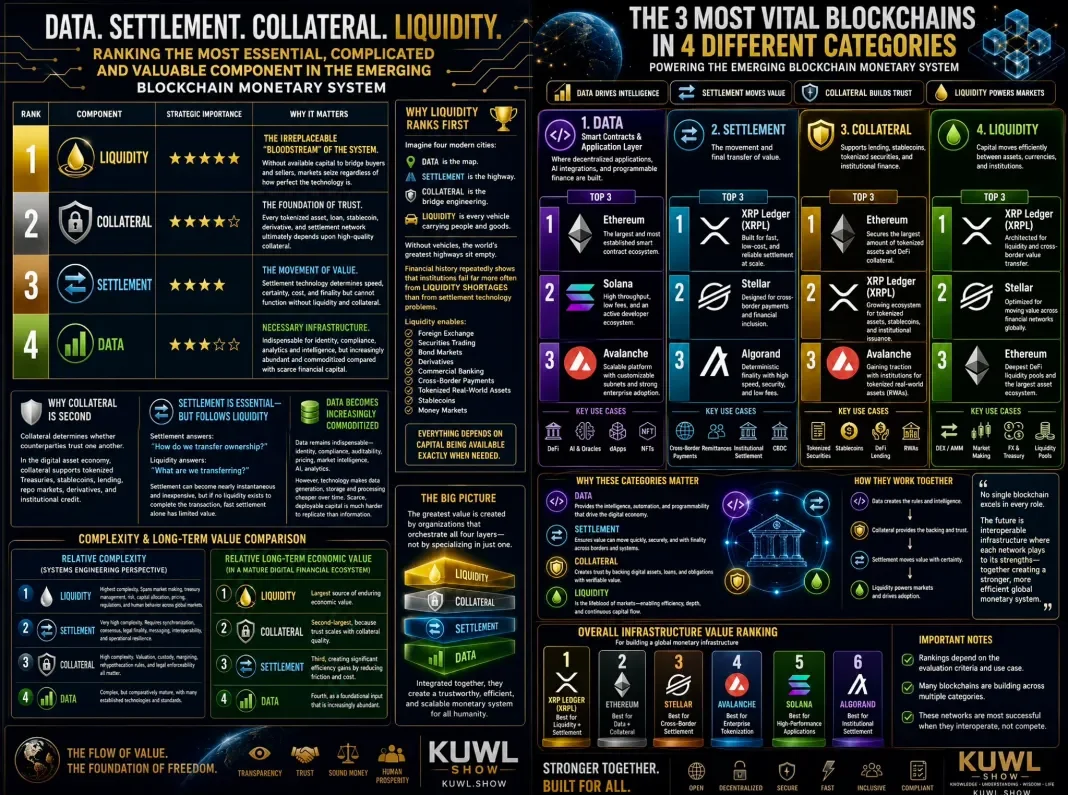
If we treat the emerging blockchain-based financial system as an integrated monetary architecture, these four functions are not equally scarce or economically valuable.
A reasonable ranking is:
1: Liquidity
The irreplaceable “bloodstream” of the system. Without available capital to bridge buyers and sellers, markets seize regardless of how perfect the technology is.
2: Collateral
The foundation of trust. Every tokenized asset, loan, stablecoin, derivative, and settlement network ultimately depends upon high-quality collateral.
3: Settlement
The movement of value. Settlement technology determines speed, certainty, cost, and finality but cannot function without liquidity and collateral.
4: Data
Necessary infrastructure, but increasingly abundant and commoditized compared with scarce financial capital.
Why liquidity ranks first
Imagine four modern cities:
1 – Data is the map.
2 – Settlement is the highway.
3 – Collateral is the bridge engineering.
4 – Liquidity is every vehicle carrying people and goods.
Without vehicles, the world’s greatest highways sit empty.
Financial history repeatedly shows that institutions fail far more often from liquidity shortages than from settlement technology problems. Even solvent organizations can collapse if they cannot access liquidity when needed.
Liquidity enables:
Foreign exchange
Securities trading
Bond markets
Derivatives
Commercial banking
Cross-border payments
Tokenized real-world assets
Stablecoins
Money markets
Everything depends on capital being available exactly when needed.
Why collateral is second
Collateral determines whether counterparties trust one another.
In the digital asset economy, collateral supports:
tokenized Treasuries
stablecoins
lending
repo markets
derivatives
institutional credit
The larger the economy becomes, the more valuable transparent, high-quality collateral becomes.
Settlement is essential – but follows liquidity
Settlement answers:
“How do we transfer ownership?”
Liquidity answers:
“What are we transferring?”
Settlement technology can become nearly instantaneous, inexpensive, and automated. That improves efficiency, but if no liquidity exists to complete the transaction, fast settlement alone has limited value.
Data becomes increasingly commoditized
Data remains indispensable:
identity
compliance
auditability
pricing
market intelligence
AI
analytics
However, technological progress generally makes data generation, storage, and processing cheaper over time.
Scarce, deployable capital is much harder to replicate than information.
Overall Relative Complexity
From a systems engineering perspective:
1) Liquidity – Highest complexity. It spans market making, treasury management, risk, capital allocation, pricing, regulations, and behavior across global markets.
2) Settlement – Very high complexity. It requires synchronization, consensus, legal finality, messaging, interoperability, and operational resilience.
3) Collateral – High complexity. Valuation, custody, margining, rehypothecation rules, and legal enforceability all matter.
4) Data – Complex, but comparatively mature, with many established technologies and standards.
Relative long-term value
As a broad conceptual framework for a mature digital financial ecosystem:
1) Liquidity – Largest source of enduring economic value.
2) Collateral – Second-largest, because trust scales with collateral quality.
3) Settlement – Third, creating significant efficiency gains by reducing friction and cost.
4) Data – Fourth, as a foundational input that is increasingly abundant.
In practice, the greatest value is often created by organizations that combine these layers rather than specializing in only one. A platform that can orchestrate liquidity, collateral, settlement, and trusted data together is positioned to capture more of the economic value than one that optimizes a single function.
Source(s):
• https://x.com/KuwlShow/status/2082248991782076843